Wei Zheng, Aifeng He, Hong Ma, Jianhua Chen, Bo Jing, Yan Li, Xiaogang Yu, Chunqiang Cao and Baoyu Sun
{"title":"Anomalous thermal activation of green upconversion luminescence in Yb/Er/ZnGdO self-assembled microflowers for high-sensitivity temperature detection†","authors":"Wei Zheng, Aifeng He, Hong Ma, Jianhua Chen, Bo Jing, Yan Li, Xiaogang Yu, Chunqiang Cao and Baoyu Sun","doi":"10.1039/D3MH01360J","DOIUrl":null,"url":null,"abstract":"<p >Non-contact optical temperature detection has shown a great promise in biological systems and microfluidics because of its outstanding spatial resolution, superior accuracy, and non-invasive nature. However, the thermal quenching of photoluminescence significantly hinders the practical applications of optical temperature probes. Herein, we report thermally enhanced green upconversion luminescence in Yb/Er/ZnGdO microflowers by a defect-assisted thermal distribution mechanism. A 1.6-fold enhancement in green emission was demonstrated as the temperature increased from 298 K to 558 K. Experimental results and dynamic analysis demonstrated that this behavior of thermally activating green upconversion luminescence originates from the emission loss compensation, which is attributed to thermally-induced energy transfer from defect levels to the green emitting level. In addition, the Yb/Er/ZnGdO microflowers can act as self-referenced radiometric optical thermometers. The ultrahigh absolute sensitivity of 1.61% K<small><sup>−1</sup></small> and an excellent relative sensitivity of 15.5% K<small><sup>−1</sup></small> based on the <small><sup>4</sup></small>F<small><sub>9/2</sub></small>/<small><sup>2</sup></small>H<small><sub>11/2(2)</sub></small> level pair were synchronously achieved at room temperature. These findings provide a novel strategy for surmounting the thermal quenching luminescence, thereby greatly promoting the application of non-contact sensitive radiometric thermometers.</p>","PeriodicalId":87,"journal":{"name":"Materials Horizons","volume":" 1","pages":" 227-237"},"PeriodicalIF":10.7000,"publicationDate":"2023-10-18","publicationTypes":"Journal Article","fieldsOfStudy":null,"isOpenAccess":false,"openAccessPdf":"","citationCount":"0","resultStr":null,"platform":"Semanticscholar","paperid":null,"PeriodicalName":"Materials Horizons","FirstCategoryId":"88","ListUrlMain":"https://pubs.rsc.org/en/content/articlelanding/2024/mh/d3mh01360j","RegionNum":2,"RegionCategory":"材料科学","ArticlePicture":[],"TitleCN":null,"AbstractTextCN":null,"PMCID":null,"EPubDate":"","PubModel":"","JCR":"Q1","JCRName":"CHEMISTRY, MULTIDISCIPLINARY","Score":null,"Total":0}
引用次数: 0
Abstract
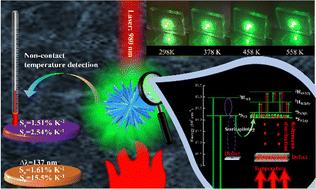
Non-contact optical temperature detection has shown a great promise in biological systems and microfluidics because of its outstanding spatial resolution, superior accuracy, and non-invasive nature. However, the thermal quenching of photoluminescence significantly hinders the practical applications of optical temperature probes. Herein, we report thermally enhanced green upconversion luminescence in Yb/Er/ZnGdO microflowers by a defect-assisted thermal distribution mechanism. A 1.6-fold enhancement in green emission was demonstrated as the temperature increased from 298 K to 558 K. Experimental results and dynamic analysis demonstrated that this behavior of thermally activating green upconversion luminescence originates from the emission loss compensation, which is attributed to thermally-induced energy transfer from defect levels to the green emitting level. In addition, the Yb/Er/ZnGdO microflowers can act as self-referenced radiometric optical thermometers. The ultrahigh absolute sensitivity of 1.61% K−1 and an excellent relative sensitivity of 15.5% K−1 based on the 4F9/2/2H11/2(2) level pair were synchronously achieved at room temperature. These findings provide a novel strategy for surmounting the thermal quenching luminescence, thereby greatly promoting the application of non-contact sensitive radiometric thermometers.




 京公网安备 11010802042870号
京ICP备2023020795号-1
京公网安备 11010802042870号
京ICP备2023020795号-1

 分享
分享
 求助内容:
求助内容: 应助结果提醒方式:
 扫码关注我们
