{"title":"Transformation of Mercuric Ions to Mercury Nanoparticles in Diatom Chaetoceros curvisetus","authors":"Hongzhe Dong, Lihong Liu*, Qinfei Zhou, Yinyin Tang, Huiling Wang, Yongguang Yin, Jianbo Shi, Bin He, Yanbin Li, Ligang Hu* and Guibin Jiang, ","doi":"10.1021/acs.est.3c05618","DOIUrl":null,"url":null,"abstract":"<p >Particulate HgS play crucial roles in the mercury (Hg) cycle. Approximately 20–90% of dissolved Hg can be transformed into particulate HgS by algae. However, detailed knowledge regarding these particles, including sizes and distribution, remains unknown. The present study explored the formation, distribution, and excretion of mercury nanoparticles (HgNPs) in diatom <i>Chaetoceros curvisetus</i>. The results demonstrated that HgNPs (HgS nanoparticles, 29.6–66.2 nm) formed intracellularly upon exposure to 5.0–100.0 μg L<sup>–1</sup> Hg(II), accounting for 12–27% of the total Hg. HgNP concentrations significantly increased with increasing intracellular Hg(II) concentrations, while their sizes remained unaffected. HgNPs formed intracellularly and partly accumulated inside the cells (7–11%). Subsequently, the sizes of intracellular HgNPs gradually decreased to facilitate expulsion, 21–50% of which were excreted. These suggested the vital roles of HgNPs in comprehending marine Hg fate. Their unique physicochemical properties and bioavailability would influence Hg biotransformation in the ocean. Additionally, both intracellular and extracellular HgNPs contributed to Hg settling with cells, ultimately leading to Hg burial in sediments. Overall, these findings further deepened our understanding of Hg biotransformation and posed challenges in accurately estimating marine Hg flux and Hg burial.</p>","PeriodicalId":36,"journal":{"name":"环境科学与技术","volume":"57 48","pages":"19772–19781"},"PeriodicalIF":11.3000,"publicationDate":"2023-11-06","publicationTypes":"Journal Article","fieldsOfStudy":null,"isOpenAccess":false,"openAccessPdf":"","citationCount":"0","resultStr":null,"platform":"Semanticscholar","paperid":null,"PeriodicalName":"环境科学与技术","FirstCategoryId":"1","ListUrlMain":"https://pubs.acs.org/doi/10.1021/acs.est.3c05618","RegionNum":1,"RegionCategory":"环境科学与生态学","ArticlePicture":[],"TitleCN":null,"AbstractTextCN":null,"PMCID":null,"EPubDate":"","PubModel":"","JCR":"Q1","JCRName":"ENGINEERING, ENVIRONMENTAL","Score":null,"Total":0}
引用次数: 0
Abstract
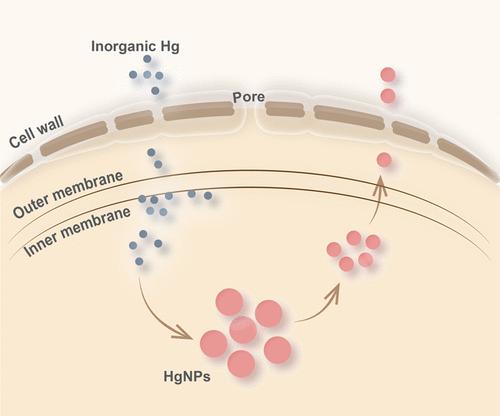
Particulate HgS play crucial roles in the mercury (Hg) cycle. Approximately 20–90% of dissolved Hg can be transformed into particulate HgS by algae. However, detailed knowledge regarding these particles, including sizes and distribution, remains unknown. The present study explored the formation, distribution, and excretion of mercury nanoparticles (HgNPs) in diatom Chaetoceros curvisetus. The results demonstrated that HgNPs (HgS nanoparticles, 29.6–66.2 nm) formed intracellularly upon exposure to 5.0–100.0 μg L–1 Hg(II), accounting for 12–27% of the total Hg. HgNP concentrations significantly increased with increasing intracellular Hg(II) concentrations, while their sizes remained unaffected. HgNPs formed intracellularly and partly accumulated inside the cells (7–11%). Subsequently, the sizes of intracellular HgNPs gradually decreased to facilitate expulsion, 21–50% of which were excreted. These suggested the vital roles of HgNPs in comprehending marine Hg fate. Their unique physicochemical properties and bioavailability would influence Hg biotransformation in the ocean. Additionally, both intracellular and extracellular HgNPs contributed to Hg settling with cells, ultimately leading to Hg burial in sediments. Overall, these findings further deepened our understanding of Hg biotransformation and posed challenges in accurately estimating marine Hg flux and Hg burial.
期刊介绍:
Environmental Science & Technology (ES&T) is a co-sponsored academic and technical magazine by the Hubei Provincial Environmental Protection Bureau and the Hubei Provincial Academy of Environmental Sciences.
Environmental Science & Technology (ES&T) holds the status of Chinese core journals, scientific papers source journals of China, Chinese Science Citation Database source journals, and Chinese Academic Journal Comprehensive Evaluation Database source journals. This publication focuses on the academic field of environmental protection, featuring articles related to environmental protection and technical advancements.



 京公网安备 11010802042870号
京ICP备2023020795号-1
京公网安备 11010802042870号
京ICP备2023020795号-1

 分享
分享
 求助内容:
求助内容: 应助结果提醒方式:
 扫码关注我们
