Marina A. Kiseleva, Andrei V. Churakov, Ilya V. Taydakov, Mikhail T. Metlin, Sergey A. Kozyukhin and Stanislav I. Bezzubov
{"title":"Aggregation-induced emission of cyclometalated rhodium(iii) and iridium(iii) phenylpyridine complexes with ancillary 1,3-diketones†","authors":"Marina A. Kiseleva, Andrei V. Churakov, Ilya V. Taydakov, Mikhail T. Metlin, Sergey A. Kozyukhin and Stanislav I. Bezzubov","doi":"10.1039/D3DT02651E","DOIUrl":null,"url":null,"abstract":"<p >A joint structural and spectroscopic study of simple bis-cyclometataled rhodium(<small>III</small>) and iridium(<small>III</small>) complexes with 2-phenylpyridine and aromatic β-diketones (dibenzoylmethane, benzoylacetone, benzoyltrifluoroacetone, and 2-thenoyltrifluoroacetone) reveals an interplay between the solid-state emission efficiency and crystal packing peculiarities of the complexes. Although the prepared rhodium(<small>III</small>) cyclometalates are isostructural with iridium(<small>III</small>) analogues, different types of π–π interactions are responsible for the aggregation-induced emission (AIE) of the complexes depending on the metal ion. For iridium(<small>III</small>) complexes, pyridyl–pyridyl contacts are essential for AIE because they lower the energy of the emissive metal-to-ligand charge transfer state below that of the non-emissive state located at the ancillary ligand. Enabled by phenyl–pyridyl interactions partially blocking the population of non-emissive d–d states, solid-state phosphorescence enhancement is successfully achieved in a rhodium(<small>III</small>) complex with ancillary benzoyltrifluoroacetone, which is the first example of a rhodium complex exhibiting AIE.</p>","PeriodicalId":71,"journal":{"name":"Dalton Transactions","volume":" 47","pages":" 17861-17872"},"PeriodicalIF":3.3000,"publicationDate":"2023-11-07","publicationTypes":"Journal Article","fieldsOfStudy":null,"isOpenAccess":false,"openAccessPdf":"","citationCount":"0","resultStr":null,"platform":"Semanticscholar","paperid":null,"PeriodicalName":"Dalton Transactions","FirstCategoryId":"92","ListUrlMain":"https://pubs.rsc.org/en/content/articlelanding/2023/dt/d3dt02651e","RegionNum":3,"RegionCategory":"化学","ArticlePicture":[],"TitleCN":null,"AbstractTextCN":null,"PMCID":null,"EPubDate":"","PubModel":"","JCR":"Q2","JCRName":"CHEMISTRY, INORGANIC & NUCLEAR","Score":null,"Total":0}
引用次数: 0
Abstract
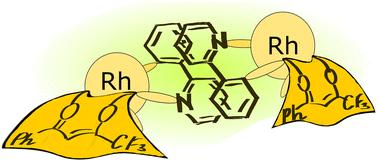
A joint structural and spectroscopic study of simple bis-cyclometataled rhodium(III) and iridium(III) complexes with 2-phenylpyridine and aromatic β-diketones (dibenzoylmethane, benzoylacetone, benzoyltrifluoroacetone, and 2-thenoyltrifluoroacetone) reveals an interplay between the solid-state emission efficiency and crystal packing peculiarities of the complexes. Although the prepared rhodium(III) cyclometalates are isostructural with iridium(III) analogues, different types of π–π interactions are responsible for the aggregation-induced emission (AIE) of the complexes depending on the metal ion. For iridium(III) complexes, pyridyl–pyridyl contacts are essential for AIE because they lower the energy of the emissive metal-to-ligand charge transfer state below that of the non-emissive state located at the ancillary ligand. Enabled by phenyl–pyridyl interactions partially blocking the population of non-emissive d–d states, solid-state phosphorescence enhancement is successfully achieved in a rhodium(III) complex with ancillary benzoyltrifluoroacetone, which is the first example of a rhodium complex exhibiting AIE.
期刊介绍:
Dalton Transactions is a journal for all areas of inorganic chemistry, which encompasses the organometallic, bioinorganic and materials chemistry of the elements, with applications including synthesis, catalysis, energy conversion/storage, electrical devices and medicine. Dalton Transactions welcomes high-quality, original submissions in all of these areas and more, where the advancement of knowledge in inorganic chemistry is significant.



 京公网安备 11010802042870号
京ICP备2023020795号-1
京公网安备 11010802042870号
京ICP备2023020795号-1

 分享
分享
 求助内容:
求助内容: 应助结果提醒方式:
 扫码关注我们
