Vasileios Stavropoulos, Daniel Zarate, Maria Prokofieva, Noirin Van de Berg, Leila Karimi, Angela Gorman Alesi, Michaella Richards, Soula Bennet, Mark D Griffiths
{"title":"Deep learning(s) in gaming disorder through the user-avatar bond: A longitudinal study using machine learning.","authors":"Vasileios Stavropoulos, Daniel Zarate, Maria Prokofieva, Noirin Van de Berg, Leila Karimi, Angela Gorman Alesi, Michaella Richards, Soula Bennet, Mark D Griffiths","doi":"10.1556/2006.2023.00062","DOIUrl":null,"url":null,"abstract":"<p><strong>Background and aims: </strong>Gaming disorder [GD] risk has been associated with the way gamers bond with their visual representation (i.e., avatar) in the game-world. More specifically, a gamer's relationship with their avatar has been shown to provide reliable mental health information about the user in their offline life, such as their current and prospective GD risk, if appropriately decoded.</p><p><strong>Methods: </strong>To contribute to the paucity of knowledge in this area, 565 gamers (Mage = 29.3 years; SD =10.6) were assessed twice, six months apart, using the User-Avatar-Bond Scale (UABS) and the Gaming Disorder Test. A series of tuned and untuned artificial intelligence [AI] classifiers analysed concurrently and prospectively their responses.</p><p><strong>Results: </strong>Findings showed that AI models learned to accurately and automatically identify GD risk cases, based on gamers' reported UABS score, age, and length of gaming involvement, both concurrently and longitudinally (i.e., six months later). Random forests outperformed all other AIs, while avatar immersion was shown to be the strongest training predictor.</p><p><strong>Conclusion: </strong>Study outcomes demonstrated that the user-avatar bond can be translated into accurate, concurrent and future GD risk predictions using trained AI classifiers. Assessment, prevention, and practice implications are discussed in the light of these findings.</p>","PeriodicalId":15049,"journal":{"name":"Journal of Behavioral Addictions","volume":" ","pages":"878-894"},"PeriodicalIF":6.2000,"publicationDate":"2023-11-09","publicationTypes":"Journal Article","fieldsOfStudy":null,"isOpenAccess":false,"openAccessPdf":"https://www.ncbi.nlm.nih.gov/pmc/articles/PMC10786223/pdf/","citationCount":"0","resultStr":null,"platform":"Semanticscholar","paperid":null,"PeriodicalName":"Journal of Behavioral Addictions","FirstCategoryId":"3","ListUrlMain":"https://doi.org/10.1556/2006.2023.00062","RegionNum":1,"RegionCategory":"医学","ArticlePicture":[],"TitleCN":null,"AbstractTextCN":null,"PMCID":null,"EPubDate":"2023/12/22 0:00:00","PubModel":"Print","JCR":"Q1","JCRName":"PSYCHIATRY","Score":null,"Total":0}
引用次数: 0
Abstract
Background and aims: Gaming disorder [GD] risk has been associated with the way gamers bond with their visual representation (i.e., avatar) in the game-world. More specifically, a gamer's relationship with their avatar has been shown to provide reliable mental health information about the user in their offline life, such as their current and prospective GD risk, if appropriately decoded.
Methods: To contribute to the paucity of knowledge in this area, 565 gamers (Mage = 29.3 years; SD =10.6) were assessed twice, six months apart, using the User-Avatar-Bond Scale (UABS) and the Gaming Disorder Test. A series of tuned and untuned artificial intelligence [AI] classifiers analysed concurrently and prospectively their responses.
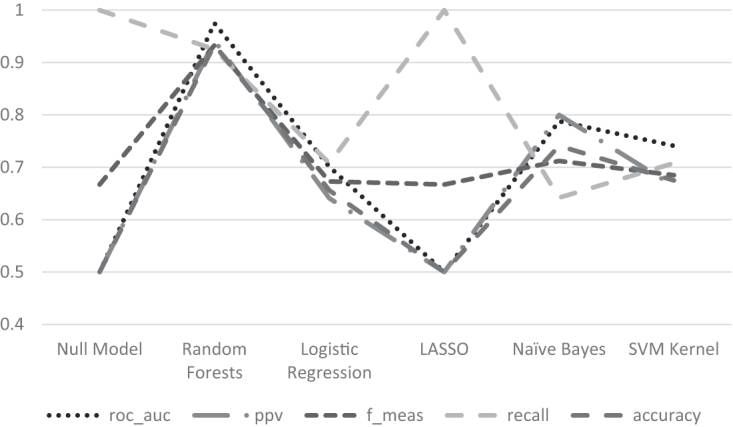
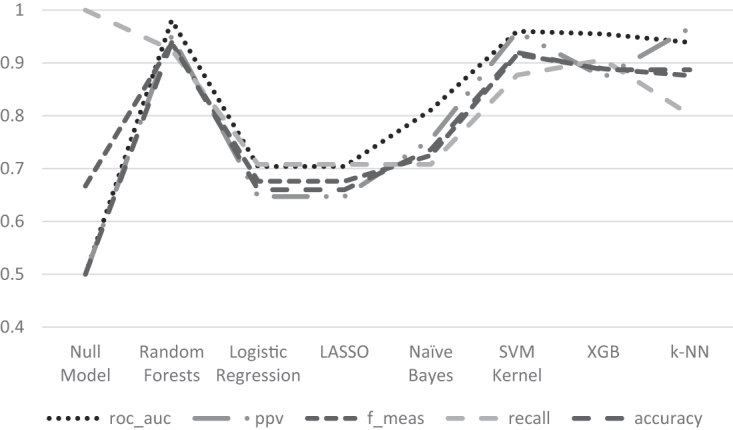
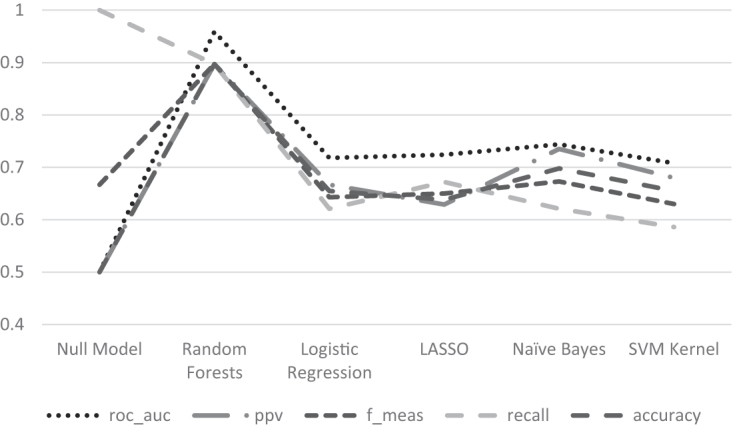
Results: Findings showed that AI models learned to accurately and automatically identify GD risk cases, based on gamers' reported UABS score, age, and length of gaming involvement, both concurrently and longitudinally (i.e., six months later). Random forests outperformed all other AIs, while avatar immersion was shown to be the strongest training predictor.
Conclusion: Study outcomes demonstrated that the user-avatar bond can be translated into accurate, concurrent and future GD risk predictions using trained AI classifiers. Assessment, prevention, and practice implications are discussed in the light of these findings.
期刊介绍:
The aim of Journal of Behavioral Addictions is to create a forum for the scientific information exchange with regard to behavioral addictions. The journal is a broad focused interdisciplinary one that publishes manuscripts on different approaches of non-substance addictions, research reports focusing on the addictive patterns of various behaviors, especially disorders of the impulsive-compulsive spectrum, and also publishes reviews in these topics. Coverage ranges from genetic and neurobiological research through psychological and clinical psychiatric approaches to epidemiological, sociological and anthropological aspects.



 京公网安备 11010802042870号
京ICP备2023020795号-1
京公网安备 11010802042870号
京ICP备2023020795号-1

 分享
分享
 求助内容:
求助内容: 应助结果提醒方式:
 扫码关注我们
