Sonja D. Mürtz, Johannes Simböck, Feng Zeng, Mahnaz Ghiasi, Simon Schönebaum, Ulrich Simon, Frank M. F. de Groot and Regina Palkovits
{"title":"Elucidating the validity of electronic characteristics of transition metal perovskites as descriptors bridging electro- and chemocatalysis†","authors":"Sonja D. Mürtz, Johannes Simböck, Feng Zeng, Mahnaz Ghiasi, Simon Schönebaum, Ulrich Simon, Frank M. F. de Groot and Regina Palkovits","doi":"10.1039/D3EY00206C","DOIUrl":null,"url":null,"abstract":"<p >The analysis of electronic characteristics as descriptors for the efficacy of catalysts provides fundamental insights into catalyst design criteria, but few studies address the applicability of descriptors across a broader range of reactions. This study on perovskite-type, B-site substituted LaCoO<small><sub>3</sub></small> derivates analyses the generalisability of the descriptor nature of electronic characteristics for electro- and chemocatalytic reactions – more specifically the occupancy of transition metal (TM) 3d orbitals, charge-transfer energy (CTE), and covalency in the interaction of O 2p – TM 3d states. The results show that among the analysed characteristics only covalency is a quasi-linear descriptor for the performance in electrocatalytic oxygen evolution reaction (OER), glycerol electro-oxidation reaction (GOR), as well as in five chemocatalytic reactions. The analysis of the reduction reaction of NO or N<small><sub>2</sub></small>O by CO illustrates that not only reaction rates but also selectivity is determined by the same electronic catalyst characteristics. Measurement conditions in the analysis of electronic characteristics need to be chosen to recreate the oxidation state during the reaction-specific kinetically relevant step to yield adequate descriptor correlations. The results imply that significant synergies may be leveraged by enhanced collaboration across electro- and chemocatalysis research.</p>","PeriodicalId":72877,"journal":{"name":"EES catalysis","volume":" 6","pages":" 961-971"},"PeriodicalIF":0.0000,"publicationDate":"2023-09-18","publicationTypes":"Journal Article","fieldsOfStudy":null,"isOpenAccess":false,"openAccessPdf":"","citationCount":"0","resultStr":null,"platform":"Semanticscholar","paperid":null,"PeriodicalName":"EES catalysis","FirstCategoryId":"1085","ListUrlMain":"https://pubs.rsc.org/en/content/articlelanding/2023/ey/d3ey00206c","RegionNum":0,"RegionCategory":null,"ArticlePicture":[],"TitleCN":null,"AbstractTextCN":null,"PMCID":null,"EPubDate":"","PubModel":"","JCR":"","JCRName":"","Score":null,"Total":0}
引用次数: 0
Abstract
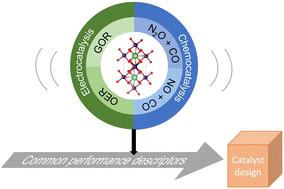
The analysis of electronic characteristics as descriptors for the efficacy of catalysts provides fundamental insights into catalyst design criteria, but few studies address the applicability of descriptors across a broader range of reactions. This study on perovskite-type, B-site substituted LaCoO3 derivates analyses the generalisability of the descriptor nature of electronic characteristics for electro- and chemocatalytic reactions – more specifically the occupancy of transition metal (TM) 3d orbitals, charge-transfer energy (CTE), and covalency in the interaction of O 2p – TM 3d states. The results show that among the analysed characteristics only covalency is a quasi-linear descriptor for the performance in electrocatalytic oxygen evolution reaction (OER), glycerol electro-oxidation reaction (GOR), as well as in five chemocatalytic reactions. The analysis of the reduction reaction of NO or N2O by CO illustrates that not only reaction rates but also selectivity is determined by the same electronic catalyst characteristics. Measurement conditions in the analysis of electronic characteristics need to be chosen to recreate the oxidation state during the reaction-specific kinetically relevant step to yield adequate descriptor correlations. The results imply that significant synergies may be leveraged by enhanced collaboration across electro- and chemocatalysis research.



 京公网安备 11010802042870号
京ICP备2023020795号-1
京公网安备 11010802042870号
京ICP备2023020795号-1

 分享
分享

 求助内容:
求助内容: 应助结果提醒方式:
 扫码关注我们
