Charlotte E. Bopp, Nora M. Bernet, Hans-Peter E. Kohler and Thomas B. Hofstetter*,
{"title":"Elucidating the Role of O2 Uncoupling in the Oxidative Biodegradation of Organic Contaminants by Rieske Non-heme Iron Dioxygenases","authors":"Charlotte E. Bopp, Nora M. Bernet, Hans-Peter E. Kohler and Thomas B. Hofstetter*, ","doi":"10.1021/acsenvironau.2c00023","DOIUrl":null,"url":null,"abstract":"<p >Oxygenations of aromatic soil and water contaminants with molecular O<sub>2</sub> catalyzed by Rieske dioxygenases are frequent initial steps of biodegradation in natural and engineered environments. Many of these non-heme ferrous iron enzymes are known to be involved in contaminant metabolism, but the understanding of enzyme–substrate interactions that lead to successful biodegradation is still elusive. Here, we studied the mechanisms of O<sub>2</sub> activation and substrate hydroxylation of two nitroarene dioxygenases to evaluate enzyme- and substrate-specific factors that determine the efficiency of oxygenated product formation. Experiments in enzyme assays of 2-nitrotoluene dioxygenase (2NTDO) and nitrobenzene dioxygenase (NBDO) with methyl-, fluoro-, chloro-, and hydroxy-substituted nitroaromatic substrates reveal that typically 20–100% of the enzyme’s activity involves unproductive paths of O<sub>2</sub> activation with generation of reactive oxygen species through so-called O<sub>2</sub> uncoupling. The <sup>18</sup>O and <sup>13</sup>C kinetic isotope effects of O<sub>2</sub> activation and nitroaromatic substrate hydroxylation, respectively, suggest that O<sub>2</sub> uncoupling occurs after generation of Fe<sup>III</sup>-(hydro)peroxo species in the catalytic cycle. While 2NTDO hydroxylates <i>ortho</i>-substituted nitroaromatic substrates more efficiently, NBDO favors <i>meta</i>-substituted, presumably due to distinct active site residues of the two enzymes. Our data implies, however, that the O<sub>2</sub> uncoupling and hydroxylation activity cannot be assessed from simple structure–reactivity relationships. By quantifying O<sub>2</sub> uncoupling by Rieske dioxygenases, our work provides a mechanistic link between contaminant biodegradation, the generation of reactive oxygen species, and possible adaptation strategies of microorganisms to the exposure of new contaminants.</p>","PeriodicalId":29801,"journal":{"name":"ACS Environmental Au","volume":"2 5","pages":"428–440"},"PeriodicalIF":7.7000,"publicationDate":"2022-07-07","publicationTypes":"Journal Article","fieldsOfStudy":null,"isOpenAccess":false,"openAccessPdf":"https://pubs.acs.org/doi/epdf/10.1021/acsenvironau.2c00023","citationCount":"3","resultStr":null,"platform":"Semanticscholar","paperid":null,"PeriodicalName":"ACS Environmental Au","FirstCategoryId":"1085","ListUrlMain":"https://pubs.acs.org/doi/10.1021/acsenvironau.2c00023","RegionNum":0,"RegionCategory":null,"ArticlePicture":[],"TitleCN":null,"AbstractTextCN":null,"PMCID":null,"EPubDate":"","PubModel":"","JCR":"Q1","JCRName":"ENGINEERING, ENVIRONMENTAL","Score":null,"Total":0}
引用次数: 3
Abstract
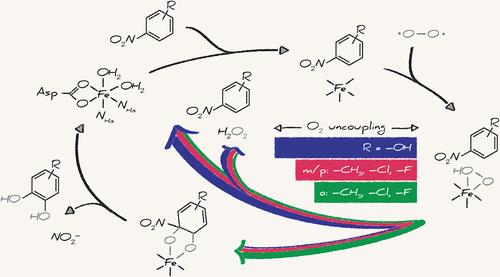
Oxygenations of aromatic soil and water contaminants with molecular O2 catalyzed by Rieske dioxygenases are frequent initial steps of biodegradation in natural and engineered environments. Many of these non-heme ferrous iron enzymes are known to be involved in contaminant metabolism, but the understanding of enzyme–substrate interactions that lead to successful biodegradation is still elusive. Here, we studied the mechanisms of O2 activation and substrate hydroxylation of two nitroarene dioxygenases to evaluate enzyme- and substrate-specific factors that determine the efficiency of oxygenated product formation. Experiments in enzyme assays of 2-nitrotoluene dioxygenase (2NTDO) and nitrobenzene dioxygenase (NBDO) with methyl-, fluoro-, chloro-, and hydroxy-substituted nitroaromatic substrates reveal that typically 20–100% of the enzyme’s activity involves unproductive paths of O2 activation with generation of reactive oxygen species through so-called O2 uncoupling. The 18O and 13C kinetic isotope effects of O2 activation and nitroaromatic substrate hydroxylation, respectively, suggest that O2 uncoupling occurs after generation of FeIII-(hydro)peroxo species in the catalytic cycle. While 2NTDO hydroxylates ortho-substituted nitroaromatic substrates more efficiently, NBDO favors meta-substituted, presumably due to distinct active site residues of the two enzymes. Our data implies, however, that the O2 uncoupling and hydroxylation activity cannot be assessed from simple structure–reactivity relationships. By quantifying O2 uncoupling by Rieske dioxygenases, our work provides a mechanistic link between contaminant biodegradation, the generation of reactive oxygen species, and possible adaptation strategies of microorganisms to the exposure of new contaminants.
期刊介绍:
ACS Environmental Au is an open access journal which publishes experimental research and theoretical results in all aspects of environmental science and technology both pure and applied. Short letters comprehensive articles reviews and perspectives are welcome in the following areas:Alternative EnergyAnthropogenic Impacts on Atmosphere Soil or WaterBiogeochemical CyclingBiomass or Wastes as ResourcesContaminants in Aquatic and Terrestrial EnvironmentsEnvironmental Data ScienceEcotoxicology and Public HealthEnergy and ClimateEnvironmental Modeling Processes and Measurement Methods and TechnologiesEnvironmental Nanotechnology and BiotechnologyGreen ChemistryGreen Manufacturing and EngineeringRisk assessment Regulatory Frameworks and Life-Cycle AssessmentsTreatment and Resource Recovery and Waste Management




 京公网安备 11010802042870号
京ICP备2023020795号-1
京公网安备 11010802042870号
京ICP备2023020795号-1

 分享
分享
 求助内容:
求助内容: 应助结果提醒方式:
 扫码关注我们
