Pedro Lisboa, Ana Rita Rodrigues, José Luis Martín, Pedro Simões, Susana Barreiros, Alexandre Paiva
{"title":"Economic analysis of a plant for biodiesel production from waste cooking oil via enzymatic transesterification using supercritical carbon dioxide","authors":"Pedro Lisboa, Ana Rita Rodrigues, José Luis Martín, Pedro Simões, Susana Barreiros, Alexandre Paiva","doi":"10.1016/j.supflu.2013.10.018","DOIUrl":null,"url":null,"abstract":"<div><p>Enzymatic transesterification is becoming a commercially competitive route to biodiesel. Supercritical CO<sub>2</sub> (scCO<sub>2</sub>) is well established as a solvent for extraction processes. Here we analyze the economy of a scCO<sub>2</sub>-based, enzymatic process, for the production of biodiesel from waste cooking sunflower oil (WCO). The conversion of WCO to fatty acid ethyl esters (FAEE) catalyzed by immobilized lipase from <em>Thermomyces lanuginosus</em> (Lipozyme TL IM), and downstream separation to recover biodiesel conforming to the EN14214 norm, were studied in a pilot plant unit. The data generated was used to design an envisaged industrial plant, for which an energy balance was carried out. Investment and production costs were estimated for the conversion of 8000<!--> <!-->ton<sub>WCO</sub>/year. This led to biodiesel costs of 1.64€/L and 0.75€/L (for a WCO price of 0.25€/kg; enzyme prices of 800€/kg and 8€/kg, respectively), which already reflect the ca. 10% impact of glycerol sales.</p></div>","PeriodicalId":17078,"journal":{"name":"Journal of Supercritical Fluids","volume":"85 ","pages":"Pages 31-40"},"PeriodicalIF":4.4000,"publicationDate":"2014-01-01","publicationTypes":"Journal Article","fieldsOfStudy":null,"isOpenAccess":false,"openAccessPdf":"https://sci-hub-pdf.com/10.1016/j.supflu.2013.10.018","citationCount":"78","resultStr":null,"platform":"Semanticscholar","paperid":null,"PeriodicalName":"Journal of Supercritical Fluids","FirstCategoryId":"5","ListUrlMain":"https://www.sciencedirect.com/science/article/pii/S0896844613003628","RegionNum":3,"RegionCategory":"工程技术","ArticlePicture":[],"TitleCN":null,"AbstractTextCN":null,"PMCID":null,"EPubDate":"","PubModel":"","JCR":"Q2","JCRName":"CHEMISTRY, PHYSICAL","Score":null,"Total":0}
引用次数: 78
Abstract
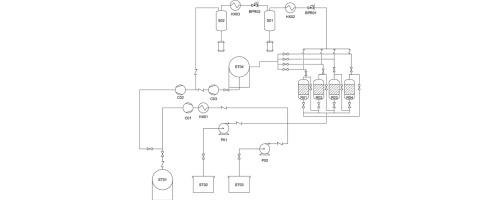
Enzymatic transesterification is becoming a commercially competitive route to biodiesel. Supercritical CO2 (scCO2) is well established as a solvent for extraction processes. Here we analyze the economy of a scCO2-based, enzymatic process, for the production of biodiesel from waste cooking sunflower oil (WCO). The conversion of WCO to fatty acid ethyl esters (FAEE) catalyzed by immobilized lipase from Thermomyces lanuginosus (Lipozyme TL IM), and downstream separation to recover biodiesel conforming to the EN14214 norm, were studied in a pilot plant unit. The data generated was used to design an envisaged industrial plant, for which an energy balance was carried out. Investment and production costs were estimated for the conversion of 8000 tonWCO/year. This led to biodiesel costs of 1.64€/L and 0.75€/L (for a WCO price of 0.25€/kg; enzyme prices of 800€/kg and 8€/kg, respectively), which already reflect the ca. 10% impact of glycerol sales.
期刊介绍:
The Journal of Supercritical Fluids is an international journal devoted to the fundamental and applied aspects of supercritical fluids and processes. Its aim is to provide a focused platform for academic and industrial researchers to report their findings and to have ready access to the advances in this rapidly growing field. Its coverage is multidisciplinary and includes both basic and applied topics.
Thermodynamics and phase equilibria, reaction kinetics and rate processes, thermal and transport properties, and all topics related to processing such as separations (extraction, fractionation, purification, chromatography) nucleation and impregnation are within the scope. Accounts of specific engineering applications such as those encountered in food, fuel, natural products, minerals, pharmaceuticals and polymer industries are included. Topics related to high pressure equipment design, analytical techniques, sensors, and process control methodologies are also within the scope of the journal.



 京公网安备 11010802042870号
京ICP备2023020795号-1
京公网安备 11010802042870号
京ICP备2023020795号-1

 分享
分享
 求助内容:
求助内容: 应助结果提醒方式:
 扫码关注我们
