Naila Albertina de Oliveira , Mônica Roberta Mazzali , Heidge Fukumasu , Cintia Bernardo Gonçalves , Alessandra Lopes de Oliveira
{"title":"Composition and physical properties of babassu seed (Orbignya phalerata) oil obtained by supercritical CO2 extraction","authors":"Naila Albertina de Oliveira , Mônica Roberta Mazzali , Heidge Fukumasu , Cintia Bernardo Gonçalves , Alessandra Lopes de Oliveira","doi":"10.1016/j.supflu.2019.04.009","DOIUrl":null,"url":null,"abstract":"<div><p>Oil was obtained from babassu seeds via supercritical CO<sub>2</sub> extraction under conditions from 40 to 80 °C and at pressures of 25–35 MPa. The fatty acid profile was determined by gas chromatography–mass spectrometry (GC–MS), and the triacylglycerol (TAG) composition was estimated. The highest oil recoveries from the seeds, 86.56% and 89.86%, were obtained by extraction at 70 °C/25 MPa and 80 °C/35 MPa, respectively. Oil yield increased as temperature increased. β-Sitosterol was maximal (274.3 mg/kg) at 40 °C/25 MPa. Extraction conditions did not influence the fatty acid and TAG composition. Babassu oil presented density (0.9021–0.9171 g/mL), viscosity (28.2786–52.2843 mPa.s) and refractive index (RI, 1.4520–1.4563) values comparable with those of refined vegetable oils. The main TAGs present in this oil were LOL (lauric, oleic and lauric acids), LOM (lauric, oleic and myristic), LOP (lauric, oleic and palmitic) and MOP (myristic, oleic and palmitic).</p></div>","PeriodicalId":17078,"journal":{"name":"Journal of Supercritical Fluids","volume":"150 ","pages":"Pages 21-29"},"PeriodicalIF":4.4000,"publicationDate":"2019-08-01","publicationTypes":"Journal Article","fieldsOfStudy":null,"isOpenAccess":false,"openAccessPdf":"https://sci-hub-pdf.com/10.1016/j.supflu.2019.04.009","citationCount":"21","resultStr":null,"platform":"Semanticscholar","paperid":null,"PeriodicalName":"Journal of Supercritical Fluids","FirstCategoryId":"5","ListUrlMain":"https://www.sciencedirect.com/science/article/pii/S0896844618305928","RegionNum":3,"RegionCategory":"工程技术","ArticlePicture":[],"TitleCN":null,"AbstractTextCN":null,"PMCID":null,"EPubDate":"","PubModel":"","JCR":"Q2","JCRName":"CHEMISTRY, PHYSICAL","Score":null,"Total":0}
引用次数: 21
Abstract
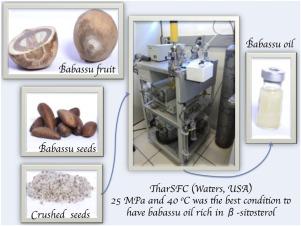
Oil was obtained from babassu seeds via supercritical CO2 extraction under conditions from 40 to 80 °C and at pressures of 25–35 MPa. The fatty acid profile was determined by gas chromatography–mass spectrometry (GC–MS), and the triacylglycerol (TAG) composition was estimated. The highest oil recoveries from the seeds, 86.56% and 89.86%, were obtained by extraction at 70 °C/25 MPa and 80 °C/35 MPa, respectively. Oil yield increased as temperature increased. β-Sitosterol was maximal (274.3 mg/kg) at 40 °C/25 MPa. Extraction conditions did not influence the fatty acid and TAG composition. Babassu oil presented density (0.9021–0.9171 g/mL), viscosity (28.2786–52.2843 mPa.s) and refractive index (RI, 1.4520–1.4563) values comparable with those of refined vegetable oils. The main TAGs present in this oil were LOL (lauric, oleic and lauric acids), LOM (lauric, oleic and myristic), LOP (lauric, oleic and palmitic) and MOP (myristic, oleic and palmitic).
期刊介绍:
The Journal of Supercritical Fluids is an international journal devoted to the fundamental and applied aspects of supercritical fluids and processes. Its aim is to provide a focused platform for academic and industrial researchers to report their findings and to have ready access to the advances in this rapidly growing field. Its coverage is multidisciplinary and includes both basic and applied topics.
Thermodynamics and phase equilibria, reaction kinetics and rate processes, thermal and transport properties, and all topics related to processing such as separations (extraction, fractionation, purification, chromatography) nucleation and impregnation are within the scope. Accounts of specific engineering applications such as those encountered in food, fuel, natural products, minerals, pharmaceuticals and polymer industries are included. Topics related to high pressure equipment design, analytical techniques, sensors, and process control methodologies are also within the scope of the journal.



 京公网安备 11010802042870号
京ICP备2023020795号-1
京公网安备 11010802042870号
京ICP备2023020795号-1

 分享
分享
 求助内容:
求助内容: 应助结果提醒方式:
 扫码关注我们
