S. M. Makhno, O. M. Lisova, R. V. Mazurenko, P. P. Gorbyk, K. O. Ivanenko, M. T. Kartel, Yu. I. Sementsov
{"title":"Electrophysical and strength characteristics of polychlorotrifluoroethylene filled with carbon nanotubes dispersed in graphene suspensions","authors":"S. M. Makhno, O. M. Lisova, R. V. Mazurenko, P. P. Gorbyk, K. O. Ivanenko, M. T. Kartel, Yu. I. Sementsov","doi":"10.1007/s13204-023-02902-6","DOIUrl":null,"url":null,"abstract":"<div><p>One of the decisive factors that determines the effectiveness of using carbon nanotubes (CNTs) for reinforcing polymer matrices is their uniform distribution in the matrix. It is shown that the percolation threshold in the polychlorotrifluoroethylene (PCTFE)–CNTs system, determined by electrical conductivity data, shifts to lower values with a more uniform distribution of CNTs, while the electrical conductivity increases and correlates with the structure and strength characteristics. Preliminary deagglomeration of CNTs was carried out using ultrasonic treatment in a dispersion of graphene nanoplatelets (GNPs). Three water systems with a CNTs content of 0.5, 0.25, and 0.125 wt.% were dispersed. The GNPs content was 0.1 mass fractions to 1 mass fractions of CNTs for all systems. The dependences of the real (εʹ) and imaginary (εʺ) components of the complex dielectric constant, electrical conductivity (σ) and relative bending strength limit on the volume content of CNTs (ϕ) were found, which have a percolation character. Percolation indices were determined for the dependences σ = f (ϕ), which for the specified concentrations were: flow thresholds (ϕ<sub>c</sub>) − 0.0047, 0.0032, 0.00097 and critical indices (t) − 2.01, 1.78, 1.75, respectively. The most uniform distribution of CNTs, which was achieved at the minimum content of CNTs during dispersion (0.125 wt.% CNTs), corresponds to the maximum value of σ, the lowest percolation threshold, which correlates with the maximum bending strength limit.</p></div>","PeriodicalId":471,"journal":{"name":"Applied Nanoscience","volume":"13 12","pages":"7591 - 7599"},"PeriodicalIF":3.6740,"publicationDate":"2023-09-01","publicationTypes":"Journal Article","fieldsOfStudy":null,"isOpenAccess":false,"openAccessPdf":"","citationCount":"0","resultStr":null,"platform":"Semanticscholar","paperid":null,"PeriodicalName":"Applied Nanoscience","FirstCategoryId":"5","ListUrlMain":"https://link.springer.com/article/10.1007/s13204-023-02902-6","RegionNum":4,"RegionCategory":"工程技术","ArticlePicture":[],"TitleCN":null,"AbstractTextCN":null,"PMCID":null,"EPubDate":"","PubModel":"","JCR":"Q1","JCRName":"Engineering","Score":null,"Total":0}
引用次数: 0
Abstract
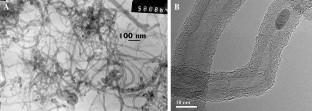
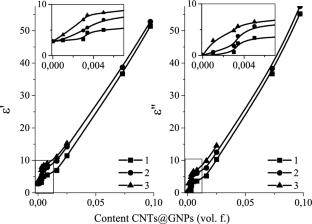
One of the decisive factors that determines the effectiveness of using carbon nanotubes (CNTs) for reinforcing polymer matrices is their uniform distribution in the matrix. It is shown that the percolation threshold in the polychlorotrifluoroethylene (PCTFE)–CNTs system, determined by electrical conductivity data, shifts to lower values with a more uniform distribution of CNTs, while the electrical conductivity increases and correlates with the structure and strength characteristics. Preliminary deagglomeration of CNTs was carried out using ultrasonic treatment in a dispersion of graphene nanoplatelets (GNPs). Three water systems with a CNTs content of 0.5, 0.25, and 0.125 wt.% were dispersed. The GNPs content was 0.1 mass fractions to 1 mass fractions of CNTs for all systems. The dependences of the real (εʹ) and imaginary (εʺ) components of the complex dielectric constant, electrical conductivity (σ) and relative bending strength limit on the volume content of CNTs (ϕ) were found, which have a percolation character. Percolation indices were determined for the dependences σ = f (ϕ), which for the specified concentrations were: flow thresholds (ϕc) − 0.0047, 0.0032, 0.00097 and critical indices (t) − 2.01, 1.78, 1.75, respectively. The most uniform distribution of CNTs, which was achieved at the minimum content of CNTs during dispersion (0.125 wt.% CNTs), corresponds to the maximum value of σ, the lowest percolation threshold, which correlates with the maximum bending strength limit.
期刊介绍:
Applied Nanoscience is a hybrid journal that publishes original articles about state of the art nanoscience and the application of emerging nanotechnologies to areas fundamental to building technologically advanced and sustainable civilization, including areas as diverse as water science, advanced materials, energy, electronics, environmental science and medicine. The journal accepts original and review articles as well as book reviews for publication. All the manuscripts are single-blind peer-reviewed for scientific quality and acceptance.



 京公网安备 11010802042870号
京ICP备2023020795号-1
京公网安备 11010802042870号
京ICP备2023020795号-1

 分享
分享
 求助内容:
求助内容: 应助结果提醒方式:
 扫码关注我们
