Gabriel C. Costa, Cristiano Nogueira, Ricardo B. Machado, Guarino R. Colli
{"title":"Squamate richness in the Brazilian Cerrado and its environmental–climatic associations","authors":"Gabriel C. Costa, Cristiano Nogueira, Ricardo B. Machado, Guarino R. Colli","doi":"10.1111/j.1472-4642.2007.00369.x","DOIUrl":null,"url":null,"abstract":"<p>We investigate patterns of species richness of squamates (lizards, snakes, and amphisbaenians) in the Brazilian Cerrado, identifying areas of particularly high richness, and testing predictions of large-scale richness hypotheses by analysing the relationship between species richness and environmental climatic variables. We used point localities from museum collections to produce maps of the predicted distributions for 237 Cerrado squamate species, using niche-modelling techniques. We superimposed distributions of all species on a composite map, depicting richness across the ecosystem. Then, we performed a multiple regression analysis using eigenvector-based spatial filtering (Principal Coordinate of Neighbour Matrices) to assess environmental–climatic variables that are best predictors of species richness. We found that the environmental–climatic and spatial filters multiple regression model explained 78% of the variation in Cerrado squamate richness (<i>r</i><sup>2</sup> = 0.78; <i>F</i> = 32.66; <i>P</i> < 0.01). Best predictors of species richness were: annual precipitation, precipitation seasonality, altitude, net primary productivity, and precipitation during the driest quarter. A model selection approach revealed that several mechanisms related to the different diversity hypothesis might work together to explain richness variation in the Cerrado. Areas of higher species richness in Cerrado were located mainly in the south-west, north, extreme east, and scattered areas in the north-west portions of the biome. Partitioning of energy among species, habitat differentiation, and tolerance to variable environments may be the primary ecological factors determining variation in squamate richness across the Cerrado. High richness areas in northern Cerrado, predicted by our models, are still poorly sampled, and biological surveys are warranted in that region. The south-western region of the Cerrado exhibits high species richness and is also undergoing high levels of deforestation. Therefore, maintenance of existing reserves, establishment of ecological corridors among reserves, and creation of new reserves are urgently needed to ensure conservation of species in these areas.</p>","PeriodicalId":51018,"journal":{"name":"Diversity and Distributions","volume":"13 6","pages":"714-724"},"PeriodicalIF":4.2000,"publicationDate":"2007-05-14","publicationTypes":"Journal Article","fieldsOfStudy":null,"isOpenAccess":false,"openAccessPdf":"https://sci-hub-pdf.com/10.1111/j.1472-4642.2007.00369.x","citationCount":"96","resultStr":null,"platform":"Semanticscholar","paperid":null,"PeriodicalName":"Diversity and Distributions","FirstCategoryId":"93","ListUrlMain":"https://onlinelibrary.wiley.com/doi/10.1111/j.1472-4642.2007.00369.x","RegionNum":2,"RegionCategory":"环境科学与生态学","ArticlePicture":[],"TitleCN":null,"AbstractTextCN":null,"PMCID":null,"EPubDate":"","PubModel":"","JCR":"Q1","JCRName":"BIODIVERSITY CONSERVATION","Score":null,"Total":0}
引用次数: 96
Abstract
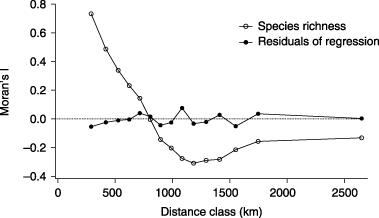
We investigate patterns of species richness of squamates (lizards, snakes, and amphisbaenians) in the Brazilian Cerrado, identifying areas of particularly high richness, and testing predictions of large-scale richness hypotheses by analysing the relationship between species richness and environmental climatic variables. We used point localities from museum collections to produce maps of the predicted distributions for 237 Cerrado squamate species, using niche-modelling techniques. We superimposed distributions of all species on a composite map, depicting richness across the ecosystem. Then, we performed a multiple regression analysis using eigenvector-based spatial filtering (Principal Coordinate of Neighbour Matrices) to assess environmental–climatic variables that are best predictors of species richness. We found that the environmental–climatic and spatial filters multiple regression model explained 78% of the variation in Cerrado squamate richness (r2 = 0.78; F = 32.66; P < 0.01). Best predictors of species richness were: annual precipitation, precipitation seasonality, altitude, net primary productivity, and precipitation during the driest quarter. A model selection approach revealed that several mechanisms related to the different diversity hypothesis might work together to explain richness variation in the Cerrado. Areas of higher species richness in Cerrado were located mainly in the south-west, north, extreme east, and scattered areas in the north-west portions of the biome. Partitioning of energy among species, habitat differentiation, and tolerance to variable environments may be the primary ecological factors determining variation in squamate richness across the Cerrado. High richness areas in northern Cerrado, predicted by our models, are still poorly sampled, and biological surveys are warranted in that region. The south-western region of the Cerrado exhibits high species richness and is also undergoing high levels of deforestation. Therefore, maintenance of existing reserves, establishment of ecological corridors among reserves, and creation of new reserves are urgently needed to ensure conservation of species in these areas.
期刊介绍:
Diversity and Distributions is a journal of conservation biogeography. We publish papers that deal with the application of biogeographical principles, theories, and analyses (being those concerned with the distributional dynamics of taxa and assemblages) to problems concerning the conservation of biodiversity. We no longer consider papers the sole aim of which is to describe or analyze patterns of biodiversity or to elucidate processes that generate biodiversity.



 京公网安备 11010802042870号
京ICP备2023020795号-1
京公网安备 11010802042870号
京ICP备2023020795号-1

 分享
分享
 求助内容:
求助内容: 应助结果提醒方式:
 扫码关注我们
