Enhanced energy density of quasi-solid-state supercapacitor based on activated carbon electrode derived from honeycomb and gel polymer electrolyte with redox-additive methylene blue
Manoj K. Singh, Atul Kumar Sharma, Sujeet Kumar Chaurasia
{"title":"Enhanced energy density of quasi-solid-state supercapacitor based on activated carbon electrode derived from honeycomb and gel polymer electrolyte with redox-additive methylene blue","authors":"Manoj K. Singh, Atul Kumar Sharma, Sujeet Kumar Chaurasia","doi":"10.1002/est2.514","DOIUrl":null,"url":null,"abstract":"<p>Incorporation of redox nature at the electrode-electrolyte interface is of the current research approach for enhancing the specific capacity as well the energy density of the carbon supercapacitor. In the present studies, symmetric carbon supercapacitor cells are fabricated by using gel polymer electrolytes (GPEs) with and without addition of redox-additive (MB) and activated carbon (AC) extracted from natural bio-waste honeycomb (HCAC). The redox-additive polymeric electrolyte offers high room temperature ionic conductivity (σ<sub>RT</sub> ~ 2.3 × 10<sup>−3</sup> S cm<sup>−1</sup>) and electrochemical stability window of ~1.4 V on the addition of 0.1 g of MB. The HC-based activated carbon (HCAC) offers high surface area ~ 586 m<sup>2</sup> g<sup>−1</sup> and dominant meso-porosity. The performance optimization of the supercapacitor cells are examined by using cyclic voltammetry, charge-discharge (CD) and electrochemical impedance spectroscopy (EIS) techniques. The supercapacitor with redox-additive GPE shows the electric double layer features along with faradaic reaction at the electrode-electrolyte interface, which offers high capacitance ~114 F g<sup>−1</sup> and specific energy ~7.76 Wh kg<sup>−1</sup> at a power density 0.49 kW kg<sup>−1</sup>, which is almost ~2.5 times higher than the supercapacitor cell without redox-additive GPE. Furthermore, the supercapacitor cell with 0.1 g MB redox-additive based electrolyte shows almost stable capacitance up to 10 000 CD cycles with ~36% initial fading.</p>","PeriodicalId":11765,"journal":{"name":"Energy Storage","volume":"6 1","pages":""},"PeriodicalIF":0.0000,"publicationDate":"2023-08-22","publicationTypes":"Journal Article","fieldsOfStudy":null,"isOpenAccess":false,"openAccessPdf":"","citationCount":"0","resultStr":null,"platform":"Semanticscholar","paperid":null,"PeriodicalName":"Energy Storage","FirstCategoryId":"1085","ListUrlMain":"https://onlinelibrary.wiley.com/doi/10.1002/est2.514","RegionNum":0,"RegionCategory":null,"ArticlePicture":[],"TitleCN":null,"AbstractTextCN":null,"PMCID":null,"EPubDate":"","PubModel":"","JCR":"","JCRName":"","Score":null,"Total":0}
引用次数: 0
Abstract
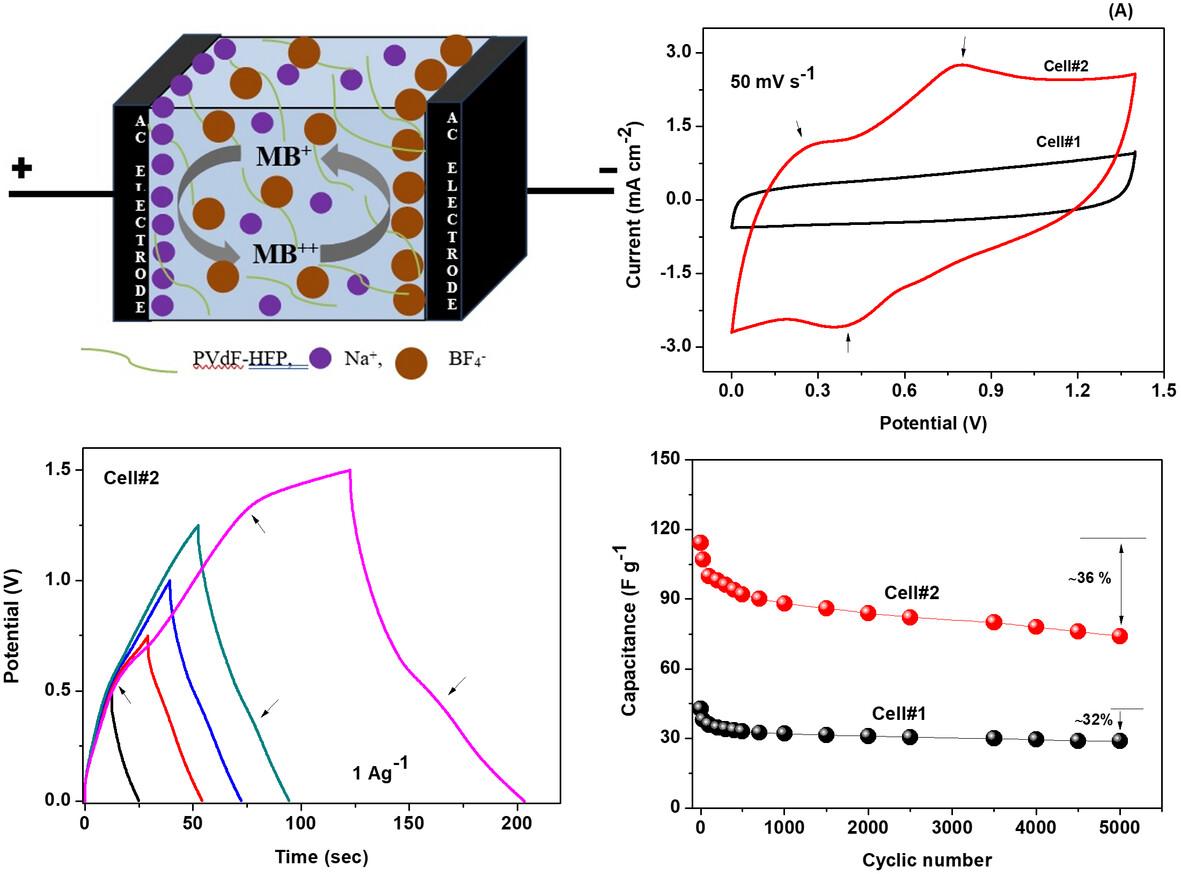
Incorporation of redox nature at the electrode-electrolyte interface is of the current research approach for enhancing the specific capacity as well the energy density of the carbon supercapacitor. In the present studies, symmetric carbon supercapacitor cells are fabricated by using gel polymer electrolytes (GPEs) with and without addition of redox-additive (MB) and activated carbon (AC) extracted from natural bio-waste honeycomb (HCAC). The redox-additive polymeric electrolyte offers high room temperature ionic conductivity (σRT ~ 2.3 × 10⁻³ S cm−1) and electrochemical stability window of ~1.4 V on the addition of 0.1 g of MB. The HC-based activated carbon (HCAC) offers high surface area ~ 586 m2 g−1 and dominant meso-porosity. The performance optimization of the supercapacitor cells are examined by using cyclic voltammetry, charge-discharge (CD) and electrochemical impedance spectroscopy (EIS) techniques. The supercapacitor with redox-additive GPE shows the electric double layer features along with faradaic reaction at the electrode-electrolyte interface, which offers high capacitance ~114 F g−1 and specific energy ~7.76 Wh kg−1 at a power density 0.49 kW kg−1, which is almost ~2.5 times higher than the supercapacitor cell without redox-additive GPE. Furthermore, the supercapacitor cell with 0.1 g MB redox-additive based electrolyte shows almost stable capacitance up to 10 000 CD cycles with ~36% initial fading.



 京公网安备 11010802042870号
京ICP备2023020795号-1
京公网安备 11010802042870号
京ICP备2023020795号-1

 分享
分享

 求助内容:
求助内容: 应助结果提醒方式:
 扫码关注我们
