Jian Yu, Yaming Xu, Cheng Xing, Jianguo Zhou, Pai Pan
{"title":"Pixel-Level Crack Detection and Quantification of Nuclear Containment with Deep Learning","authors":"Jian Yu, Yaming Xu, Cheng Xing, Jianguo Zhou, Pai Pan","doi":"10.1155/2023/9982080","DOIUrl":null,"url":null,"abstract":"<div>\n <p>Crack detection based on deep learning is an advanced technology, and many scholars have proposed many methods for the segmentation of pavement cracks. However, due to the difference of image specifications and crack characteristics, some existing methods are not effective in detecting cracks of containment. To quickly detect cracks and accurately extract crack quantitative information, this paper proposes a crack detection model, called MA_CrackNet, based on deep learning and a crack quantitative analysis algorithm. MA_CrackNet is an end-to-end model based on multiscale fusions that achieve pixel-level segmentation of cracks. Experimental results show that the proposed MA_CrackNet has excellent performance in the crack detection task of nuclear containment, achieving a precision, recall, F1, and mean intersection-over-union (mIoU) of 86.07%, 89.96%, 87.97%, and 89.19%, respectively, outperforming other advanced semantic segmentation models. The quantification algorithm automatically measures the four characteristic indicators of the crack, namely, the length of the crack, the area, the maximum width, and the mean width and obtains reliable results.</p>\n </div>","PeriodicalId":49471,"journal":{"name":"Structural Control & Health Monitoring","volume":"2023 1","pages":""},"PeriodicalIF":5.1000,"publicationDate":"2023-08-10","publicationTypes":"Journal Article","fieldsOfStudy":null,"isOpenAccess":false,"openAccessPdf":"https://onlinelibrary.wiley.com/doi/epdf/10.1155/2023/9982080","citationCount":"0","resultStr":null,"platform":"Semanticscholar","paperid":null,"PeriodicalName":"Structural Control & Health Monitoring","FirstCategoryId":"5","ListUrlMain":"https://onlinelibrary.wiley.com/doi/10.1155/2023/9982080","RegionNum":2,"RegionCategory":"工程技术","ArticlePicture":[],"TitleCN":null,"AbstractTextCN":null,"PMCID":null,"EPubDate":"","PubModel":"","JCR":"Q1","JCRName":"CONSTRUCTION & BUILDING TECHNOLOGY","Score":null,"Total":0}
引用次数: 0
Abstract
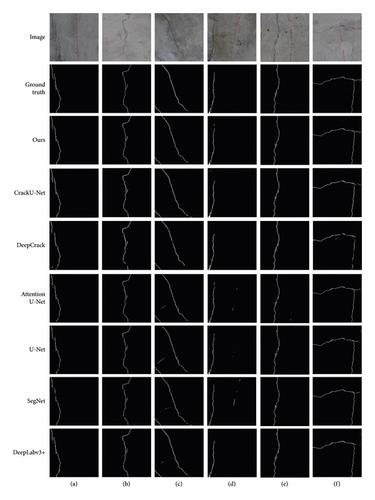
Crack detection based on deep learning is an advanced technology, and many scholars have proposed many methods for the segmentation of pavement cracks. However, due to the difference of image specifications and crack characteristics, some existing methods are not effective in detecting cracks of containment. To quickly detect cracks and accurately extract crack quantitative information, this paper proposes a crack detection model, called MA_CrackNet, based on deep learning and a crack quantitative analysis algorithm. MA_CrackNet is an end-to-end model based on multiscale fusions that achieve pixel-level segmentation of cracks. Experimental results show that the proposed MA_CrackNet has excellent performance in the crack detection task of nuclear containment, achieving a precision, recall, F1, and mean intersection-over-union (mIoU) of 86.07%, 89.96%, 87.97%, and 89.19%, respectively, outperforming other advanced semantic segmentation models. The quantification algorithm automatically measures the four characteristic indicators of the crack, namely, the length of the crack, the area, the maximum width, and the mean width and obtains reliable results.
期刊介绍:
The Journal Structural Control and Health Monitoring encompasses all theoretical and technological aspects of structural control, structural health monitoring theory and smart materials and structures. The journal focuses on aerospace, civil, infrastructure and mechanical engineering applications.
Original contributions based on analytical, computational and experimental methods are solicited in three main areas: monitoring, control, and smart materials and structures, covering subjects such as system identification, health monitoring, health diagnostics, multi-functional materials, signal processing, sensor technology, passive, active and semi active control schemes and implementations, shape memory alloys, piezoelectrics and mechatronics.
Also of interest are actuator design, dynamic systems, dynamic stability, artificial intelligence tools, data acquisition, wireless communications, measurements, MEMS/NEMS sensors for local damage detection, optical fibre sensors for health monitoring, remote control of monitoring systems, sensor-logger combinations for mobile applications, corrosion sensors, scour indicators and experimental techniques.



 京公网安备 11010802042870号
京ICP备2023020795号-1
京公网安备 11010802042870号
京ICP备2023020795号-1

 分享
分享
 求助内容:
求助内容: 应助结果提醒方式:
 扫码关注我们
