Gastric vascular and motor responses to anaphylactic hypotension in anesthetized rats, in comparison to those with hemorrhagic or vasodilator-induced hypotension.
{"title":"Gastric vascular and motor responses to anaphylactic hypotension in anesthetized rats, in comparison to those with hemorrhagic or vasodilator-induced hypotension.","authors":"Yuhichi Kuda, Toshishige Shibamoto, Tao Zhang, Wei Yang, Mamoru Tanida, Yasutaka Kurata","doi":"10.1007/s12576-017-0527-y","DOIUrl":null,"url":null,"abstract":"<p><p>Anaphylactic shock is life-threatening, but pathophysiology of the stomach lesion remains unclear. We determined gastric hemodynamics and gastric functions during anaphylactic hypotension, as compared to hypotension induced by hemorrhage or sodium nitroprusside (SNP) in anesthetized and ovalbumin-sensitized Sprague-Dawley rats. Systemic arterial pressure, portal venous pressure, and gastric arterial blood flow were measured, and gastric vascular resistance (GVR) was determined. Separately, the intragastric pressure (IGP) and gastric effluent, as a measure of gastric flux, were continuously measured. During anaphylaxis, GVR decreased only transiently at 0.5 min, followed by an increase. IGP increased markedly, while gastric flux decreased. During hemorrhage, GVR and IGP increased, while gastric flux did not change. When SNP was injected, both GVR and IGP decreased and gastric flux increased only just after injection. In conclusion, gastric vasodilatation occurs only transiently after antigen injection, and gastric motility increases, but gastric emptying deceases during anaphylactic hypotension in anesthetized rats.</p>","PeriodicalId":22836,"journal":{"name":"The Journal of Physiological Sciences","volume":"42 1","pages":"253-260"},"PeriodicalIF":0.0000,"publicationDate":"2018-05-01","publicationTypes":"Journal Article","fieldsOfStudy":null,"isOpenAccess":false,"openAccessPdf":"https://www.ncbi.nlm.nih.gov/pmc/articles/PMC5886998/pdf/","citationCount":"0","resultStr":null,"platform":"Semanticscholar","paperid":null,"PeriodicalName":"The Journal of Physiological Sciences","FirstCategoryId":"1085","ListUrlMain":"https://doi.org/10.1007/s12576-017-0527-y","RegionNum":0,"RegionCategory":null,"ArticlePicture":[],"TitleCN":null,"AbstractTextCN":null,"PMCID":null,"EPubDate":"2017/1/31 0:00:00","PubModel":"Epub","JCR":"","JCRName":"","Score":null,"Total":0}
引用次数: 0
Abstract
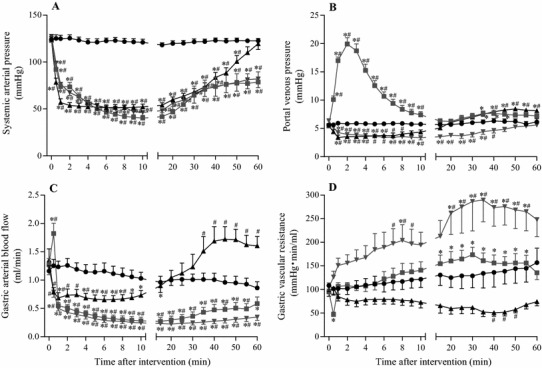
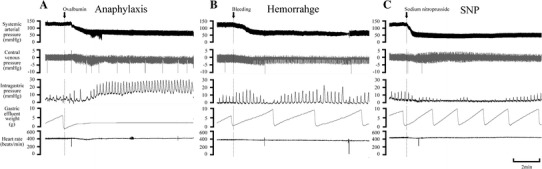
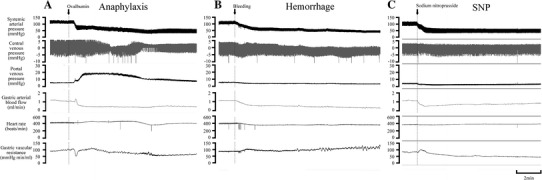
Anaphylactic shock is life-threatening, but pathophysiology of the stomach lesion remains unclear. We determined gastric hemodynamics and gastric functions during anaphylactic hypotension, as compared to hypotension induced by hemorrhage or sodium nitroprusside (SNP) in anesthetized and ovalbumin-sensitized Sprague-Dawley rats. Systemic arterial pressure, portal venous pressure, and gastric arterial blood flow were measured, and gastric vascular resistance (GVR) was determined. Separately, the intragastric pressure (IGP) and gastric effluent, as a measure of gastric flux, were continuously measured. During anaphylaxis, GVR decreased only transiently at 0.5 min, followed by an increase. IGP increased markedly, while gastric flux decreased. During hemorrhage, GVR and IGP increased, while gastric flux did not change. When SNP was injected, both GVR and IGP decreased and gastric flux increased only just after injection. In conclusion, gastric vasodilatation occurs only transiently after antigen injection, and gastric motility increases, but gastric emptying deceases during anaphylactic hypotension in anesthetized rats.



 京公网安备 11010802042870号
京ICP备2023020795号-1
京公网安备 11010802042870号
京ICP备2023020795号-1

 分享
分享

 求助内容:
求助内容: 应助结果提醒方式:
 扫码关注我们
