A comprehensive review on the recovery of cathode active materials via direct recycling from spent Li-ion batteries

IF 16.3 1区 工程技术 Q1 ENERGY & FUELS Renewable and Sustainable Energy Reviews Pub Date : 2023-11-01 DOI:10.1016/j.rser.2023.113693
Youngjun Shin , Seoa Kim , Sanghyuk Park , Jimin Lee , Jihyeon Bae , Dongwoo Kim , Hyeoncheol Joo , Sungho Ban , Haeun Lee , Yonghoon Kim , Kyungjung Kwon
{"title":"A comprehensive review on the recovery of cathode active materials via direct recycling from spent Li-ion batteries","authors":"Youngjun Shin ,&nbsp;Seoa Kim ,&nbsp;Sanghyuk Park ,&nbsp;Jimin Lee ,&nbsp;Jihyeon Bae ,&nbsp;Dongwoo Kim ,&nbsp;Hyeoncheol Joo ,&nbsp;Sungho Ban ,&nbsp;Haeun Lee ,&nbsp;Yonghoon Kim ,&nbsp;Kyungjung Kwon","doi":"10.1016/j.rser.2023.113693","DOIUrl":null,"url":null,"abstract":"<div><p><span>The appropriate disposal of spent Li-ion batteries (LIBs) is critical considering the limited resources of strategic metals and negative impacts on the environment as well as economic profits from LIB recycling. The direct recycling process as one of LIB recycling schemes regenerates spent cathode active materials through a series of liberation and relithiation processes without the destruction of active materials. In this review, we comprehensively cover the overall liberation and regeneration process for all kinds of commercial cathode active materials. Specifically, separation technologies that liberate cathode active materials are analyzed based on categorized methodologies including thermal treatment with single or multiple stages, chemical treatment through solvent- or mechanically-assisted dissolution methods, and the combined processes of chemo-thermal treatment. Next, we summarize the degradation mechanisms of cathode active materials and introduce regeneration methods that are mainly adopted in the direct recycling process such as solid-state, hydrothermal, molten-salt methods. We further compare the electrochemical performance of regenerated cathode active materials according to their regeneration process. The impacts of impurities that could exist during the direct recycling process on the structural and electrochemical properties of regenerated cathode active materials are firstly addressed. Lastly, research issues are suggested for the </span>commercialization of the direct recycling process.</p></div>","PeriodicalId":418,"journal":{"name":"Renewable and Sustainable Energy Reviews","volume":"187 ","pages":"Article 113693"},"PeriodicalIF":16.3000,"publicationDate":"2023-11-01","publicationTypes":"Journal Article","fieldsOfStudy":null,"isOpenAccess":false,"openAccessPdf":"","citationCount":"1","resultStr":null,"platform":"Semanticscholar","paperid":null,"PeriodicalName":"Renewable and Sustainable Energy Reviews","FirstCategoryId":"1","ListUrlMain":"https://www.sciencedirect.com/science/article/pii/S1364032123005506","RegionNum":1,"RegionCategory":"工程技术","ArticlePicture":[],"TitleCN":null,"AbstractTextCN":null,"PMCID":null,"EPubDate":"","PubModel":"","JCR":"Q1","JCRName":"ENERGY & FUELS","Score":null,"Total":0}
引用次数: 1

Abstract

The appropriate disposal of spent Li-ion batteries (LIBs) is critical considering the limited resources of strategic metals and negative impacts on the environment as well as economic profits from LIB recycling. The direct recycling process as one of LIB recycling schemes regenerates spent cathode active materials through a series of liberation and relithiation processes without the destruction of active materials. In this review, we comprehensively cover the overall liberation and regeneration process for all kinds of commercial cathode active materials. Specifically, separation technologies that liberate cathode active materials are analyzed based on categorized methodologies including thermal treatment with single or multiple stages, chemical treatment through solvent- or mechanically-assisted dissolution methods, and the combined processes of chemo-thermal treatment. Next, we summarize the degradation mechanisms of cathode active materials and introduce regeneration methods that are mainly adopted in the direct recycling process such as solid-state, hydrothermal, molten-salt methods. We further compare the electrochemical performance of regenerated cathode active materials according to their regeneration process. The impacts of impurities that could exist during the direct recycling process on the structural and electrochemical properties of regenerated cathode active materials are firstly addressed. Lastly, research issues are suggested for the commercialization of the direct recycling process.
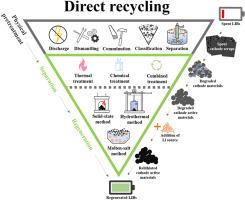
Abstract Image

查看原文
分享 分享
微信好友 朋友圈 QQ好友 复制链接
本刊更多论文
废旧锂离子电池直接回收正极活性材料的研究进展
考虑到战略性金属资源有限、对环境的负面影响以及锂离子电池回收的经济效益,对废旧锂离子电池(LIB)的适当处置至关重要。直接回收工艺作为锂离子电池回收方案之一,在不破坏活性物质的情况下,通过一系列的解离和再提纯过程对废阴极活性物质进行再生。本文全面介绍了各种商用正极活性材料的整体释放和再生过程。具体来说,根据分类方法分析了释放阴极活性物质的分离技术,包括单阶段或多阶段的热处理,通过溶剂或机械辅助溶解方法的化学处理,以及化学-热处理的组合过程。其次,总结了阴极活性材料的降解机理,并介绍了直接回收过程中主要采用的固相法、水热法、熔盐法等再生方法。根据不同的再生过程,对再生阴极活性材料的电化学性能进行了比较。首先讨论了直接回收过程中可能存在的杂质对再生正极活性材料结构和电化学性能的影响。最后,对直接回收工艺的商业化研究提出了建议。
本文章由计算机程序翻译,如有差异,请以英文原文为准。
求助全文
约1分钟内获得全文 去求助
来源期刊
Renewable and Sustainable Energy Reviews
Renewable and Sustainable Energy Reviews 工程技术-能源与燃料
CiteScore
31.20
自引率
5.70%
发文量
1055
审稿时长
62 days
期刊介绍: The mission of Renewable and Sustainable Energy Reviews is to disseminate the most compelling and pertinent critical insights in renewable and sustainable energy, fostering collaboration among the research community, private sector, and policy and decision makers. The journal aims to exchange challenges, solutions, innovative concepts, and technologies, contributing to sustainable development, the transition to a low-carbon future, and the attainment of emissions targets outlined by the United Nations Framework Convention on Climate Change. Renewable and Sustainable Energy Reviews publishes a diverse range of content, including review papers, original research, case studies, and analyses of new technologies, all featuring a substantial review component such as critique, comparison, or analysis. Introducing a distinctive paper type, Expert Insights, the journal presents commissioned mini-reviews authored by field leaders, addressing topics of significant interest. Case studies undergo consideration only if they showcase the work's applicability to other regions or contribute valuable insights to the broader field of renewable and sustainable energy. Notably, a bibliographic or literature review lacking critical analysis is deemed unsuitable for publication.
期刊最新文献
Not all CO2 is equal: Source-specific constraints and viability trade-offs in methanol synthesis from industrial emissions Wildfire-power grid interactions: Feedback, impacts, monitoring, modeling, and mitigation strategies Thermal management of electric vehicles batteries under drive cycles: A review A coordinated framework for integrating technologies, challenges, and management strategies of distributed energy resources in microgrids From copper-chromite to MXenes: A century of furfural hydrogenation – Experiments, DFT, machine learning, and path forward
×
引用
GB/T 7714-2015
复制
MLA
复制
APA
复制
导出至
BibTeX EndNote RefMan NoteFirst NoteExpress
×
×
提示
您的信息不完整,为了账户安全,请先补充。
现在去补充
×
提示
您因"违规操作"
具体请查看互助需知
我知道了
×
提示
现在去查看 取消
×
提示
确定
0
微信
客服QQ
Book学术公众号 扫码关注我们
反馈
×
意见反馈
请填写您的意见或建议
请填写您的手机或邮箱
已复制链接
已复制链接
快去分享给好友吧!
我知道了
×
扫码分享
扫码分享
Book学术官方微信
Book学术文献互助
Book学术文献互助群
群 号:604180095
Book学术
文献互助 智能选刊 最新文献 互助须知 联系我们:info@booksci.cn
Book学术提供免费学术资源搜索服务,方便国内外学者检索中英文文献。致力于提供最便捷和优质的服务体验。
Copyright © 2023 Book学术 All rights reserved.
ghs 京公网安备 11010802042870号 京ICP备2023020795号-1





