Sorption properties of porous aluminosilicate minerals of Ukraine, in situ modified by poly[5-(p-nitrophenylazo)-8-methacryloxyquinoline] of toxic metal ions
Irina Savchenko, Elina Yanovska, Dariush Sternik, Olga Kychkyruk
{"title":"Sorption properties of porous aluminosilicate minerals of Ukraine, in situ modified by poly[5-(p-nitrophenylazo)-8-methacryloxyquinoline] of toxic metal ions","authors":"Irina Savchenko, Elina Yanovska, Dariush Sternik, Olga Kychkyruk","doi":"10.1007/s13204-023-02951-x","DOIUrl":null,"url":null,"abstract":"<div><p>The new polymer–mineral composite materials have been obtained by in situ immobilization of poly-[5-(<i>p</i>-nitrophenylazo)-8-methacryloxyquinoline] on the saponite of Tashkivsky deposit (Sap-AzoQN) and clinoptilolite of the Tushinsky deposit (Clin-AzoQN) surface. The fact of polymer immobilization on the surface of minerals by the selected method was confirmed by thermogravimetric analysis combined with mass spectrometry and IR spectroscopy. Scanning electron microscopy showed that the immobilized polymer is located on the surface of both minerals in the form of needles, located in different directions to the surface, and acicular formations. The properties of the composite materials have been determined by means of a sorption test when removing ions Pb<sup>2+</sup>, Fe<sup>3+</sup>, and Cu<sup>2+</sup> from the model solutions in static conditions. A twofold increase in the sorption capacity of the Sap-AzoQN composite for Cu(II) and Pb(II) ions and a 5.6-fold increase in the Clin-AzoQN composite for Fe(III) ions were recorded compared to the original minerals. As a result, composite materials revealed high-efficiency sorption of heavy metals.</p></div>","PeriodicalId":471,"journal":{"name":"Applied Nanoscience","volume":"13 12","pages":"7555 - 7567"},"PeriodicalIF":3.6740,"publicationDate":"2023-09-01","publicationTypes":"Journal Article","fieldsOfStudy":null,"isOpenAccess":false,"openAccessPdf":"","citationCount":"0","resultStr":null,"platform":"Semanticscholar","paperid":null,"PeriodicalName":"Applied Nanoscience","FirstCategoryId":"5","ListUrlMain":"https://link.springer.com/article/10.1007/s13204-023-02951-x","RegionNum":4,"RegionCategory":"工程技术","ArticlePicture":[],"TitleCN":null,"AbstractTextCN":null,"PMCID":null,"EPubDate":"","PubModel":"","JCR":"Q1","JCRName":"Engineering","Score":null,"Total":0}
引用次数: 0
Abstract
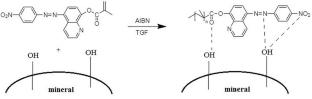
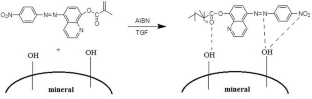
The new polymer–mineral composite materials have been obtained by in situ immobilization of poly-[5-(p-nitrophenylazo)-8-methacryloxyquinoline] on the saponite of Tashkivsky deposit (Sap-AzoQN) and clinoptilolite of the Tushinsky deposit (Clin-AzoQN) surface. The fact of polymer immobilization on the surface of minerals by the selected method was confirmed by thermogravimetric analysis combined with mass spectrometry and IR spectroscopy. Scanning electron microscopy showed that the immobilized polymer is located on the surface of both minerals in the form of needles, located in different directions to the surface, and acicular formations. The properties of the composite materials have been determined by means of a sorption test when removing ions Pb2+, Fe3+, and Cu2+ from the model solutions in static conditions. A twofold increase in the sorption capacity of the Sap-AzoQN composite for Cu(II) and Pb(II) ions and a 5.6-fold increase in the Clin-AzoQN composite for Fe(III) ions were recorded compared to the original minerals. As a result, composite materials revealed high-efficiency sorption of heavy metals.
期刊介绍:
Applied Nanoscience is a hybrid journal that publishes original articles about state of the art nanoscience and the application of emerging nanotechnologies to areas fundamental to building technologically advanced and sustainable civilization, including areas as diverse as water science, advanced materials, energy, electronics, environmental science and medicine. The journal accepts original and review articles as well as book reviews for publication. All the manuscripts are single-blind peer-reviewed for scientific quality and acceptance.