{"title":"A deep learning approach for prediction of electrical vehicle charging stations power demand in regulated electricity markets: The case of Morocco","authors":"Mouaad Boulakhbar , Markos Farag , Kawtar Benabdelaziz , Tarik Kousksou , Malika Zazi","doi":"10.1016/j.cles.2022.100039","DOIUrl":null,"url":null,"abstract":"<div><p>The transport sector is a prominent source of increasing fuel consumption and greenhouse gas (GHG) emissions. Electric vehicle (EV) is deemed an appealing solution for those problems. However, due to the variation in charging demands, the high penetration of electric vehicles may cause different problems to the distribution network and its reliability. Therefore, several approaches are employed to predict the EVs charging demand and avoid the corresponding challenges. This paper compares the performance of four well-known deep learning models, namely artificial neural networks (ANN), recurrent neural networks (RNNs), long short-term memory (LSTM), and gated recurrent units (GRUs), in predicting charging demand for EV users after a charging session begins. We use a dataset consisting of 2000 observations of charging events collected from two public charging stations in Morocco. According to numerical data results, the first layer of the GRU regression approach marginally beats the other three methods in estimating power charging needs. Specifically, the GRU regression model has an RMSE and MAPE of 1.39% and 0.50% in the training stage and 2.90% and 0.76% in the testing stage, respectively. These findings can assist the National Office of Electricity and Water in Morocco in ensuring the reliability of grid utility in the short run and guiding them to construct additional charging stations in the long run.</p></div>","PeriodicalId":100252,"journal":{"name":"Cleaner Energy Systems","volume":"3 ","pages":"Article 100039"},"PeriodicalIF":0.0000,"publicationDate":"2022-12-01","publicationTypes":"Journal Article","fieldsOfStudy":null,"isOpenAccess":false,"openAccessPdf":"https://www.sciencedirect.com/science/article/pii/S2772783122000371/pdfft?md5=444ed2d671561920f30280fdfd39767a&pid=1-s2.0-S2772783122000371-main.pdf","citationCount":"12","resultStr":null,"platform":"Semanticscholar","paperid":null,"PeriodicalName":"Cleaner Energy Systems","FirstCategoryId":"1085","ListUrlMain":"https://www.sciencedirect.com/science/article/pii/S2772783122000371","RegionNum":0,"RegionCategory":null,"ArticlePicture":[],"TitleCN":null,"AbstractTextCN":null,"PMCID":null,"EPubDate":"2022/11/6 0:00:00","PubModel":"Epub","JCR":"","JCRName":"","Score":null,"Total":0}
引用次数: 12
Abstract
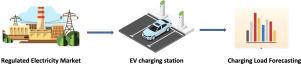
The transport sector is a prominent source of increasing fuel consumption and greenhouse gas (GHG) emissions. Electric vehicle (EV) is deemed an appealing solution for those problems. However, due to the variation in charging demands, the high penetration of electric vehicles may cause different problems to the distribution network and its reliability. Therefore, several approaches are employed to predict the EVs charging demand and avoid the corresponding challenges. This paper compares the performance of four well-known deep learning models, namely artificial neural networks (ANN), recurrent neural networks (RNNs), long short-term memory (LSTM), and gated recurrent units (GRUs), in predicting charging demand for EV users after a charging session begins. We use a dataset consisting of 2000 observations of charging events collected from two public charging stations in Morocco. According to numerical data results, the first layer of the GRU regression approach marginally beats the other three methods in estimating power charging needs. Specifically, the GRU regression model has an RMSE and MAPE of 1.39% and 0.50% in the training stage and 2.90% and 0.76% in the testing stage, respectively. These findings can assist the National Office of Electricity and Water in Morocco in ensuring the reliability of grid utility in the short run and guiding them to construct additional charging stations in the long run.



 京公网安备 11010802042870号
京ICP备2023020795号-1
京公网安备 11010802042870号
京ICP备2023020795号-1

 分享
分享

 求助内容:
求助内容: 应助结果提醒方式:
 扫码关注我们
