{"title":"Induced pluripotent stem cells from homozygous Runx2-deficient mice show poor response to vitamin D during osteoblastic differentiation.","authors":"Hideto Aoki, Eiichi Suzuki, Takashi Nakamura, Shoko Onodera, Akiko Saito, Manami Ohtaka, Mahito Nakanishi, Ken Nishimura, Atsushi Saito, Toshifumi Azuma","doi":"10.1007/s00795-022-00317-w","DOIUrl":null,"url":null,"abstract":"<p><p>Cleidocranial dysplasia (CCD) is a hereditary disorder associated with skeletal dysplasia and dental abnormalities. CCD arises from heterozygous loss of function mutations in the Runt-related transcription factor 2 (RUNX2) gene. Osteoporosis is often observed in CCD patients and conventional vitamin D supplementation is recommended. However, sufficient evidences have not been presented yet. This study investigated the role of RUNX2 in osteoblastic differentiation and sought to identify potential target genes for the treatment of osteoporosis associated with CCD, using induced pluripotent stem cell (iPSC) technology. We successfully established Runx2<sup>-/-</sup>, Runx2<sup>+/-</sup> and wild-type miPSCs from litter-matched mice and found poor Vdr expression in Runx2<sup>-/-</sup>cells. Significant down-regulation of osteoblastic differentiation in Runx2<sup>-/-</sup> miPSCs was observed. Gene expression array revealed unexpected results such as remarkable increase of Rankl expression and decrease of Vdr in Runx2<sup>-/-</sup> cells. Insufficient response to vitamin D in Runx2<sup>-/-</sup> cells was also observed. Our results suggest that RUNX2 functions as a regulator of Rankl and Vdr and thereby controls bone density. These findings also suggest that conventional vitamin D supplementation may not be as effective as previously expected, in the treatment of osteoporosis associated with CCD, and that inhibiting RANKL function might be worth considering as an alternative treatment strategy.</p>","PeriodicalId":18338,"journal":{"name":"Medical Molecular Morphology","volume":"77 1","pages":"174-186"},"PeriodicalIF":1.1000,"publicationDate":"2022-09-01","publicationTypes":"Journal Article","fieldsOfStudy":null,"isOpenAccess":false,"openAccessPdf":"","citationCount":"0","resultStr":null,"platform":"Semanticscholar","paperid":null,"PeriodicalName":"Medical Molecular Morphology","FirstCategoryId":"3","ListUrlMain":"https://doi.org/10.1007/s00795-022-00317-w","RegionNum":4,"RegionCategory":"医学","ArticlePicture":[],"TitleCN":null,"AbstractTextCN":null,"PMCID":null,"EPubDate":"2022/4/23 0:00:00","PubModel":"Epub","JCR":"Q3","JCRName":"PATHOLOGY","Score":null,"Total":0}
引用次数: 0
Abstract
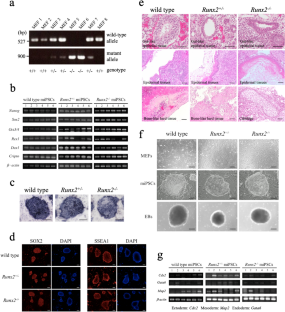
Cleidocranial dysplasia (CCD) is a hereditary disorder associated with skeletal dysplasia and dental abnormalities. CCD arises from heterozygous loss of function mutations in the Runt-related transcription factor 2 (RUNX2) gene. Osteoporosis is often observed in CCD patients and conventional vitamin D supplementation is recommended. However, sufficient evidences have not been presented yet. This study investigated the role of RUNX2 in osteoblastic differentiation and sought to identify potential target genes for the treatment of osteoporosis associated with CCD, using induced pluripotent stem cell (iPSC) technology. We successfully established Runx2-/-, Runx2+/- and wild-type miPSCs from litter-matched mice and found poor Vdr expression in Runx2-/-cells. Significant down-regulation of osteoblastic differentiation in Runx2-/- miPSCs was observed. Gene expression array revealed unexpected results such as remarkable increase of Rankl expression and decrease of Vdr in Runx2-/- cells. Insufficient response to vitamin D in Runx2-/- cells was also observed. Our results suggest that RUNX2 functions as a regulator of Rankl and Vdr and thereby controls bone density. These findings also suggest that conventional vitamin D supplementation may not be as effective as previously expected, in the treatment of osteoporosis associated with CCD, and that inhibiting RANKL function might be worth considering as an alternative treatment strategy.
期刊介绍:
Medical Molecular Morphology is an international forum for researchers in both basic and clinical medicine to present and discuss new research on the structural mechanisms and the processes of health and disease at the molecular level. The structures of molecules, organelles, cells, tissues, and organs determine their normal function. Disease is thus best understood in terms of structural changes in these different levels of biological organization, especially in molecules and molecular interactions as well as the cellular localization of chemical components. Medical Molecular Morphology welcomes articles on basic or clinical research in the fields of cell biology, molecular biology, and medical, veterinary, and dental sciences using techniques for structural research such as electron microscopy, confocal laser scanning microscopy, enzyme histochemistry, immunohistochemistry, radioautography, X-ray microanalysis, and in situ hybridization.
Manuscripts submitted for publication must contain a statement to the effect that all human studies have been reviewed by the appropriate ethics committee and have therefore been performed in accordance with the ethical standards laid down in an appropriate version of the 1964 Declaration of Helsinki. It should also be stated clearly in the text that all persons gave their informed consent prior to their inclusion in the study. Details that might disclose the identity of the subjects under study should be omitted.



 京公网安备 11010802042870号
京ICP备2023020795号-1
京公网安备 11010802042870号
京ICP备2023020795号-1

 分享
分享
 求助内容:
求助内容: 应助结果提醒方式:
 扫码关注我们
