AiYu Chen, Xiang Tong, Tang LiZhen, Tao Lu, CaiHong Wu
{"title":"Study on serum miR-185-5p in assessing the injury severity and prognosis of patients with traumatic brain injury.","authors":"AiYu Chen, Xiang Tong, Tang LiZhen, Tao Lu, CaiHong Wu","doi":"10.5937/jomb0-37716","DOIUrl":null,"url":null,"abstract":"<p><strong>Background: </strong>This study aims to explore whether serum miR-185-5p levels are related to the injury severity and prognosis of traumatic brain injury patients.</p><p><strong>Methods: </strong>Serum miR-185-5p level was quantified in 120 TBI patients. The Glasgow Coma Scale (GCS) was used to grade the damage, and the Glasgow Outcome Scale (GOS) was used to evaluate the prognosis 3 months after TBI. Pearson correlation analysis was performed to determine the relationship between serum miR-185-5p level and injury severity and prognosis, and the value of serum miR-185-5p level to assess injury severity and prognosis was evaluated by receiver operating characteristic (ROC) curve.</p><p><strong>Results: </strong>Serum miR-185-5p level in moderate and severe TBI patients was higher than in mild TBI patients, and serum miR-185-5p was closely related to GCS score and GOS score. Serum miR-185-5p level higher than 0.36 could distinguish patients with mild to moderate TBI injury, with 72.97% sensitivity and 97.62% specificity, while that higher than 0.43 had 46.34% sensitivity and 91.89% specificity to distinguish moderate to severe TBI patients. Moreover, serum miR-185-5p levels higher than 0.36, with a sensitivity of 96.30% and a specificity of 60.24%, distinguished the poor prognosis of TBI patients. Serum miR185-5p level was an independent predictor of poor prognosis in TBI patients after 3 months and was effective in discriminating adverse outcomes at 3 months.</p><p><strong>Conclusions: </strong>Serum miR-185-5p level was significantly correlated with 3-month injury and adverse prognosis in TBI patients, suggesting that serum miR-185-5p level may be a biomarker that provides supplementary prognostic information and can be used to identify the risk of adverse prognosis in TBI patients.</p>","PeriodicalId":20628,"journal":{"name":"Polymer Testing","volume":"32 1","pages":"582-590"},"PeriodicalIF":6.0000,"publicationDate":"2023-10-27","publicationTypes":"Journal Article","fieldsOfStudy":null,"isOpenAccess":false,"openAccessPdf":"https://www.ncbi.nlm.nih.gov/pmc/articles/PMC10710806/pdf/","citationCount":"0","resultStr":null,"platform":"Semanticscholar","paperid":null,"PeriodicalName":"Polymer Testing","FirstCategoryId":"3","ListUrlMain":"https://doi.org/10.5937/jomb0-37716","RegionNum":2,"RegionCategory":"材料科学","ArticlePicture":[],"TitleCN":null,"AbstractTextCN":null,"PMCID":null,"EPubDate":"","PubModel":"","JCR":"Q1","JCRName":"MATERIALS SCIENCE, CHARACTERIZATION & TESTING","Score":null,"Total":0}
引用次数: 0
Abstract
Background: This study aims to explore whether serum miR-185-5p levels are related to the injury severity and prognosis of traumatic brain injury patients.
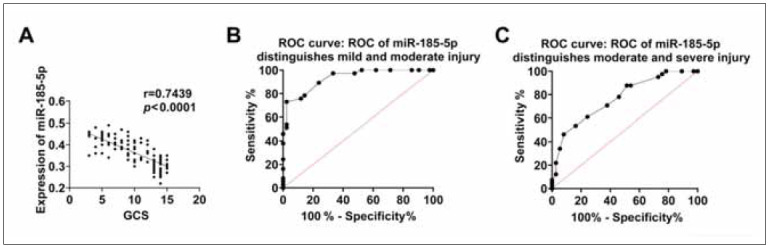
Methods: Serum miR-185-5p level was quantified in 120 TBI patients. The Glasgow Coma Scale (GCS) was used to grade the damage, and the Glasgow Outcome Scale (GOS) was used to evaluate the prognosis 3 months after TBI. Pearson correlation analysis was performed to determine the relationship between serum miR-185-5p level and injury severity and prognosis, and the value of serum miR-185-5p level to assess injury severity and prognosis was evaluated by receiver operating characteristic (ROC) curve.
Results: Serum miR-185-5p level in moderate and severe TBI patients was higher than in mild TBI patients, and serum miR-185-5p was closely related to GCS score and GOS score. Serum miR-185-5p level higher than 0.36 could distinguish patients with mild to moderate TBI injury, with 72.97% sensitivity and 97.62% specificity, while that higher than 0.43 had 46.34% sensitivity and 91.89% specificity to distinguish moderate to severe TBI patients. Moreover, serum miR-185-5p levels higher than 0.36, with a sensitivity of 96.30% and a specificity of 60.24%, distinguished the poor prognosis of TBI patients. Serum miR185-5p level was an independent predictor of poor prognosis in TBI patients after 3 months and was effective in discriminating adverse outcomes at 3 months.
Conclusions: Serum miR-185-5p level was significantly correlated with 3-month injury and adverse prognosis in TBI patients, suggesting that serum miR-185-5p level may be a biomarker that provides supplementary prognostic information and can be used to identify the risk of adverse prognosis in TBI patients.
期刊介绍:
Polymer Testing focuses on the testing, analysis and characterization of polymer materials, including both synthetic and natural or biobased polymers. Novel testing methods and the testing of novel polymeric materials in bulk, solution and dispersion is covered. In addition, we welcome the submission of the testing of polymeric materials for a wide range of applications and industrial products as well as nanoscale characterization.
The scope includes but is not limited to the following main topics:
Novel testing methods and Chemical analysis
• mechanical, thermal, electrical, chemical, imaging, spectroscopy, scattering and rheology
Physical properties and behaviour of novel polymer systems
• nanoscale properties, morphology, transport properties
Degradation and recycling of polymeric materials when combined with novel testing or characterization methods
• degradation, biodegradation, ageing and fire retardancy
Modelling and Simulation work will be only considered when it is linked to new or previously published experimental results.





 京公网安备 11010802042870号
京ICP备2023020795号-1
京公网安备 11010802042870号
京ICP备2023020795号-1

 分享
分享
 求助内容:
求助内容: 应助结果提醒方式:
 扫码关注我们
