Ioannis Neofytou, K. Kantartzi, S. Roumeliotis, V. Manolopoulos, E. Thodis, S. Panagoutsos
{"title":"#2771 PRESCRIBING PATTERNS IN GREEK HEMODIALYSIS PATIENTS: A MULTICENTER PHARMACOEPIDEMIOLOGY STUDY","authors":"Ioannis Neofytou, K. Kantartzi, S. Roumeliotis, V. Manolopoulos, E. Thodis, S. Panagoutsos","doi":"10.1093/ndt/gfad063c_2771","DOIUrl":null,"url":null,"abstract":"\n \n \n The aim of the study is to investigate the prescribing patterns and polypharmacy in Greek hemodialysis patients and make comparisons between renal units. Polypharmacy and hyperpolypharmacy emerged as a concerning problem, that affects patient's adherence, causes drug-drug interactions, adverse drug events, increases morbidity and economically strains the health system. Patients in Europe, are prescribed on average 10–12 drugs despite recommendations on polypharmacy.\n \n \n \n This is a multicenter retrospective study (2018-2021), in Northeastern Greece, of 270 patients (male = 168, female = 102) with mean age of 63.8±15 years and median dialysis duration of 45(18-96) months. The medications and laboratory values were documented for a period of 12 months, provided that there were no major changes on their therapy that time. The 4 public health dialysis units participating on the survey, were classified as secondary (179 patients) and tertiary care (91 patients) depending on the bed capacity (>600) and the availability of health services. Statistical analysis was conducted using SPSS ver26.\n \n \n \n The mean number of prescribed medications was 10.4 (SD 2.9, range 2–20). Of the participants, 97.4% were experiencing polypharmacy (≥5 medications per person) and 62.6% hyperpolypharmacy (≥10 medications). The average number of prescribed medications in tertiary care was substantially lower comparing with secondary care (mean: 8,7 vs 11,3, p<0.001). The difference in the mean number, remained significant even when the result was adjusted for age, gender, cardiovascular disease, primary disease and dialysis duration. Notably, despite the fewer medications, there was no statistically significant difference between the two groups, in achieving the most recent Kidney Disease Improving Global Outcomes (KDIGO) guidelines for URR (Urea Ruction Ratio), renal mineral bone disease and renal anemia (chi-sqaure, p>0.05 for all variables). The most frequently prescribed group of medications were EPO analogues (87%), Vitamin D supplements (83%), Proton Pump Inhibitors (68%), β-blockers (56%), Antiplatelets (45%) and Loop diuretics (37%). It is important to note the alarming number of patients receiving medication for mental illness (35.2%), mainly benzodiazepines (26%), with women to be more vulnerable (42.2% vs 30.1%, OR:1.63).\n \n \n \n This study reports that Greek prescribing practices follow the same worrisome patterns as other European countries. Rural hospitals appear to prescribe more drugs than tertiary facilities.\n","PeriodicalId":19078,"journal":{"name":"Nephrology Dialysis Transplantation","volume":"165 1","pages":""},"PeriodicalIF":5.6000,"publicationDate":"2023-06-01","publicationTypes":"Journal Article","fieldsOfStudy":null,"isOpenAccess":false,"openAccessPdf":"","citationCount":"0","resultStr":null,"platform":"Semanticscholar","paperid":null,"PeriodicalName":"Nephrology Dialysis Transplantation","FirstCategoryId":"3","ListUrlMain":"https://doi.org/10.1093/ndt/gfad063c_2771","RegionNum":2,"RegionCategory":"医学","ArticlePicture":[],"TitleCN":null,"AbstractTextCN":null,"PMCID":null,"EPubDate":"","PubModel":"","JCR":"Q1","JCRName":"TRANSPLANTATION","Score":null,"Total":0}
引用次数: 0
Abstract
The aim of the study is to investigate the prescribing patterns and polypharmacy in Greek hemodialysis patients and make comparisons between renal units. Polypharmacy and hyperpolypharmacy emerged as a concerning problem, that affects patient's adherence, causes drug-drug interactions, adverse drug events, increases morbidity and economically strains the health system. Patients in Europe, are prescribed on average 10–12 drugs despite recommendations on polypharmacy.
This is a multicenter retrospective study (2018-2021), in Northeastern Greece, of 270 patients (male = 168, female = 102) with mean age of 63.8±15 years and median dialysis duration of 45(18-96) months. The medications and laboratory values were documented for a period of 12 months, provided that there were no major changes on their therapy that time. The 4 public health dialysis units participating on the survey, were classified as secondary (179 patients) and tertiary care (91 patients) depending on the bed capacity (>600) and the availability of health services. Statistical analysis was conducted using SPSS ver26.
The mean number of prescribed medications was 10.4 (SD 2.9, range 2–20). Of the participants, 97.4% were experiencing polypharmacy (≥5 medications per person) and 62.6% hyperpolypharmacy (≥10 medications). The average number of prescribed medications in tertiary care was substantially lower comparing with secondary care (mean: 8,7 vs 11,3, p<0.001). The difference in the mean number, remained significant even when the result was adjusted for age, gender, cardiovascular disease, primary disease and dialysis duration. Notably, despite the fewer medications, there was no statistically significant difference between the two groups, in achieving the most recent Kidney Disease Improving Global Outcomes (KDIGO) guidelines for URR (Urea Ruction Ratio), renal mineral bone disease and renal anemia (chi-sqaure, p>0.05 for all variables). The most frequently prescribed group of medications were EPO analogues (87%), Vitamin D supplements (83%), Proton Pump Inhibitors (68%), β-blockers (56%), Antiplatelets (45%) and Loop diuretics (37%). It is important to note the alarming number of patients receiving medication for mental illness (35.2%), mainly benzodiazepines (26%), with women to be more vulnerable (42.2% vs 30.1%, OR:1.63).
This study reports that Greek prescribing practices follow the same worrisome patterns as other European countries. Rural hospitals appear to prescribe more drugs than tertiary facilities.
该研究的目的是调查处方模式和多种药物在希腊血液透析患者和肾脏单位之间进行比较。多种用药和过度用药已成为一个令人关注的问题,影响患者的依从性,导致药物-药物相互作用,药物不良事件,增加发病率并使卫生系统经济紧张。在欧洲,患者平均要服用10-12种药物,尽管推荐使用多种药物。这是一项多中心回顾性研究(2018-2021),在希腊东北部,270例患者(男性= 168,女性= 102),平均年龄为63.8±15岁,中位透析持续时间为45(18-96)个月。在12个月的时间里,只要他们的治疗方法没有重大变化,药物和实验室值都被记录下来。参与调查的4个公共卫生透析单位,根据床位容量(600桶)和卫生服务的可得性,被分为二级(179名患者)和三级(91名患者)。采用SPSS v26进行统计分析。平均处方药物数为10.4种(标准差2.9,范围2-20)。在参与者中,97.4%的人正在经历多重用药(每人≥5种药物),62.6%的人正在经历多重用药(每人≥10种药物)。三级护理的平均处方药物数量明显低于二级护理(所有变量的平均值:8,7 vs 11,3, p0.05)。最常用的药物是促生成素类似物(87%)、维生素D补充剂(83%)、质子泵抑制剂(68%)、β受体阻滞剂(56%)、抗血小板药(45%)和袢利尿剂(37%)。值得注意的是,接受精神疾病药物治疗的患者数量惊人(35.2%),主要是苯二氮卓类药物(26%),女性更容易受到伤害(42.2% vs 30.1%, OR:1.63)。这项研究报告称,希腊的处方做法与其他欧洲国家一样令人担忧。农村医院开出的药似乎比三级医院多。
期刊介绍:
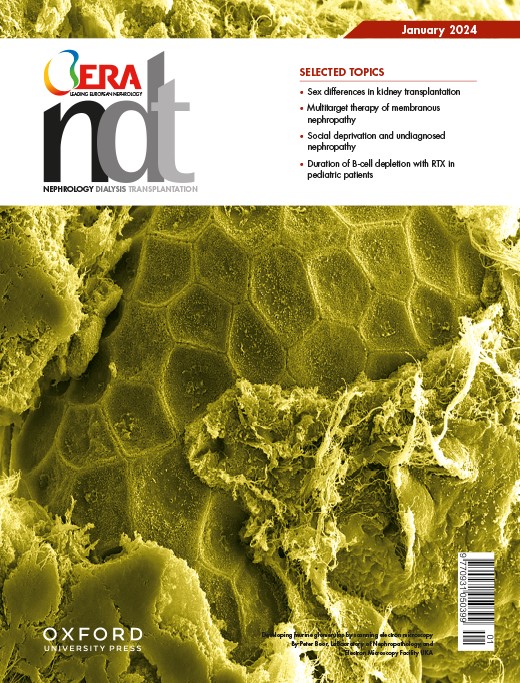
Nephrology Dialysis Transplantation (ndt) is the leading nephrology journal in Europe and renowned worldwide, devoted to original clinical and laboratory research in nephrology, dialysis and transplantation. ndt is an official journal of the [ERA-EDTA](http://www.era-edta.org/) (European Renal Association-European Dialysis and Transplant Association). Published monthly, the journal provides an essential resource for researchers and clinicians throughout the world. All research articles in this journal have undergone peer review.
Print ISSN: 0931-0509.



 京公网安备 11010802042870号
京ICP备2023020795号-1
京公网安备 11010802042870号
京ICP备2023020795号-1

 分享
分享
 求助内容:
求助内容: 应助结果提醒方式:
 扫码关注我们
