Sakshi Batra, Dipaloy Datta, Nitin Sai Beesabathuni, Nihit Kanjolia, Shibayan Saha
{"title":"Adsorption of Bisphenol-A from aqueous solution using amberlite XAD-7 impregnated with aliquat 336: Batch, column, and design studies","authors":"Sakshi Batra, Dipaloy Datta, Nitin Sai Beesabathuni, Nihit Kanjolia, Shibayan Saha","doi":"10.1016/j.psep.2018.12.005","DOIUrl":null,"url":null,"abstract":"<div><p>Bisphenol-A (BPA) was removed from water solution using washed (WX7) and impregnated (IX7) Amberlite XAD-7 resin with Aliquat-336 (A336). 0.5 g (IX7-0.5) and 1 g (IX7-1) of A336 per g of WX7 were loaded on the resin. Characterization of prepared adsorbents was done by FTIR, FE-SEM, EDS, BET. Point of zero charge study was also conducted to find the point at which the surface of adsorbent became neutrally charged. Equilibrium and kinetic experiments in the batch mode were carried out to observe the influence of contact time, amount of adsorbent, the initial concentration of BPA, pH, temperature, and ionic strength of solution (NaCl and Na<sub>2</sub>SO<sub>4</sub>) on the adsorption. IX7-1 showed comparatively better removal efficiency than that of IX7-0.5 or WX7. 5 g L<sup>-1</sup> was determined to be the optimum mass of adsorbent (WX7, IX7-0.5, and IX7-1). Equilibrium (Langmuir, Freundlich, Temkin, and Dubinin-Radushkevich) and kinetic (pseudo-first-order, pseudo-second-order, intraparticle diffusion, and Elovich) models were fitted to the experimental results. Used IX7-1 was regenerated up to 5 times, and showed almost the same removal and good reusability of impregnated resin even after 5<sup>th</sup> cycle. Studies in a fixed bed column were also done by changing the flow rate, the height of the bed, and initial BPA concentration to evaluate the performance of IX7-1. Models like Thomas, Adham Bohart, and BDST were used to predict the column behavior, and to estimate the parameters for the scale-up of the process. Finally, the economic analysis of prepared resin was done, and the cost of impregnated resin (IX7-1) was found to be $2.055/g.</p></div>","PeriodicalId":20743,"journal":{"name":"Process Safety and Environmental Protection","volume":"122 ","pages":"Pages 232-246"},"PeriodicalIF":7.8000,"publicationDate":"2019-02-01","publicationTypes":"Journal Article","fieldsOfStudy":null,"isOpenAccess":false,"openAccessPdf":"https://sci-hub-pdf.com/10.1016/j.psep.2018.12.005","citationCount":"44","resultStr":null,"platform":"Semanticscholar","paperid":null,"PeriodicalName":"Process Safety and Environmental Protection","FirstCategoryId":"93","ListUrlMain":"https://www.sciencedirect.com/science/article/pii/S0957582018309960","RegionNum":2,"RegionCategory":"环境科学与生态学","ArticlePicture":[],"TitleCN":null,"AbstractTextCN":null,"PMCID":null,"EPubDate":"2018/12/11 0:00:00","PubModel":"Epub","JCR":"Q1","JCRName":"ENGINEERING, CHEMICAL","Score":null,"Total":0}
引用次数: 44
Abstract
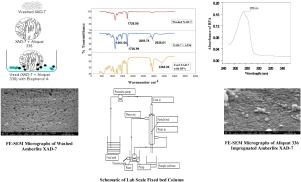
Bisphenol-A (BPA) was removed from water solution using washed (WX7) and impregnated (IX7) Amberlite XAD-7 resin with Aliquat-336 (A336). 0.5 g (IX7-0.5) and 1 g (IX7-1) of A336 per g of WX7 were loaded on the resin. Characterization of prepared adsorbents was done by FTIR, FE-SEM, EDS, BET. Point of zero charge study was also conducted to find the point at which the surface of adsorbent became neutrally charged. Equilibrium and kinetic experiments in the batch mode were carried out to observe the influence of contact time, amount of adsorbent, the initial concentration of BPA, pH, temperature, and ionic strength of solution (NaCl and Na2SO4) on the adsorption. IX7-1 showed comparatively better removal efficiency than that of IX7-0.5 or WX7. 5 g L-1 was determined to be the optimum mass of adsorbent (WX7, IX7-0.5, and IX7-1). Equilibrium (Langmuir, Freundlich, Temkin, and Dubinin-Radushkevich) and kinetic (pseudo-first-order, pseudo-second-order, intraparticle diffusion, and Elovich) models were fitted to the experimental results. Used IX7-1 was regenerated up to 5 times, and showed almost the same removal and good reusability of impregnated resin even after 5th cycle. Studies in a fixed bed column were also done by changing the flow rate, the height of the bed, and initial BPA concentration to evaluate the performance of IX7-1. Models like Thomas, Adham Bohart, and BDST were used to predict the column behavior, and to estimate the parameters for the scale-up of the process. Finally, the economic analysis of prepared resin was done, and the cost of impregnated resin (IX7-1) was found to be $2.055/g.
期刊介绍:
The Process Safety and Environmental Protection (PSEP) journal is a leading international publication that focuses on the publication of high-quality, original research papers in the field of engineering, specifically those related to the safety of industrial processes and environmental protection. The journal encourages submissions that present new developments in safety and environmental aspects, particularly those that show how research findings can be applied in process engineering design and practice.
PSEP is particularly interested in research that brings fresh perspectives to established engineering principles, identifies unsolved problems, or suggests directions for future research. The journal also values contributions that push the boundaries of traditional engineering and welcomes multidisciplinary papers.
PSEP's articles are abstracted and indexed by a range of databases and services, which helps to ensure that the journal's research is accessible and recognized in the academic and professional communities. These databases include ANTE, Chemical Abstracts, Chemical Hazards in Industry, Current Contents, Elsevier Engineering Information database, Pascal Francis, Web of Science, Scopus, Engineering Information Database EnCompass LIT (Elsevier), and INSPEC. This wide coverage facilitates the dissemination of the journal's content to a global audience interested in process safety and environmental engineering.



 京公网安备 11010802042870号
京ICP备2023020795号-1
京公网安备 11010802042870号
京ICP备2023020795号-1

 分享
分享
 求助内容:
求助内容: 应助结果提醒方式:
 扫码关注我们
