{"title":"Interplate Slip Following the 2003 Tokachi-oki Earthquake From Ocean Bottom Pressure Gauge and Land GNSS Data","authors":"Yuji Itoh, Takuya Nishimura, Keisuke Ariyoshi, Hiroyuki Matsumoto","doi":"10.1029/2018JB016328","DOIUrl":null,"url":null,"abstract":"<p>Preseismic, coseismic, and 7.5 years of postseismic deformation of the 2003 <i>M</i><sub><i>w</i></sub> 8.0 Tokachi-oki earthquake are modeled using land Global Navigation Satellite System (GNSS) data and two ocean bottom pressure gauges (OBP) using viscoelastic Green's functions. The postseismic slip distribution is shown to not overlap with the main shock or the source regions of past large earthquakes along the southern part of the Kurile trench. The preseismic locking is estimated in the coseismic and postseismic slip regions using the same plate interface geometry. The temporal evolution of the postseismic slip is described with a single logarithmic function. The slip is shown to decay faster updip of the coseismic slip region compared to the downdip extension. Sustained postseismic slip indicates that the interplate locking in the postseismic slip region had not fully recovered to the pre-2003 status in the 7.5 year analyzed period. Postseismic slip history also indicates rapid recovery of locking in the coseismic slip region. We examined the constraint of the OBP time series for the postseismic deformation modeling and found that the observed uplift at the OBP sites requires small postseismic slip near the trench, where a tsunamigenic <i>M</i>9 earthquake occurred in the seventeenth century. Uplift at the OBP sites does not constrain the absolute slip magnitude between the updip and downdip sides of the OBP sites but requires the slip in the updip side to be smaller than that in the downdip side. Our model describes transient postseismic deformation observed by both land GNSS and OBP.</p>","PeriodicalId":15864,"journal":{"name":"Journal of Geophysical Research: Solid Earth","volume":"124 4","pages":"4205-4230"},"PeriodicalIF":4.1000,"publicationDate":"2019-04-04","publicationTypes":"Journal Article","fieldsOfStudy":null,"isOpenAccess":false,"openAccessPdf":"https://sci-hub-pdf.com/10.1029/2018JB016328","citationCount":"19","resultStr":null,"platform":"Semanticscholar","paperid":null,"PeriodicalName":"Journal of Geophysical Research: Solid Earth","FirstCategoryId":"89","ListUrlMain":"https://onlinelibrary.wiley.com/doi/10.1029/2018JB016328","RegionNum":2,"RegionCategory":"地球科学","ArticlePicture":[],"TitleCN":null,"AbstractTextCN":null,"PMCID":null,"EPubDate":"","PubModel":"","JCR":"Q1","JCRName":"GEOCHEMISTRY & GEOPHYSICS","Score":null,"Total":0}
引用次数: 19
Abstract
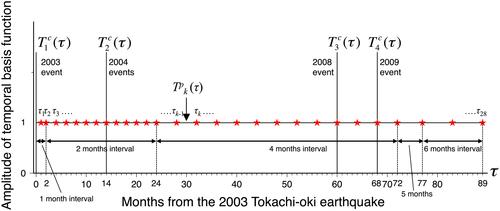
Preseismic, coseismic, and 7.5 years of postseismic deformation of the 2003 Mw 8.0 Tokachi-oki earthquake are modeled using land Global Navigation Satellite System (GNSS) data and two ocean bottom pressure gauges (OBP) using viscoelastic Green's functions. The postseismic slip distribution is shown to not overlap with the main shock or the source regions of past large earthquakes along the southern part of the Kurile trench. The preseismic locking is estimated in the coseismic and postseismic slip regions using the same plate interface geometry. The temporal evolution of the postseismic slip is described with a single logarithmic function. The slip is shown to decay faster updip of the coseismic slip region compared to the downdip extension. Sustained postseismic slip indicates that the interplate locking in the postseismic slip region had not fully recovered to the pre-2003 status in the 7.5 year analyzed period. Postseismic slip history also indicates rapid recovery of locking in the coseismic slip region. We examined the constraint of the OBP time series for the postseismic deformation modeling and found that the observed uplift at the OBP sites requires small postseismic slip near the trench, where a tsunamigenic M9 earthquake occurred in the seventeenth century. Uplift at the OBP sites does not constrain the absolute slip magnitude between the updip and downdip sides of the OBP sites but requires the slip in the updip side to be smaller than that in the downdip side. Our model describes transient postseismic deformation observed by both land GNSS and OBP.
期刊介绍:
The Journal of Geophysical Research: Solid Earth serves as the premier publication for the breadth of solid Earth geophysics including (in alphabetical order): electromagnetic methods; exploration geophysics; geodesy and gravity; geodynamics, rheology, and plate kinematics; geomagnetism and paleomagnetism; hydrogeophysics; Instruments, techniques, and models; solid Earth interactions with the cryosphere, atmosphere, oceans, and climate; marine geology and geophysics; natural and anthropogenic hazards; near surface geophysics; petrology, geochemistry, and mineralogy; planet Earth physics and chemistry; rock mechanics and deformation; seismology; tectonophysics; and volcanology.
JGR: Solid Earth has long distinguished itself as the venue for publication of Research Articles backed solidly by data and as well as presenting theoretical and numerical developments with broad applications. Research Articles published in JGR: Solid Earth have had long-term impacts in their fields.
JGR: Solid Earth provides a venue for special issues and special themes based on conferences, workshops, and community initiatives. JGR: Solid Earth also publishes Commentaries on research and emerging trends in the field; these are commissioned by the editors, and suggestion are welcome.



 京公网安备 11010802042870号
京ICP备2023020795号-1
京公网安备 11010802042870号
京ICP备2023020795号-1

 分享
分享
 求助内容:
求助内容: 应助结果提醒方式:
 扫码关注我们
