What do Consumers Read About Meat? An Analysis of Media Representations of the Meat-environment Relationship Found in Popular Online News Sites in the UK.
{"title":"What do Consumers Read About Meat? An Analysis of Media Representations of the Meat-environment Relationship Found in Popular Online News Sites in the UK.","authors":"Gilly Mroz, James Painter","doi":"10.1080/17524032.2022.2072929","DOIUrl":null,"url":null,"abstract":"<p><p>Previous scholarship suggests that elite media have tended to pay little attention to the adverse environmental impacts associated with meat consumption and production. Through content analysis of 116 articles from 2019, published on eight popular online news sites consumed by a wide range of demographics in the UK, including lower-income groups (the sector most likely to eat meat), we identify common anti-meat and pro-meat environmental narratives, solutions and recommendations, and the dominant sentiment towards both meat consumption and production. We observed a significantly greater presence of anti-meat consumption and/or production narratives than pro-meat. Over half the articles showed anti-meat consumption sentiment, with only 5% predominately in favour. 10% were against unspecified or industrial production practices, 28% were against industrial-scale farming but supported sustainable methods; and none were entirely in favour of the meat industry. These findings are reflected in the dominant recommendation, present in over 60% of articles, to eat less meat. Our results add substantially to previous media research, particularly showing the increased volume of coverage of the meat-environment nexus, varying levels of contestation around meat eating, and the division of responsibility between consumers and industry.</p>","PeriodicalId":374,"journal":{"name":"Journal of Organometallic Chemistry","volume":"67 1","pages":"947-964"},"PeriodicalIF":2.1000,"publicationDate":"2022-10-03","publicationTypes":"Journal Article","fieldsOfStudy":null,"isOpenAccess":false,"openAccessPdf":"https://www.ncbi.nlm.nih.gov/pmc/articles/PMC10721226/pdf/","citationCount":"0","resultStr":null,"platform":"Semanticscholar","paperid":null,"PeriodicalName":"Journal of Organometallic Chemistry","FirstCategoryId":"90","ListUrlMain":"https://doi.org/10.1080/17524032.2022.2072929","RegionNum":3,"RegionCategory":"化学","ArticlePicture":[],"TitleCN":null,"AbstractTextCN":null,"PMCID":null,"EPubDate":"2023/1/1 0:00:00","PubModel":"eCollection","JCR":"Q3","JCRName":"CHEMISTRY, INORGANIC & NUCLEAR","Score":null,"Total":0}
引用次数: 0
Abstract
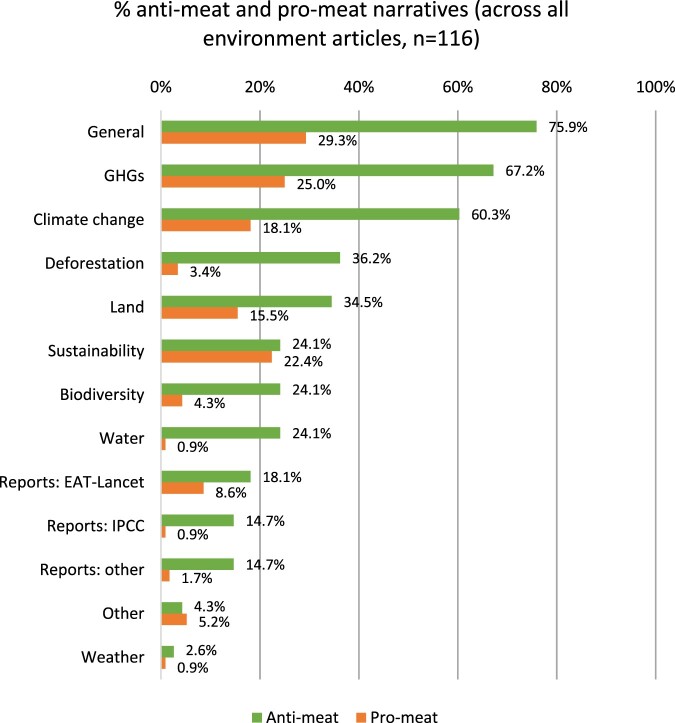
Previous scholarship suggests that elite media have tended to pay little attention to the adverse environmental impacts associated with meat consumption and production. Through content analysis of 116 articles from 2019, published on eight popular online news sites consumed by a wide range of demographics in the UK, including lower-income groups (the sector most likely to eat meat), we identify common anti-meat and pro-meat environmental narratives, solutions and recommendations, and the dominant sentiment towards both meat consumption and production. We observed a significantly greater presence of anti-meat consumption and/or production narratives than pro-meat. Over half the articles showed anti-meat consumption sentiment, with only 5% predominately in favour. 10% were against unspecified or industrial production practices, 28% were against industrial-scale farming but supported sustainable methods; and none were entirely in favour of the meat industry. These findings are reflected in the dominant recommendation, present in over 60% of articles, to eat less meat. Our results add substantially to previous media research, particularly showing the increased volume of coverage of the meat-environment nexus, varying levels of contestation around meat eating, and the division of responsibility between consumers and industry.
期刊介绍:
The Journal of Organometallic Chemistry targets original papers dealing with theoretical aspects, structural chemistry, synthesis, physical and chemical properties (including reaction mechanisms), and practical applications of organometallic compounds.
Organometallic compounds are defined as compounds that contain metal - carbon bonds. The term metal includes all alkali and alkaline earth metals, all transition metals and the lanthanides and actinides in the Periodic Table. Metalloids including the elements in Group 13 and the heavier members of the Groups 14 - 16 are also included. The term chemistry includes syntheses, characterizations and reaction chemistry of all such compounds. Research reports based on use of organometallic complexes in bioorganometallic chemistry, medicine, material sciences, homogeneous catalysis and energy conversion are also welcome.
The scope of the journal has been enlarged to encompass important research on organometallic complexes in bioorganometallic chemistry and material sciences, and of heavier main group elements in organometallic chemistry. The journal also publishes review articles, short communications and notes.




 京公网安备 11010802042870号
京ICP备2023020795号-1
京公网安备 11010802042870号
京ICP备2023020795号-1

 分享
分享
 求助内容:
求助内容: 应助结果提醒方式:
 扫码关注我们
