{"title":"Endoplasmic reticulum-unfolded protein response pathway modulates the cellular response to mitochondrial proteotoxic stress","authors":"Rajasri Sarkar , Kannan Boosi Narayana Rao , Mainak Pratim Jha , Koyeli Mapa","doi":"10.1007/s12192-022-01264-2","DOIUrl":null,"url":null,"abstract":"<div><div>Mitochondria and endoplasmic reticulum (ER) remain closely tethered by contact sites to maintain unhindered biosynthetic, metabolic, and signalling functions. Apart from its constituent proteins, contact sites localize ER-unfolded protein response (UPR) sensors like Ire1 and PERK, indicating the importance of ER-mitochondria communication during stress. In the mitochondrial sub-compartment-specific proteotoxic model of yeast, <em>Saccharomyces cerevisiae</em>, we show that an intact ER-UPR pathway is important in stress tolerance of mitochondrial intermembrane space (IMS) proteotoxic stress, while disrupting the pathway is beneficial during matrix stress. Deletion of <em>IRE1</em> and <em>HAC1</em> leads to accumulation of misfolding-prone proteins in mitochondrial IMS indicating the importance of intact ER-UPR pathway in enduring mitochondrial IMS proteotoxic stresses. Although localized proteotoxic stress within mitochondrial IMS does not induce ER-UPR, its artificial activation helps cells to better withstand the IMS proteotoxicity. Furthermore, overexpression of individual components of ER-mitochondria contact sites is found to be beneficial for general mitochondrial proteotoxic stress, in an Ire1-Hac1-independent manner.</div></div>","PeriodicalId":9684,"journal":{"name":"Cell Stress & Chaperones","volume":"27 3","pages":"Pages 241-256"},"PeriodicalIF":3.2000,"publicationDate":"2022-05-01","publicationTypes":"Journal Article","fieldsOfStudy":null,"isOpenAccess":false,"openAccessPdf":"https://www.ncbi.nlm.nih.gov/pmc/articles/PMC9106787/pdf/","citationCount":"0","resultStr":null,"platform":"Semanticscholar","paperid":null,"PeriodicalName":"Cell Stress & Chaperones","FirstCategoryId":"99","ListUrlMain":"https://www.sciencedirect.com/science/article/pii/S1355814523001001","RegionNum":3,"RegionCategory":"生物学","ArticlePicture":[],"TitleCN":null,"AbstractTextCN":null,"PMCID":null,"EPubDate":"","PubModel":"","JCR":"Q3","JCRName":"CELL BIOLOGY","Score":null,"Total":0}
引用次数: 0
Abstract
Mitochondria and endoplasmic reticulum (ER) remain closely tethered by contact sites to maintain unhindered biosynthetic, metabolic, and signalling functions. Apart from its constituent proteins, contact sites localize ER-unfolded protein response (UPR) sensors like Ire1 and PERK, indicating the importance of ER-mitochondria communication during stress. In the mitochondrial sub-compartment-specific proteotoxic model of yeast, Saccharomyces cerevisiae, we show that an intact ER-UPR pathway is important in stress tolerance of mitochondrial intermembrane space (IMS) proteotoxic stress, while disrupting the pathway is beneficial during matrix stress. Deletion of IRE1 and HAC1 leads to accumulation of misfolding-prone proteins in mitochondrial IMS indicating the importance of intact ER-UPR pathway in enduring mitochondrial IMS proteotoxic stresses. Although localized proteotoxic stress within mitochondrial IMS does not induce ER-UPR, its artificial activation helps cells to better withstand the IMS proteotoxicity. Furthermore, overexpression of individual components of ER-mitochondria contact sites is found to be beneficial for general mitochondrial proteotoxic stress, in an Ire1-Hac1-independent manner.
期刊介绍:
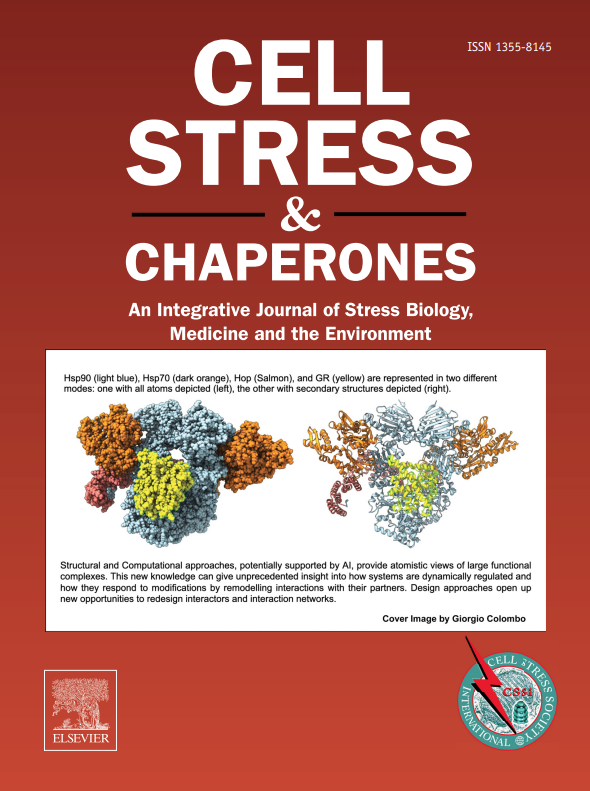
Cell Stress and Chaperones is an integrative journal that bridges the gap between laboratory model systems and natural populations. The journal captures the eclectic spirit of the cellular stress response field in a single, concentrated source of current information. Major emphasis is placed on the effects of climate change on individual species in the natural environment and their capacity to adapt. This emphasis expands our focus on stress biology and medicine by linking climate change effects to research on cellular stress responses of animals, micro-organisms and plants.



 京公网安备 11010802042870号
京ICP备2023020795号-1
京公网安备 11010802042870号
京ICP备2023020795号-1

 分享
分享
 求助内容:
求助内容: 应助结果提醒方式:
 扫码关注我们
