{"title":"The human physiological impact of global deoxygenation.","authors":"Daniel Martin, Helen McKenna, Valerie Livina","doi":"10.1007/s12576-016-0501-0","DOIUrl":null,"url":null,"abstract":"<p><p>There has been a clear decline in the volume of oxygen in Earth's atmosphere over the past 20 years. Although the magnitude of this decrease appears small compared to the amount of oxygen in the atmosphere, it is difficult to predict how this process may evolve, due to the brevity of the collected records. A recently proposed model predicts a non-linear decay, which would result in an increasingly rapid fall-off in atmospheric oxygen concentration, with potentially devastating consequences for human health. We discuss the impact that global deoxygenation, over hundreds of generations, might have on human physiology. Exploring the changes between different native high-altitude populations provides a paradigm of how humans might tolerate worsening hypoxia over time. Using this model of atmospheric change, we predict that humans may continue to survive in an unprotected atmosphere for ~3600 years. Accordingly, without dramatic changes to the way in which we interact with our planet, humans may lose their dominance on Earth during the next few millennia.</p>","PeriodicalId":22836,"journal":{"name":"The Journal of Physiological Sciences","volume":"40 1","pages":"97-106"},"PeriodicalIF":0.0000,"publicationDate":"2017-01-01","publicationTypes":"Journal Article","fieldsOfStudy":null,"isOpenAccess":false,"openAccessPdf":"https://www.ncbi.nlm.nih.gov/pmc/articles/PMC5138252/pdf/","citationCount":"0","resultStr":null,"platform":"Semanticscholar","paperid":null,"PeriodicalName":"The Journal of Physiological Sciences","FirstCategoryId":"1085","ListUrlMain":"https://doi.org/10.1007/s12576-016-0501-0","RegionNum":0,"RegionCategory":null,"ArticlePicture":[],"TitleCN":null,"AbstractTextCN":null,"PMCID":null,"EPubDate":"2016/11/15 0:00:00","PubModel":"Epub","JCR":"","JCRName":"","Score":null,"Total":0}
引用次数: 0
Abstract
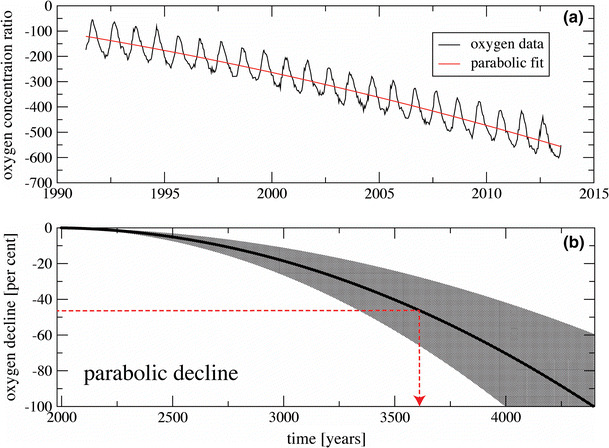
There has been a clear decline in the volume of oxygen in Earth's atmosphere over the past 20 years. Although the magnitude of this decrease appears small compared to the amount of oxygen in the atmosphere, it is difficult to predict how this process may evolve, due to the brevity of the collected records. A recently proposed model predicts a non-linear decay, which would result in an increasingly rapid fall-off in atmospheric oxygen concentration, with potentially devastating consequences for human health. We discuss the impact that global deoxygenation, over hundreds of generations, might have on human physiology. Exploring the changes between different native high-altitude populations provides a paradigm of how humans might tolerate worsening hypoxia over time. Using this model of atmospheric change, we predict that humans may continue to survive in an unprotected atmosphere for ~3600 years. Accordingly, without dramatic changes to the way in which we interact with our planet, humans may lose their dominance on Earth during the next few millennia.



 京公网安备 11010802042870号
京ICP备2023020795号-1
京公网安备 11010802042870号
京ICP备2023020795号-1

 分享
分享

 求助内容:
求助内容: 应助结果提醒方式:
 扫码关注我们
