Photosynthetic response dynamics in the invasive species Tithonia diversifolia and two co-occurring native shrub species under fluctuating light conditions.
{"title":"Photosynthetic response dynamics in the invasive species <i>Tithonia diversifolia</i> and two co-occurring native shrub species under fluctuating light conditions.","authors":"Ju Li, Shu-Bin Zhang, Yang-Ping Li","doi":"10.1016/j.pld.2023.04.001","DOIUrl":null,"url":null,"abstract":"<p><p>To determine the invasiveness of invasive plants, many studies have compared photosynthetic traits or strategies between invasive and native species. However, few studies have compared the photosynthetic dynamics between invasive and native species during light fluctuations. We compared photosynthetic induction, relaxation dynamics and leaf traits between the invasive species, <i>Tithonia diversifolia</i> and two native species, <i>Clerodendrum bungei</i> and <i>Blumea balsamifera</i>, in full-sun and shady habitats. The photosynthetic dynamics and leaf traits differed among species. <i>T. diversifolia</i> showed a slower induction speed and stomatal opening response but had higher average intrinsic water-use efficiency than the two native species in full-sun habitats. Thus, the slow induction response may be attributed to the longer stomatal length in <i>T. diversifolia</i>. Habitat had a significant effect on photosynthetic dynamics in <i>T. diversifolia</i> and <i>B. balsamifera</i> but not in <i>C. bungei</i>. In shady habitat, <i>T. diversifolia</i> had a faster photosynthetic induction response than in full-sun habitat, leading to a higher average stomatal conductance during photosynthetic induction in <i>T. diversifolia</i> than in the two native species. In contrast, <i>B. balsamifera</i> had a larger stomatal length and slower photosynthetic induction and relaxation response in shady habitat than in full-sun habitat, resulting in higher carbon gain during photosynthetic relaxation. Nevertheless, in both habitats, <i>T. diversifolia</i> had an overall higher carbon gain during light fluctuations than the two native species. Our results indicated that <i>T. diversifolia</i> can adopt more effective response strategies under fluctuating light environments to maximize carbon gain, which may contribute to its successful invasion.</p>","PeriodicalId":368,"journal":{"name":"Journal of Membrane Science","volume":"2 1","pages":"265-273"},"PeriodicalIF":9.0000,"publicationDate":"2023-04-25","publicationTypes":"Journal Article","fieldsOfStudy":null,"isOpenAccess":false,"openAccessPdf":"https://www.ncbi.nlm.nih.gov/pmc/articles/PMC11128914/pdf/","citationCount":"0","resultStr":null,"platform":"Semanticscholar","paperid":null,"PeriodicalName":"Journal of Membrane Science","FirstCategoryId":"99","ListUrlMain":"https://doi.org/10.1016/j.pld.2023.04.001","RegionNum":1,"RegionCategory":"工程技术","ArticlePicture":[],"TitleCN":null,"AbstractTextCN":null,"PMCID":null,"EPubDate":"2024/3/1 0:00:00","PubModel":"eCollection","JCR":"Q1","JCRName":"ENGINEERING, CHEMICAL","Score":null,"Total":0}
引用次数: 0
Abstract
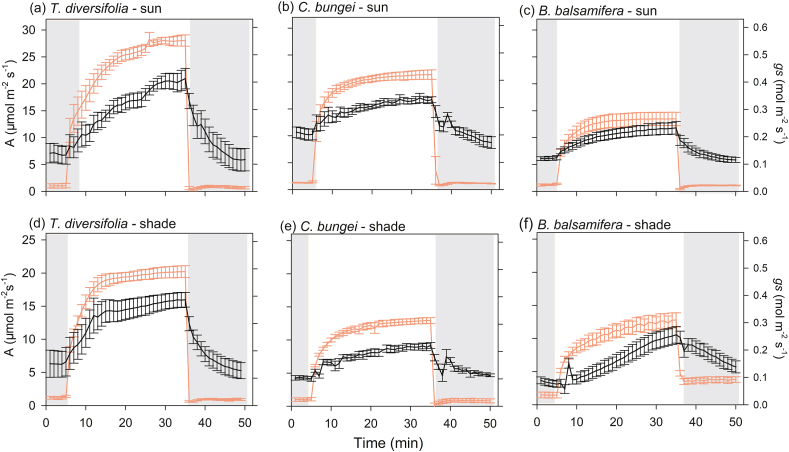
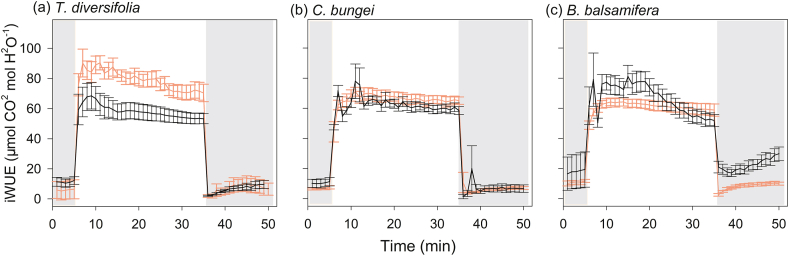
To determine the invasiveness of invasive plants, many studies have compared photosynthetic traits or strategies between invasive and native species. However, few studies have compared the photosynthetic dynamics between invasive and native species during light fluctuations. We compared photosynthetic induction, relaxation dynamics and leaf traits between the invasive species, Tithonia diversifolia and two native species, Clerodendrum bungei and Blumea balsamifera, in full-sun and shady habitats. The photosynthetic dynamics and leaf traits differed among species. T. diversifolia showed a slower induction speed and stomatal opening response but had higher average intrinsic water-use efficiency than the two native species in full-sun habitats. Thus, the slow induction response may be attributed to the longer stomatal length in T. diversifolia. Habitat had a significant effect on photosynthetic dynamics in T. diversifolia and B. balsamifera but not in C. bungei. In shady habitat, T. diversifolia had a faster photosynthetic induction response than in full-sun habitat, leading to a higher average stomatal conductance during photosynthetic induction in T. diversifolia than in the two native species. In contrast, B. balsamifera had a larger stomatal length and slower photosynthetic induction and relaxation response in shady habitat than in full-sun habitat, resulting in higher carbon gain during photosynthetic relaxation. Nevertheless, in both habitats, T. diversifolia had an overall higher carbon gain during light fluctuations than the two native species. Our results indicated that T. diversifolia can adopt more effective response strategies under fluctuating light environments to maximize carbon gain, which may contribute to its successful invasion.
期刊介绍:
The Journal of Membrane Science is a publication that focuses on membrane systems and is aimed at academic and industrial chemists, chemical engineers, materials scientists, and membranologists. It publishes original research and reviews on various aspects of membrane transport, membrane formation/structure, fouling, module/process design, and processes/applications. The journal primarily focuses on the structure, function, and performance of non-biological membranes but also includes papers that relate to biological membranes. The Journal of Membrane Science publishes Full Text Papers, State-of-the-Art Reviews, Letters to the Editor, and Perspectives.




 京公网安备 11010802042870号
京ICP备2023020795号-1
京公网安备 11010802042870号
京ICP备2023020795号-1

 分享
分享
 求助内容:
求助内容: 应助结果提醒方式:
 扫码关注我们
