{"title":"Genetic Determination of Serum Levels of Diabetes-Associated Adipokines.","authors":"Dorit Schleinitz","doi":"10.1900/RDS.2015.12.277","DOIUrl":null,"url":null,"abstract":"<p><p>Adipose tissue secretes an abundance of proteins. Some of these proteins are known as adipokines and adipose-derived hormones which have been linked with metabolic disorders, including type 2 diabetes, and even with cancer. Variance in serum adipokine concentration is often closely associated with an increase (obesity) or decrease (lipodystrophy) in fat tissue mass, and it is affected by age, gender, and localization of the adipose tissue. However, there may be genetic variants which, in consequence, influence the serum concentration of a certain adipokine, and thereby promote metabolic disturbances or, with regard to the \"protective\" allele, exert beneficial effects. This review focuses on the genetic determination of serum levels of the following adipokines: adiponectin, chemerin, leptin, progranulin, resistin, retinol binding protein 4, vaspin, adipsin, apelin, and omentin. The article reports on the latest findings from genome-wide association studies (GWAS) and candidate gene studies, showing variants located in/nearby the adipokine genes and other (non-receptor) genes. An extra chapter highlights adipokine-receptor variants. Epigenetic studies on adipokines are also addressed. </p>","PeriodicalId":50980,"journal":{"name":"Applied Mathematical Modelling","volume":"28 1","pages":"277-98"},"PeriodicalIF":4.4000,"publicationDate":"2015-09-01","publicationTypes":"Journal Article","fieldsOfStudy":null,"isOpenAccess":false,"openAccessPdf":"https://www.ncbi.nlm.nih.gov/pmc/articles/PMC5275755/pdf/","citationCount":"0","resultStr":null,"platform":"Semanticscholar","paperid":null,"PeriodicalName":"Applied Mathematical Modelling","FirstCategoryId":"1085","ListUrlMain":"https://doi.org/10.1900/RDS.2015.12.277","RegionNum":2,"RegionCategory":"工程技术","ArticlePicture":[],"TitleCN":null,"AbstractTextCN":null,"PMCID":null,"EPubDate":"2016/1/28 0:00:00","PubModel":"Epub","JCR":"Q1","JCRName":"ENGINEERING, MULTIDISCIPLINARY","Score":null,"Total":0}
引用次数: 0
Abstract
Adipose tissue secretes an abundance of proteins. Some of these proteins are known as adipokines and adipose-derived hormones which have been linked with metabolic disorders, including type 2 diabetes, and even with cancer. Variance in serum adipokine concentration is often closely associated with an increase (obesity) or decrease (lipodystrophy) in fat tissue mass, and it is affected by age, gender, and localization of the adipose tissue. However, there may be genetic variants which, in consequence, influence the serum concentration of a certain adipokine, and thereby promote metabolic disturbances or, with regard to the "protective" allele, exert beneficial effects. This review focuses on the genetic determination of serum levels of the following adipokines: adiponectin, chemerin, leptin, progranulin, resistin, retinol binding protein 4, vaspin, adipsin, apelin, and omentin. The article reports on the latest findings from genome-wide association studies (GWAS) and candidate gene studies, showing variants located in/nearby the adipokine genes and other (non-receptor) genes. An extra chapter highlights adipokine-receptor variants. Epigenetic studies on adipokines are also addressed.
期刊介绍:
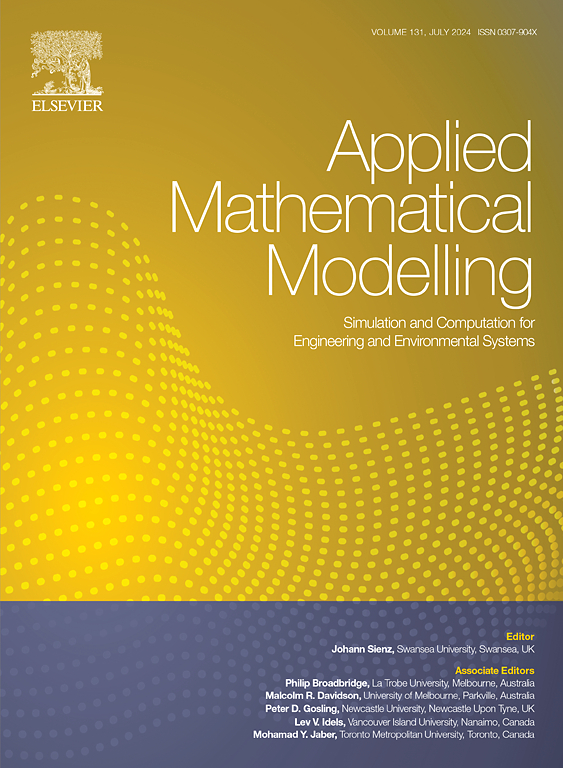
Applied Mathematical Modelling focuses on research related to the mathematical modelling of engineering and environmental processes, manufacturing, and industrial systems. A significant emerging area of research activity involves multiphysics processes, and contributions in this area are particularly encouraged.
This influential publication covers a wide spectrum of subjects including heat transfer, fluid mechanics, CFD, and transport phenomena; solid mechanics and mechanics of metals; electromagnets and MHD; reliability modelling and system optimization; finite volume, finite element, and boundary element procedures; modelling of inventory, industrial, manufacturing and logistics systems for viable decision making; civil engineering systems and structures; mineral and energy resources; relevant software engineering issues associated with CAD and CAE; and materials and metallurgical engineering.
Applied Mathematical Modelling is primarily interested in papers developing increased insights into real-world problems through novel mathematical modelling, novel applications or a combination of these. Papers employing existing numerical techniques must demonstrate sufficient novelty in the solution of practical problems. Papers on fuzzy logic in decision-making or purely financial mathematics are normally not considered. Research on fractional differential equations, bifurcation, and numerical methods needs to include practical examples. Population dynamics must solve realistic scenarios. Papers in the area of logistics and business modelling should demonstrate meaningful managerial insight. Submissions with no real-world application will not be considered.



 京公网安备 11010802042870号
京ICP备2023020795号-1
京公网安备 11010802042870号
京ICP备2023020795号-1

 分享
分享
 求助内容:
求助内容: 应助结果提醒方式:
 扫码关注我们
