{"title":"Solving Geophysical Inversion Problems with Intractable Likelihoods: Linearized Gaussian Approximations Versus the Correlated Pseudo-marginal Method.","authors":"Lea Friedli, Niklas Linde","doi":"10.1007/s11004-023-10064-y","DOIUrl":null,"url":null,"abstract":"<p><p>A geophysical Bayesian inversion problem may target the posterior distribution of geological or hydrogeological parameters given geophysical data. To account for the scatter in the petrophysical relationship linking the target parameters to the geophysical properties, this study treats the intermediate geophysical properties as latent (unobservable) variables. To perform inversion in such a latent variable model, the intractable likelihood function of the (hydro)geological parameters given the geophysical data needs to be estimated. This can be achieved by approximation with a Gaussian probability density function based on local linearization of the geophysical forward operator, thereby, accounting for the noise in the petrophysical relationship by a corresponding addition to the data covariance matrix. The new approximate method is compared against the general correlated pseudo-marginal method, which estimates the likelihood by Monte Carlo averaging over samples of the latent variable. First, the performances of the two methods are tested on a synthetic test example, in which a multivariate Gaussian porosity field is inferred using crosshole ground-penetrating radar first-arrival travel times. For this example with rather small petrophysical uncertainty, the two methods provide near-identical estimates, while an inversion that ignores petrophysical uncertainty leads to biased estimates. The results of a sensitivity analysis are then used to suggest that the linearized Gaussian approach, while attractive due to its relative computational speed, suffers from a decreasing accuracy with increasing scatter in the petrophysical relationship. The computationally more expensive correlated pseudo-marginal method performs very well even for settings with high petrophysical uncertainty.</p>","PeriodicalId":18787,"journal":{"name":"Nature","volume":"75 1","pages":"55-75"},"PeriodicalIF":48.5000,"publicationDate":"2024-01-01","publicationTypes":"Journal Article","fieldsOfStudy":null,"isOpenAccess":false,"openAccessPdf":"https://www.ncbi.nlm.nih.gov/pmc/articles/PMC10817994/pdf/","citationCount":"0","resultStr":null,"platform":"Semanticscholar","paperid":null,"PeriodicalName":"Nature","FirstCategoryId":"89","ListUrlMain":"https://doi.org/10.1007/s11004-023-10064-y","RegionNum":1,"RegionCategory":"综合性期刊","ArticlePicture":[],"TitleCN":null,"AbstractTextCN":null,"PMCID":null,"EPubDate":"2023/6/2 0:00:00","PubModel":"Epub","JCR":"Q1","JCRName":"MULTIDISCIPLINARY SCIENCES","Score":null,"Total":0}
引用次数: 0
Abstract
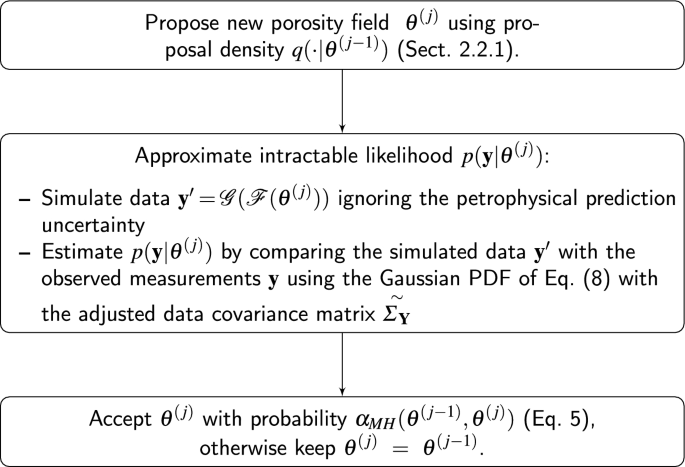
A geophysical Bayesian inversion problem may target the posterior distribution of geological or hydrogeological parameters given geophysical data. To account for the scatter in the petrophysical relationship linking the target parameters to the geophysical properties, this study treats the intermediate geophysical properties as latent (unobservable) variables. To perform inversion in such a latent variable model, the intractable likelihood function of the (hydro)geological parameters given the geophysical data needs to be estimated. This can be achieved by approximation with a Gaussian probability density function based on local linearization of the geophysical forward operator, thereby, accounting for the noise in the petrophysical relationship by a corresponding addition to the data covariance matrix. The new approximate method is compared against the general correlated pseudo-marginal method, which estimates the likelihood by Monte Carlo averaging over samples of the latent variable. First, the performances of the two methods are tested on a synthetic test example, in which a multivariate Gaussian porosity field is inferred using crosshole ground-penetrating radar first-arrival travel times. For this example with rather small petrophysical uncertainty, the two methods provide near-identical estimates, while an inversion that ignores petrophysical uncertainty leads to biased estimates. The results of a sensitivity analysis are then used to suggest that the linearized Gaussian approach, while attractive due to its relative computational speed, suffers from a decreasing accuracy with increasing scatter in the petrophysical relationship. The computationally more expensive correlated pseudo-marginal method performs very well even for settings with high petrophysical uncertainty.
期刊介绍:
Nature is a prestigious international journal that publishes peer-reviewed research in various scientific and technological fields. The selection of articles is based on criteria such as originality, importance, interdisciplinary relevance, timeliness, accessibility, elegance, and surprising conclusions. In addition to showcasing significant scientific advances, Nature delivers rapid, authoritative, insightful news, and interpretation of current and upcoming trends impacting science, scientists, and the broader public. The journal serves a dual purpose: firstly, to promptly share noteworthy scientific advances and foster discussions among scientists, and secondly, to ensure the swift dissemination of scientific results globally, emphasizing their significance for knowledge, culture, and daily life.




 京公网安备 11010802042870号
京ICP备2023020795号-1
京公网安备 11010802042870号
京ICP备2023020795号-1

 分享
分享
 求助内容:
求助内容: 应助结果提醒方式:
 扫码关注我们
