Kheng Yong Ong, Elise Yap, Yvonne May Fen Chia, Hung Yong Tay, Peter Ting, Sui Yung Chan, Yu Heng Kwan
{"title":"Impact of Community-Based Cardiac Rehabilitation on Clinical Parameters of Patients with Cardiovascular Diseases.","authors":"Kheng Yong Ong, Elise Yap, Yvonne May Fen Chia, Hung Yong Tay, Peter Ting, Sui Yung Chan, Yu Heng Kwan","doi":"10.7603/s40602-016-0005-4","DOIUrl":null,"url":null,"abstract":"<p><strong>Background: </strong>Cardiac rehabilitation (CR) programmes have been shown to improve patient outcomes, but vary widely in their components. The impact of Singapore's CR programme on clinical outcomes is currently not known.</p><p><strong>Objective: </strong>To evaluate the effects of a community-based CR programme on important clinical parameters in patients with cardiovascular disease in Singapore.</p><p><strong>Method: </strong>A retrospective cohort study was conducted. Cardiovascular patients who had completed a hospital-based CR programme were included. Patients who continued with community-based CR (n = 94) during the period of 2009-2013 were compared with patients who received regular care (n = 157). Changes in clinical and physical examination parameters between baseline and one-year post follow-up were analyzed. Within-group differences were compared using the paired t-test, while multivariate linear regression was used to compare the changes in the various parameters between the intervention and control groups. The primary outcome measure was low density lipoprotein (LDL) levels.</p><p><strong>Results: </strong>Patients in the intervention group had significant lowering of LDL (2.5 to 2.2 mmol/L, p<0.01), while the control group's LDL increased (2.2 to 2.4 mmol/L, p<0.01). The intervention group had greater improvements in LDL (-0.3 vs. +0.2 mmol/L, p<0.01), triglycerides (-0.1 vs. +0.1 mmol/L, p=0.01), total cholesterol (-0.3 vs. +0.3 mmol/L, p<0.01), fasting blood glucose (-0.5 vs. +0.3 mmol/L, p<0.01), systolic blood pressure (-3.2 vs. +5 mmHg, p<0.01) and diastolic blood pressure (-2.6 vs. +2.8 mmHg, p<0.01).</p><p><strong>Conclusion: </strong>The community-based CR programme in Singapore is associated with improvements in several cardiovascular clinical parameters and may be of benefit to cardiovascular patients.</p>","PeriodicalId":11556,"journal":{"name":"Electronics Letters","volume":"18 1","pages":"5"},"PeriodicalIF":0.8000,"publicationDate":"2016-10-13","publicationTypes":"Journal Article","fieldsOfStudy":null,"isOpenAccess":false,"openAccessPdf":"https://www.ncbi.nlm.nih.gov/pmc/articles/PMC5061824/pdf/","citationCount":"0","resultStr":null,"platform":"Semanticscholar","paperid":null,"PeriodicalName":"Electronics Letters","FirstCategoryId":"1085","ListUrlMain":"https://doi.org/10.7603/s40602-016-0005-4","RegionNum":4,"RegionCategory":"工程技术","ArticlePicture":[],"TitleCN":null,"AbstractTextCN":null,"PMCID":null,"EPubDate":"2016/10/1 0:00:00","PubModel":"eCollection","JCR":"Q4","JCRName":"ENGINEERING, ELECTRICAL & ELECTRONIC","Score":null,"Total":0}
引用次数: 0
Abstract
Background: Cardiac rehabilitation (CR) programmes have been shown to improve patient outcomes, but vary widely in their components. The impact of Singapore's CR programme on clinical outcomes is currently not known.
Objective: To evaluate the effects of a community-based CR programme on important clinical parameters in patients with cardiovascular disease in Singapore.
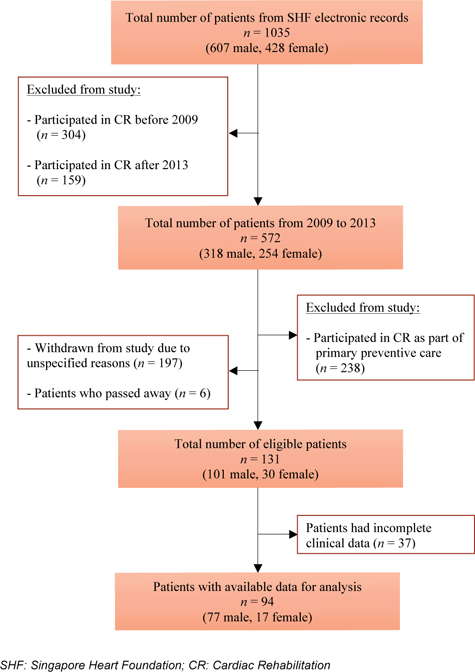
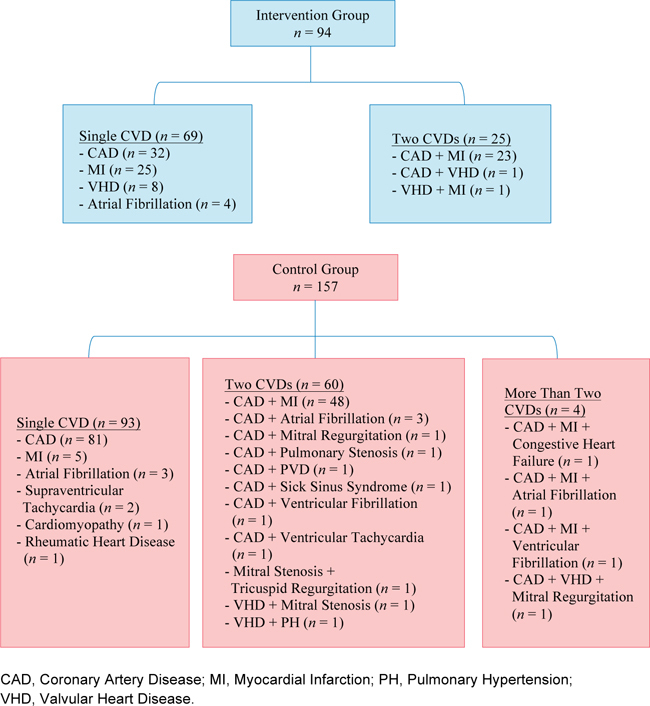
Method: A retrospective cohort study was conducted. Cardiovascular patients who had completed a hospital-based CR programme were included. Patients who continued with community-based CR (n = 94) during the period of 2009-2013 were compared with patients who received regular care (n = 157). Changes in clinical and physical examination parameters between baseline and one-year post follow-up were analyzed. Within-group differences were compared using the paired t-test, while multivariate linear regression was used to compare the changes in the various parameters between the intervention and control groups. The primary outcome measure was low density lipoprotein (LDL) levels.
Results: Patients in the intervention group had significant lowering of LDL (2.5 to 2.2 mmol/L, p<0.01), while the control group's LDL increased (2.2 to 2.4 mmol/L, p<0.01). The intervention group had greater improvements in LDL (-0.3 vs. +0.2 mmol/L, p<0.01), triglycerides (-0.1 vs. +0.1 mmol/L, p=0.01), total cholesterol (-0.3 vs. +0.3 mmol/L, p<0.01), fasting blood glucose (-0.5 vs. +0.3 mmol/L, p<0.01), systolic blood pressure (-3.2 vs. +5 mmHg, p<0.01) and diastolic blood pressure (-2.6 vs. +2.8 mmHg, p<0.01).
Conclusion: The community-based CR programme in Singapore is associated with improvements in several cardiovascular clinical parameters and may be of benefit to cardiovascular patients.
期刊介绍:
Electronics Letters is an internationally renowned peer-reviewed rapid-communication journal that publishes short original research papers every two weeks. Its broad and interdisciplinary scope covers the latest developments in all electronic engineering related fields including communication, biomedical, optical and device technologies. Electronics Letters also provides further insight into some of the latest developments through special features and interviews.
Scope
As a journal at the forefront of its field, Electronics Letters publishes papers covering all themes of electronic and electrical engineering. The major themes of the journal are listed below.
Antennas and Propagation
Biomedical and Bioinspired Technologies, Signal Processing and Applications
Control Engineering
Electromagnetism: Theory, Materials and Devices
Electronic Circuits and Systems
Image, Video and Vision Processing and Applications
Information, Computing and Communications
Instrumentation and Measurement
Microwave Technology
Optical Communications
Photonics and Opto-Electronics
Power Electronics, Energy and Sustainability
Radar, Sonar and Navigation
Semiconductor Technology
Signal Processing
MIMO





 京公网安备 11010802042870号
京ICP备2023020795号-1
京公网安备 11010802042870号
京ICP备2023020795号-1

 分享
分享
 求助内容:
求助内容: 应助结果提醒方式:
 扫码关注我们
