{"title":"Unveiling the physics underlying symmetry breaking of the actin cytoskeleton: An artificial cell-based approach.","authors":"Ryota Sakamoto, Yusuke T Maeda","doi":"10.2142/biophysico.bppb-v20.0032","DOIUrl":null,"url":null,"abstract":"<p><p>Single-cell behaviors cover many biological functions, such as cell division during morphogenesis and tissue metastasis, and cell migration during cancer cell invasion and immune cell responses. Symmetry breaking of the positioning of organelles and the cell shape are often associated with these biological functions. One of the main players in symmetry breaking at the cellular scale is the actin cytoskeleton, comprising actin filaments and myosin motors that generate contractile forces. However, because the self-organization of the actomyosin network is regulated by the biochemical signaling in cells, how the mechanical contraction of the actin cytoskeleton induces diverse self-organized behaviors and drives the cell-scale symmetry breaking remains unclear. In recent times, to understand the physical underpinnings of the symmetry breaking exhibited in the actin cytoskeleton, artificial cell models encapsulating the cytoplasmic actomyosin networks covered with lipid monolayers have been developed. By decoupling the actomyosin mechanics from the complex biochemical signaling within living cells, this system allows one to study the self-organization of actomyosin networks confined in cell-sized spaces. We review the recent developments in the physics of confined actomyosin networks and provide future perspectives on the artificial cell-based approach. This review article is an extended version of the Japanese article, The Physical Principle of Cell Migration Under Confinement: Artificial Cell-based Bottom-up Approach, published in SEIBUTSU BUTSURI Vol. 63, p. 163-164 (2023).</p>","PeriodicalId":18787,"journal":{"name":"Nature","volume":"165 1","pages":"e200032"},"PeriodicalIF":48.5000,"publicationDate":"2023-08-19","publicationTypes":"Journal Article","fieldsOfStudy":null,"isOpenAccess":false,"openAccessPdf":"https://www.ncbi.nlm.nih.gov/pmc/articles/PMC10728624/pdf/","citationCount":"0","resultStr":null,"platform":"Semanticscholar","paperid":null,"PeriodicalName":"Nature","FirstCategoryId":"1085","ListUrlMain":"https://doi.org/10.2142/biophysico.bppb-v20.0032","RegionNum":1,"RegionCategory":"综合性期刊","ArticlePicture":[],"TitleCN":null,"AbstractTextCN":null,"PMCID":null,"EPubDate":"2023/1/1 0:00:00","PubModel":"eCollection","JCR":"Q1","JCRName":"MULTIDISCIPLINARY SCIENCES","Score":null,"Total":0}
引用次数: 0
Abstract
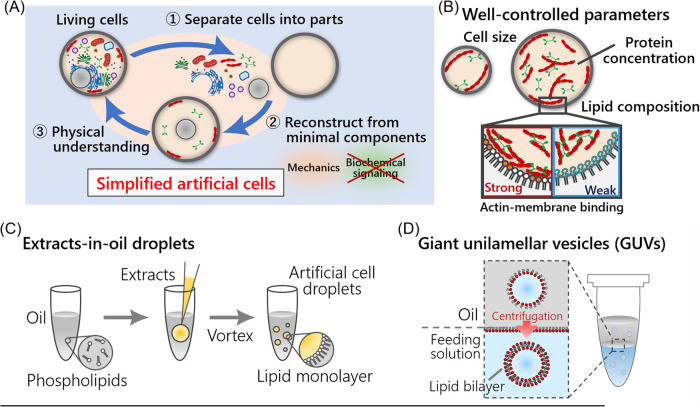
Single-cell behaviors cover many biological functions, such as cell division during morphogenesis and tissue metastasis, and cell migration during cancer cell invasion and immune cell responses. Symmetry breaking of the positioning of organelles and the cell shape are often associated with these biological functions. One of the main players in symmetry breaking at the cellular scale is the actin cytoskeleton, comprising actin filaments and myosin motors that generate contractile forces. However, because the self-organization of the actomyosin network is regulated by the biochemical signaling in cells, how the mechanical contraction of the actin cytoskeleton induces diverse self-organized behaviors and drives the cell-scale symmetry breaking remains unclear. In recent times, to understand the physical underpinnings of the symmetry breaking exhibited in the actin cytoskeleton, artificial cell models encapsulating the cytoplasmic actomyosin networks covered with lipid monolayers have been developed. By decoupling the actomyosin mechanics from the complex biochemical signaling within living cells, this system allows one to study the self-organization of actomyosin networks confined in cell-sized spaces. We review the recent developments in the physics of confined actomyosin networks and provide future perspectives on the artificial cell-based approach. This review article is an extended version of the Japanese article, The Physical Principle of Cell Migration Under Confinement: Artificial Cell-based Bottom-up Approach, published in SEIBUTSU BUTSURI Vol. 63, p. 163-164 (2023).
期刊介绍:
Nature is a prestigious international journal that publishes peer-reviewed research in various scientific and technological fields. The selection of articles is based on criteria such as originality, importance, interdisciplinary relevance, timeliness, accessibility, elegance, and surprising conclusions. In addition to showcasing significant scientific advances, Nature delivers rapid, authoritative, insightful news, and interpretation of current and upcoming trends impacting science, scientists, and the broader public. The journal serves a dual purpose: firstly, to promptly share noteworthy scientific advances and foster discussions among scientists, and secondly, to ensure the swift dissemination of scientific results globally, emphasizing their significance for knowledge, culture, and daily life.






 京公网安备 11010802042870号
京ICP备2023020795号-1
京公网安备 11010802042870号
京ICP备2023020795号-1

 分享
分享
 求助内容:
求助内容: 应助结果提醒方式:
 扫码关注我们
