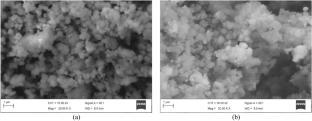
ZnO/Zeolite composite photocatalyst for dyes degradation

IF 3.674 4区 工程技术 Q1 Engineering Applied Nanoscience Pub Date : 2023-09-04 DOI:10.1007/s13204-023-02950-y
Khrystyna Hutsul, Iryna Ivanenko, Lyubov Patrylak, Olexandra Pertko, Dmytro Kamenskyh
{"title":"ZnO/Zeolite composite photocatalyst for dyes degradation","authors":"Khrystyna Hutsul,&nbsp;Iryna Ivanenko,&nbsp;Lyubov Patrylak,&nbsp;Olexandra Pertko,&nbsp;Dmytro Kamenskyh","doi":"10.1007/s13204-023-02950-y","DOIUrl":null,"url":null,"abstract":"<div><p>The ZnO/Zeolite composite was obtained by the method of deposition of zinc oxide on the surface of hydrogen form of the faujasite-type Zeolite Y that was impregnated with a hydrolysis product of zinc acetate precursor and calcinated at 300 °C for this. The deposition of zinc oxide covering the nanoparticles of the initial Zeolite was confirmed by SEM. The zinc oxide phase of the hexagonal syngony of the wurtzite type with a content of 20 wt. % in the synthesized ZnO/Zeolite composite was proved by XRD and XRF. The BET surface, the total, and the micropore volume of the initial Zeolite decreased, and the average pore size rose as a result of ZnO deposition. The centers with pKa = 9.45 which were OH<sup>−</sup> groups attached to the edge regions of the surface doubled after zinc oxide deposition on the Zeolite since ZnO nanoparticles tended to interact with the water molecule. That was the very reason for the advanced photocatalytic activity of ZnO/Zeolite composite toward the anionic dye. Congo red dye (8.0, 25.0, and 50.0 mg/L) was decolorized completely for only 1 min, but methylene blue dye (8.0 mg/L) decomposed incompletely even after 1 h of UV irradiation.</p></div>","PeriodicalId":471,"journal":{"name":"Applied Nanoscience","volume":"13 12","pages":"7601 - 7609"},"PeriodicalIF":3.6740,"publicationDate":"2023-09-04","publicationTypes":"Journal Article","fieldsOfStudy":null,"isOpenAccess":false,"openAccessPdf":"","citationCount":"0","resultStr":null,"platform":"Semanticscholar","paperid":null,"PeriodicalName":"Applied Nanoscience","FirstCategoryId":"5","ListUrlMain":"https://link.springer.com/article/10.1007/s13204-023-02950-y","RegionNum":4,"RegionCategory":"工程技术","ArticlePicture":[],"TitleCN":null,"AbstractTextCN":null,"PMCID":null,"EPubDate":"","PubModel":"","JCR":"Q1","JCRName":"Engineering","Score":null,"Total":0}
引用次数: 0

Abstract

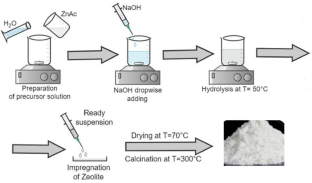
The ZnO/Zeolite composite was obtained by the method of deposition of zinc oxide on the surface of hydrogen form of the faujasite-type Zeolite Y that was impregnated with a hydrolysis product of zinc acetate precursor and calcinated at 300 °C for this. The deposition of zinc oxide covering the nanoparticles of the initial Zeolite was confirmed by SEM. The zinc oxide phase of the hexagonal syngony of the wurtzite type with a content of 20 wt. % in the synthesized ZnO/Zeolite composite was proved by XRD and XRF. The BET surface, the total, and the micropore volume of the initial Zeolite decreased, and the average pore size rose as a result of ZnO deposition. The centers with pKa = 9.45 which were OH groups attached to the edge regions of the surface doubled after zinc oxide deposition on the Zeolite since ZnO nanoparticles tended to interact with the water molecule. That was the very reason for the advanced photocatalytic activity of ZnO/Zeolite composite toward the anionic dye. Congo red dye (8.0, 25.0, and 50.0 mg/L) was decolorized completely for only 1 min, but methylene blue dye (8.0 mg/L) decomposed incompletely even after 1 h of UV irradiation.
Abstract Image

Abstract Image

查看原文
分享 分享
微信好友 朋友圈 QQ好友 复制链接
本刊更多论文
用于染料降解的氧化锌/沸石复合光催化剂
氧化锌/沸石复合材料是通过在用醋酸锌前驱体的水解产物浸渍并在 300 ℃ 煅烧的氢型芒硝型沸石 Y 表面沉积氧化锌的方法获得的。扫描电子显微镜证实了覆盖在初始沸石纳米颗粒上的氧化锌沉积。XRD 和 XRF 证实,在合成的氧化锌/沸石复合材料中,氧化锌的含量为 20 wt.由于 ZnO 的沉积,初始沸石的 BET 表面、总量和微孔体积都有所下降,而平均孔径则有所增大。在沸石上沉积氧化锌后,表面边缘区域附着的 pKa = 9.45 的中心(即 OH- 基团)增加了一倍,因为氧化锌纳米颗粒倾向于与水分子相互作用。这就是氧化锌/沸石复合材料对阴离子染料具有较高光催化活性的根本原因。刚果红染料(8.0、25.0 和 50.0 mg/L)仅在 1 分钟内就被完全脱色,但亚甲基蓝染料(8.0 mg/L)即使在紫外线照射 1 小时后也不能完全分解。
本文章由计算机程序翻译,如有差异,请以英文原文为准。
求助全文
约1分钟内获得全文 去求助
来源期刊
Applied Nanoscience
Applied Nanoscience Materials Science-Materials Science (miscellaneous)
CiteScore
7.10
自引率
0.00%
发文量
430
期刊介绍: Applied Nanoscience is a hybrid journal that publishes original articles about state of the art nanoscience and the application of emerging nanotechnologies to areas fundamental to building technologically advanced and sustainable civilization, including areas as diverse as water science, advanced materials, energy, electronics, environmental science and medicine. The journal accepts original and review articles as well as book reviews for publication. All the manuscripts are single-blind peer-reviewed for scientific quality and acceptance.
期刊最新文献
Study of structural, optical, and dielectric properties of Gd3⁺ doped Mn-Cd nanoferrites and applications Modified Zinc Oxide Nanoparticles (ZnO NPs) for termites’ control Innovative use of commercial wipes as a template for the synthesis of ZnO and CuO nanoparticles via combustion method for antibacterial applications "Development and evaluation of nanocarriers loaded with acacia catechu for the management of dextran sulfate-induced crohn’s disease" Graphite nanopowder-enhanced curcumin-chitosan-aloe vera nanocomposite as a green multifunctional platform for anti inflammatory and liver cancer therapy
×
引用
GB/T 7714-2015
复制
MLA
复制
APA
复制
导出至
BibTeX EndNote RefMan NoteFirst NoteExpress
×
×
提示
您的信息不完整,为了账户安全,请先补充。
现在去补充
×
提示
您因"违规操作"
具体请查看互助需知
我知道了
×
提示
现在去查看 取消
×
提示
确定
0
微信
客服QQ
Book学术公众号 扫码关注我们
反馈
×
意见反馈
请填写您的意见或建议
请填写您的手机或邮箱
已复制链接
已复制链接
快去分享给好友吧!
我知道了
×
扫码分享
扫码分享
Book学术官方微信
Book学术文献互助
Book学术文献互助群
群 号:604180095
Book学术
文献互助 智能选刊 最新文献 互助须知 联系我们:info@booksci.cn
Book学术提供免费学术资源搜索服务,方便国内外学者检索中英文文献。致力于提供最便捷和优质的服务体验。
Copyright © 2023 Book学术 All rights reserved.
ghs 京公网安备 11010802042870号 京ICP备2023020795号-1