Photocatalytic degradation of naproxen by Bi2MoO6/g-C3N4 heterojunction photocatalyst under visible light: Mechanisms, degradation pathway, and DFT calculation
Kun Fu , Yishuai Pan , Chao Ding , Jun Shi , Huiping Deng
{"title":"Photocatalytic degradation of naproxen by Bi2MoO6/g-C3N4 heterojunction photocatalyst under visible light: Mechanisms, degradation pathway, and DFT calculation","authors":"Kun Fu , Yishuai Pan , Chao Ding , Jun Shi , Huiping Deng","doi":"10.1016/j.jphotochem.2021.113235","DOIUrl":null,"url":null,"abstract":"<div><p>In this research, a 2D/2D Bi<sub>2</sub>MoO<sub>6</sub>/g-C<sub>3</sub>N<sub>4</sub> heterojunction photocatalyst, which can be driven by visible light, was fabricated through a hydrothermal coprecipitation method. Naproxen was used as the target organic contaminant to evaluate the photocatalytic performance of Bi<sub>2</sub>MoO<sub>6</sub>/g-C<sub>3</sub>N<sub>4</sub>. The composite photocatalyst showed promoted photocatalytic activity, among which BMO/CN50−50 with a mass ratio 50/50 exhibited the fastest degradation rate, the degradation rate was 3.9 and 2.5 times higher than that of g-C<sub>3</sub>N<sub>4</sub> and Bi<sub>2</sub>MoO<sub>6</sub>, respectively. Scavenger experiments and EPR measurements demonstrated that hole (h<sup>+</sup>) and superoxide radical (<sup><img></sup>O<sub>2</sub><sup>−</sup>) play a leading role in the degradation reactions. Moreover, the degradation pathway was suggested in the light of identified intermediates by Liquid Chromatography-Mass Spectrometry (LC–MS/MS) and DFT analysis. Furthermore, the Quantitative Structure-Activity Relationship (QSAR) analysis was used to evaluate the toxicity of identified degradation intermediates.</p></div>","PeriodicalId":16782,"journal":{"name":"Journal of Photochemistry and Photobiology A-chemistry","volume":"412 ","pages":"Article 113235"},"PeriodicalIF":4.7000,"publicationDate":"2021-05-01","publicationTypes":"Journal Article","fieldsOfStudy":null,"isOpenAccess":false,"openAccessPdf":"https://sci-hub-pdf.com/10.1016/j.jphotochem.2021.113235","citationCount":"37","resultStr":null,"platform":"Semanticscholar","paperid":null,"PeriodicalName":"Journal of Photochemistry and Photobiology A-chemistry","FirstCategoryId":"92","ListUrlMain":"https://www.sciencedirect.com/science/article/pii/S1010603021001076","RegionNum":3,"RegionCategory":"化学","ArticlePicture":[],"TitleCN":null,"AbstractTextCN":null,"PMCID":null,"EPubDate":"","PubModel":"","JCR":"Q2","JCRName":"CHEMISTRY, PHYSICAL","Score":null,"Total":0}
引用次数: 37
Abstract
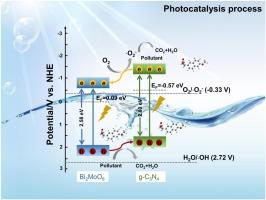
In this research, a 2D/2D Bi2MoO6/g-C3N4 heterojunction photocatalyst, which can be driven by visible light, was fabricated through a hydrothermal coprecipitation method. Naproxen was used as the target organic contaminant to evaluate the photocatalytic performance of Bi2MoO6/g-C3N4. The composite photocatalyst showed promoted photocatalytic activity, among which BMO/CN50−50 with a mass ratio 50/50 exhibited the fastest degradation rate, the degradation rate was 3.9 and 2.5 times higher than that of g-C3N4 and Bi2MoO6, respectively. Scavenger experiments and EPR measurements demonstrated that hole (h+) and superoxide radical (O2−) play a leading role in the degradation reactions. Moreover, the degradation pathway was suggested in the light of identified intermediates by Liquid Chromatography-Mass Spectrometry (LC–MS/MS) and DFT analysis. Furthermore, the Quantitative Structure-Activity Relationship (QSAR) analysis was used to evaluate the toxicity of identified degradation intermediates.
期刊介绍:
JPPA publishes the results of fundamental studies on all aspects of chemical phenomena induced by interactions between light and molecules/matter of all kinds.
All systems capable of being described at the molecular or integrated multimolecular level are appropriate for the journal. This includes all molecular chemical species as well as biomolecular, supramolecular, polymer and other macromolecular systems, as well as solid state photochemistry. In addition, the journal publishes studies of semiconductor and other photoactive organic and inorganic materials, photocatalysis (organic, inorganic, supramolecular and superconductor).
The scope includes condensed and gas phase photochemistry, as well as synchrotron radiation chemistry. A broad range of processes and techniques in photochemistry are covered such as light induced energy, electron and proton transfer; nonlinear photochemical behavior; mechanistic investigation of photochemical reactions and identification of the products of photochemical reactions; quantum yield determinations and measurements of rate constants for primary and secondary photochemical processes; steady-state and time-resolved emission, ultrafast spectroscopic methods, single molecule spectroscopy, time resolved X-ray diffraction, luminescence microscopy, and scattering spectroscopy applied to photochemistry. Papers in emerging and applied areas such as luminescent sensors, electroluminescence, solar energy conversion, atmospheric photochemistry, environmental remediation, and related photocatalytic chemistry are also welcome.



 京公网安备 11010802042870号
京ICP备2023020795号-1
京公网安备 11010802042870号
京ICP备2023020795号-1

 分享
分享
 求助内容:
求助内容: 应助结果提醒方式:
 扫码关注我们
