L A De Graaf, P F Harmsen, J M Vereijken, M Mönikes
{"title":"Requirements for non-food applications of pea proteins. A review.","authors":"L A De Graaf, P F Harmsen, J M Vereijken, M Mönikes","doi":"10.1002/1521-3803(20011001)45:6<408::AID-FOOD408>3.0.CO;2-#","DOIUrl":null,"url":null,"abstract":"<p><p>So far, limited research is performed on technical applications of pea proteins and no applications have yet been reported. At ATO, three technical applications were investigated: surfactants, films, and microspheres as encapsulation matrices. Pea protein hydrolysates are surfactants with good emulsifying and foaming properties. By variation of enzyme type and degree of hydrolysis, the surfactant properties can be tailored toward specific applications. Pea protein films could be prepared by casting from dispersions at pH 7 and 10, and by compression moulding at 140 degrees C. Opposite to many other proteins, pea protein films combine strength (5-7.5 MPa) with high elongation at break (150%). A protein isolate derived from peas was applied as matrix material for the microencapsulation of beta-carotene, intended for cosmetic applications. Supercritical CO2 technology appeared to be a promising encapsulation technique for beta-carotene in porous pea protein microspheres. Advantages of this method are that no organic solvents are used, and that encapsulation is achieved under mild conditions, thereby preventing the sensitive beta-carotene from degradation.</p>","PeriodicalId":67,"journal":{"name":"Chemical Communications","volume":"54 85 1","pages":"408-11"},"PeriodicalIF":4.2000,"publicationDate":"2001-10-01","publicationTypes":"Journal Article","fieldsOfStudy":null,"isOpenAccess":false,"openAccessPdf":"https://sci-hub-pdf.com/10.1002/1521-3803(20011001)45:6<408::AID-FOOD408>3.0.CO;2-#","citationCount":"42","resultStr":null,"platform":"Semanticscholar","paperid":null,"PeriodicalName":"Chemical Communications","FirstCategoryId":"1085","ListUrlMain":"https://doi.org/10.1002/1521-3803(20011001)45:6<408::AID-FOOD408>3.0.CO;2-#","RegionNum":2,"RegionCategory":"化学","ArticlePicture":[],"TitleCN":null,"AbstractTextCN":null,"PMCID":null,"EPubDate":"","PubModel":"","JCR":"Q2","JCRName":"CHEMISTRY, MULTIDISCIPLINARY","Score":null,"Total":0}
引用次数: 42
Abstract
So far, limited research is performed on technical applications of pea proteins and no applications have yet been reported. At ATO, three technical applications were investigated: surfactants, films, and microspheres as encapsulation matrices. Pea protein hydrolysates are surfactants with good emulsifying and foaming properties. By variation of enzyme type and degree of hydrolysis, the surfactant properties can be tailored toward specific applications. Pea protein films could be prepared by casting from dispersions at pH 7 and 10, and by compression moulding at 140 degrees C. Opposite to many other proteins, pea protein films combine strength (5-7.5 MPa) with high elongation at break (150%). A protein isolate derived from peas was applied as matrix material for the microencapsulation of beta-carotene, intended for cosmetic applications. Supercritical CO2 technology appeared to be a promising encapsulation technique for beta-carotene in porous pea protein microspheres. Advantages of this method are that no organic solvents are used, and that encapsulation is achieved under mild conditions, thereby preventing the sensitive beta-carotene from degradation.
期刊介绍:
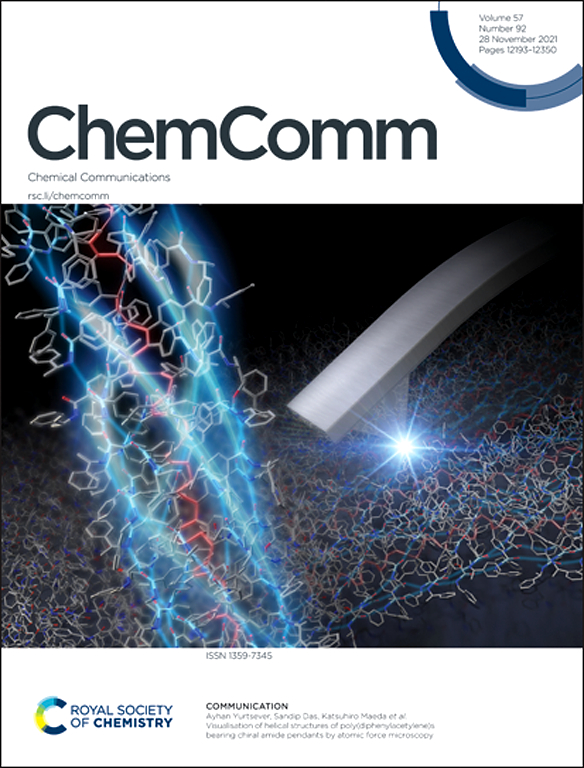
ChemComm (Chemical Communications) is renowned as the fastest publisher of articles providing information on new avenues of research, drawn from all the world''s major areas of chemical research.



 京公网安备 11010802042870号
京ICP备2023020795号-1
京公网安备 11010802042870号
京ICP备2023020795号-1

 分享
分享
 求助内容:
求助内容: 应助结果提醒方式:
 扫码关注我们
