{"title":"Injectable neural hydrogel as <i>in vivo</i> therapeutic delivery vehicle.","authors":"Nora Hlavac, Deanna Bousalis, Emily Pallack, Yuan Li, Eleana Manousiouthakis, Raffae Ahmad, Christine E Schmidt","doi":"10.1007/s40883-022-00292-9","DOIUrl":null,"url":null,"abstract":"<p><strong>Purpose: </strong>This study demonstrated <i>in vivo</i> delivery of a decellularized, injectable peripheral nerve (iPN) hydrogel and explored options for using iPN in combination with regenerative biomolecular therapies like stem cell secretome.</p><p><strong>Methods: </strong>Rat-derived iPN hydrogel solutions were combined with a dextran-dye before subcutaneous injection into adult Sprague Dawley rats. After injection, an <i>in vivo</i> imaging system (IVIS) was used to visualize hydrogels and quantify dextran-dye release over time. Poly(lactic-co-glycolic) acid (PLGA) was used to encapsulate the dextran-dye to prolong molecular release from the hydrogel scaffolds. Lastly, we investigated use of adipose-derived stem cell (ASC) secretome as a potential future combination strategy with iPN. ASC secretome was assessed for growth factor levels in response to media stimulation and was encapsulated in PLGA to determine loading efficiency.</p><p><strong>Results: </strong>Gelation of iPN hydrogels was successful upon subcutaneous injection. When combined with iPN, a 10 kDa dextran-dye was reduced to 54% its initial signal at 24 hours, while PLGA-encapsulated dextran-dye in iPN was only reduced to 78% by 24 hours. Modified media stimulation resulted in changes in ASC phenotype and dramatic upregulation of VEGF secretion. The PLGA encapsulation protocol was adapted for use with temperature sensitive biomolecules, however, considerations must be made with loading efficiency for cell secretome as the maximum efficiency was 28%.</p><p><strong>Conclusion: </strong>The results of this study demonstrated successful injection and subsequent gelation of our iPN hydrogel formulation <i>in vivo</i>. Biomolecular payloads can be encapsulated in PLGA to help prolong their release from the soft iPN hydrogels in future combination therapies.</p><p><strong>Lay summary: </strong>We developed an injectable decellularized tissue scaffold from rat peripheral nerve tissue (called iPN), a potential minimally invasive therapeutic meant to fill lesion spaces after injury. This study was the first demonstration of iPN delivery to a living animal. The iPN solution was injected subcutaneously in a rat and properly formed a gelled material upon entering the body. Our results showed that encapsulating biomolecules in an FDA-approved polymer (PLGA) slowed the release of biomolecules from the iPN, which could allow therapeutics more time around the scaffold to help repair native tissue. Lastly, we investigated one potential avenue for combining iPN with other regenerative cues obtained from adipose-derived stem cells.</p><p><strong>Description of future works: </strong>Future work must focus on optimal loading conditions and release profiles from the iPN hydrogels. Next steps will be applying iPN in various combination therapies for spinal cord injury. We will focus efforts on developing a pro-regenerative secretome that directly promotes neurite extension and neural cell infiltration into iPN scaffolds upon transplantation in spinal cord.</p>","PeriodicalId":10690,"journal":{"name":"Clinical chemistry","volume":"28 10 1","pages":"424-430"},"PeriodicalIF":6.3000,"publicationDate":"2023-09-01","publicationTypes":"Journal Article","fieldsOfStudy":null,"isOpenAccess":false,"openAccessPdf":"https://www.ncbi.nlm.nih.gov/pmc/articles/PMC10683944/pdf/","citationCount":"0","resultStr":null,"platform":"Semanticscholar","paperid":null,"PeriodicalName":"Clinical chemistry","FirstCategoryId":"1085","ListUrlMain":"https://doi.org/10.1007/s40883-022-00292-9","RegionNum":2,"RegionCategory":"医学","ArticlePicture":[],"TitleCN":null,"AbstractTextCN":null,"PMCID":null,"EPubDate":"2023/1/26 0:00:00","PubModel":"Epub","JCR":"Q1","JCRName":"MEDICAL LABORATORY TECHNOLOGY","Score":null,"Total":0}
引用次数: 0
Abstract
Purpose: This study demonstrated in vivo delivery of a decellularized, injectable peripheral nerve (iPN) hydrogel and explored options for using iPN in combination with regenerative biomolecular therapies like stem cell secretome.
Methods: Rat-derived iPN hydrogel solutions were combined with a dextran-dye before subcutaneous injection into adult Sprague Dawley rats. After injection, an in vivo imaging system (IVIS) was used to visualize hydrogels and quantify dextran-dye release over time. Poly(lactic-co-glycolic) acid (PLGA) was used to encapsulate the dextran-dye to prolong molecular release from the hydrogel scaffolds. Lastly, we investigated use of adipose-derived stem cell (ASC) secretome as a potential future combination strategy with iPN. ASC secretome was assessed for growth factor levels in response to media stimulation and was encapsulated in PLGA to determine loading efficiency.
Results: Gelation of iPN hydrogels was successful upon subcutaneous injection. When combined with iPN, a 10 kDa dextran-dye was reduced to 54% its initial signal at 24 hours, while PLGA-encapsulated dextran-dye in iPN was only reduced to 78% by 24 hours. Modified media stimulation resulted in changes in ASC phenotype and dramatic upregulation of VEGF secretion. The PLGA encapsulation protocol was adapted for use with temperature sensitive biomolecules, however, considerations must be made with loading efficiency for cell secretome as the maximum efficiency was 28%.
Conclusion: The results of this study demonstrated successful injection and subsequent gelation of our iPN hydrogel formulation in vivo. Biomolecular payloads can be encapsulated in PLGA to help prolong their release from the soft iPN hydrogels in future combination therapies.
Lay summary: We developed an injectable decellularized tissue scaffold from rat peripheral nerve tissue (called iPN), a potential minimally invasive therapeutic meant to fill lesion spaces after injury. This study was the first demonstration of iPN delivery to a living animal. The iPN solution was injected subcutaneously in a rat and properly formed a gelled material upon entering the body. Our results showed that encapsulating biomolecules in an FDA-approved polymer (PLGA) slowed the release of biomolecules from the iPN, which could allow therapeutics more time around the scaffold to help repair native tissue. Lastly, we investigated one potential avenue for combining iPN with other regenerative cues obtained from adipose-derived stem cells.
Description of future works: Future work must focus on optimal loading conditions and release profiles from the iPN hydrogels. Next steps will be applying iPN in various combination therapies for spinal cord injury. We will focus efforts on developing a pro-regenerative secretome that directly promotes neurite extension and neural cell infiltration into iPN scaffolds upon transplantation in spinal cord.
期刊介绍:
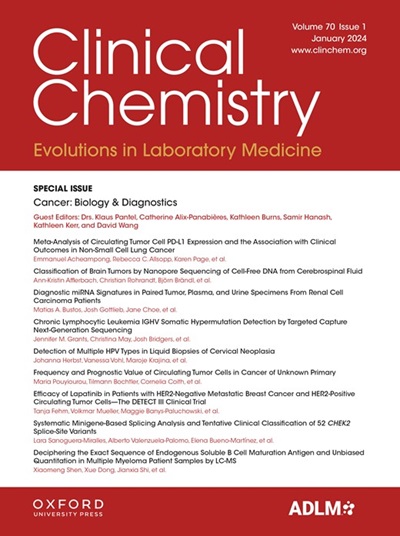
Clinical Chemistry is a peer-reviewed scientific journal that is the premier publication for the science and practice of clinical laboratory medicine. It was established in 1955 and is associated with the Association for Diagnostics & Laboratory Medicine (ADLM).
The journal focuses on laboratory diagnosis and management of patients, and has expanded to include other clinical laboratory disciplines such as genomics, hematology, microbiology, and toxicology. It also publishes articles relevant to clinical specialties including cardiology, endocrinology, gastroenterology, genetics, immunology, infectious diseases, maternal-fetal medicine, neurology, nutrition, oncology, and pediatrics.
In addition to original research, editorials, and reviews, Clinical Chemistry features recurring sections such as clinical case studies, perspectives, podcasts, and Q&A articles. It has the highest impact factor among journals of clinical chemistry, laboratory medicine, pathology, analytical chemistry, transfusion medicine, and clinical microbiology.
The journal is indexed in databases such as MEDLINE and Web of Science.



 京公网安备 11010802042870号
京ICP备2023020795号-1
京公网安备 11010802042870号
京ICP备2023020795号-1

 分享
分享
 求助内容:
求助内容: 应助结果提醒方式:
 扫码关注我们
