Extraction of Collagen/Gelatin from the Marine Demosponge Chondrosia reniformis (Nardo, 1847) Using Water Acidified with Carbon Dioxide – Process Optimization
João C. Silva, Alexandre A. Barros, Ivo M. Aroso, Dario Fassini, Tiago H. Silva, Rui L. Reis, Ana Rita C. Duarte*
{"title":"Extraction of Collagen/Gelatin from the Marine Demosponge Chondrosia reniformis (Nardo, 1847) Using Water Acidified with Carbon Dioxide – Process Optimization","authors":"João C. Silva, Alexandre A. Barros, Ivo M. Aroso, Dario Fassini, Tiago H. Silva, Rui L. Reis, Ana Rita C. Duarte*","doi":"10.1021/acs.iecr.6b00523","DOIUrl":null,"url":null,"abstract":"<p >Marine sponges are a rich source of natural bioactive compounds. One of the most abundant valuable products is collagen/gelatin, which presents an interesting alternative source for pharmaceutical and biomedical applications. We have previously proposed an innovative green technology for the extraction of collagen/gelatin from marine sponges based in water acidified with carbon dioxide. In this work, we have optimized the process operating conditions toward high yields and collagen quality as well as to reduce extraction procedure duration and energy consumption. The process extraction efficiency is higher than 50%, corresponding to a yield of approximately 10% of the sponge dry mass, obtained for mild operating conditions of 10 bar and 3 h. The extracted material was characterized by scanning electron microscopy (SEM), rheology, Fourier transformed infrared spectroscopy (FTIR), circular dichroism (CD), amino acid analysis, and SDS-PAGE. The extracts were found to be composed of highly pure mixtures of collagen and gelatin with similar properties to collagen isolated from other marine sources. The cytotoxicity evaluation, performed with L929 cells, has proven the biocompatibility of the material extracted. Overall, the results obtained demonstrate the efficiency of this approach and the high industrial potential of this technology to obtain marine collagen/gelatin with properties suitable for biomedical applications.</p>","PeriodicalId":39,"journal":{"name":"Industrial & Engineering Chemistry Research","volume":"55 25","pages":"6922–6930"},"PeriodicalIF":3.9000,"publicationDate":"2016-06-07","publicationTypes":"Journal Article","fieldsOfStudy":null,"isOpenAccess":false,"openAccessPdf":"https://sci-hub-pdf.com/10.1021/acs.iecr.6b00523","citationCount":"52","resultStr":null,"platform":"Semanticscholar","paperid":null,"PeriodicalName":"Industrial & Engineering Chemistry Research","FirstCategoryId":"5","ListUrlMain":"https://pubs.acs.org/doi/10.1021/acs.iecr.6b00523","RegionNum":3,"RegionCategory":"工程技术","ArticlePicture":[],"TitleCN":null,"AbstractTextCN":null,"PMCID":null,"EPubDate":"","PubModel":"","JCR":"Q2","JCRName":"ENGINEERING, CHEMICAL","Score":null,"Total":0}
引用次数: 52
Abstract
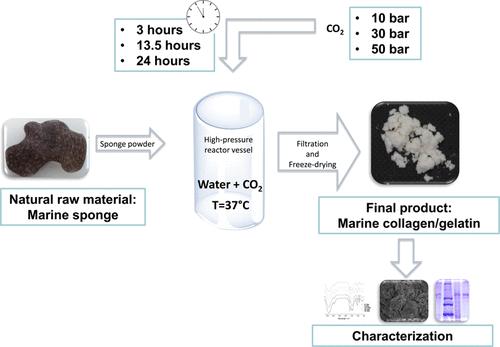
Marine sponges are a rich source of natural bioactive compounds. One of the most abundant valuable products is collagen/gelatin, which presents an interesting alternative source for pharmaceutical and biomedical applications. We have previously proposed an innovative green technology for the extraction of collagen/gelatin from marine sponges based in water acidified with carbon dioxide. In this work, we have optimized the process operating conditions toward high yields and collagen quality as well as to reduce extraction procedure duration and energy consumption. The process extraction efficiency is higher than 50%, corresponding to a yield of approximately 10% of the sponge dry mass, obtained for mild operating conditions of 10 bar and 3 h. The extracted material was characterized by scanning electron microscopy (SEM), rheology, Fourier transformed infrared spectroscopy (FTIR), circular dichroism (CD), amino acid analysis, and SDS-PAGE. The extracts were found to be composed of highly pure mixtures of collagen and gelatin with similar properties to collagen isolated from other marine sources. The cytotoxicity evaluation, performed with L929 cells, has proven the biocompatibility of the material extracted. Overall, the results obtained demonstrate the efficiency of this approach and the high industrial potential of this technology to obtain marine collagen/gelatin with properties suitable for biomedical applications.
期刊介绍:
ndustrial & Engineering Chemistry, with variations in title and format, has been published since 1909 by the American Chemical Society. Industrial & Engineering Chemistry Research is a weekly publication that reports industrial and academic research in the broad fields of applied chemistry and chemical engineering with special focus on fundamentals, processes, and products.



 京公网安备 11010802042870号
京ICP备2023020795号-1
京公网安备 11010802042870号
京ICP备2023020795号-1

 分享
分享
 求助内容:
求助内容: 应助结果提醒方式:
 扫码关注我们
