The structure of child temperament as measured by the Polish versions of the Children's Behavior Questionnaire and the Temperament in Middle Childhood Questionnaire: insight from the network psychometrics approach.
Anna Lipska, Radosław Rogoza, Ewelina Dębska, Klaudia Ponikiewska, Samuel Putnam, Jan Cieciuch
{"title":"The structure of child temperament as measured by the Polish versions of the Children's Behavior Questionnaire and the Temperament in Middle Childhood Questionnaire: insight from the network psychometrics approach.","authors":"Anna Lipska, Radosław Rogoza, Ewelina Dębska, Klaudia Ponikiewska, Samuel Putnam, Jan Cieciuch","doi":"10.5114/cipp.2021.108826","DOIUrl":null,"url":null,"abstract":"<p><strong>Background: </strong>The model proposed by Rothbart is one of the most frequently used models to describe children's temperament. However, the structure of temperamental traits in children is not unambiguous. We examine this structure in children from 3 to 10 years of age using two different measures in a less often studied cultural context (i.e., central Europe), and using a recently developed and still less common approach to study the internal structure of scales (i.e., network psychometrics).</p><p><strong>Participants and procedure: </strong>This paper examines the structure of temperamental dimensions in children using two different measures - the Children's Behavior Questionnaire (CBQ) and the Temperament in Middle Childhood Questionnaire (TMCQ) - in two studies conducted on children aged 4-7 years (<i>N</i> = 178; CBQ) and aged 7-10 years (<i>N</i> = 189; TMCQ). We verified the structural validity of these measures with a bootstrapped exploratory graph analysis, which represents the network psychometric approach.</p><p><strong>Results: </strong>Network psychometric analysis supported differentiation of three factors of temperamental traits in both groups of children. In addition, the construct validity of these instruments was supported through correlations of the temperament factors measured by the CBQ and the TMCQ with Emotionality, Activity, Sociability, and Shyness scales measured with the EAS Temperament Survey; and through confirmation of expected gender differences in the CBQ and TMCQ factors.</p><p><strong>Conclusions: </strong>Our findings support a three-factor solution of temperamental traits in children representing Negative Affectivity, Effortful Control, and Surgency.</p>","PeriodicalId":48701,"journal":{"name":"Physical Review B","volume":"84 1","pages":"265-276"},"PeriodicalIF":3.7000,"publicationDate":"2021-11-26","publicationTypes":"Journal Article","fieldsOfStudy":null,"isOpenAccess":false,"openAccessPdf":"https://www.ncbi.nlm.nih.gov/pmc/articles/PMC10535634/pdf/","citationCount":"1","resultStr":null,"platform":"Semanticscholar","paperid":null,"PeriodicalName":"Physical Review B","FirstCategoryId":"1085","ListUrlMain":"https://doi.org/10.5114/cipp.2021.108826","RegionNum":2,"RegionCategory":"物理与天体物理","ArticlePicture":[],"TitleCN":null,"AbstractTextCN":null,"PMCID":null,"EPubDate":"2022/1/1 0:00:00","PubModel":"eCollection","JCR":"Q2","JCRName":"MATERIALS SCIENCE, MULTIDISCIPLINARY","Score":null,"Total":0}
引用次数: 1
Abstract
Background: The model proposed by Rothbart is one of the most frequently used models to describe children's temperament. However, the structure of temperamental traits in children is not unambiguous. We examine this structure in children from 3 to 10 years of age using two different measures in a less often studied cultural context (i.e., central Europe), and using a recently developed and still less common approach to study the internal structure of scales (i.e., network psychometrics).
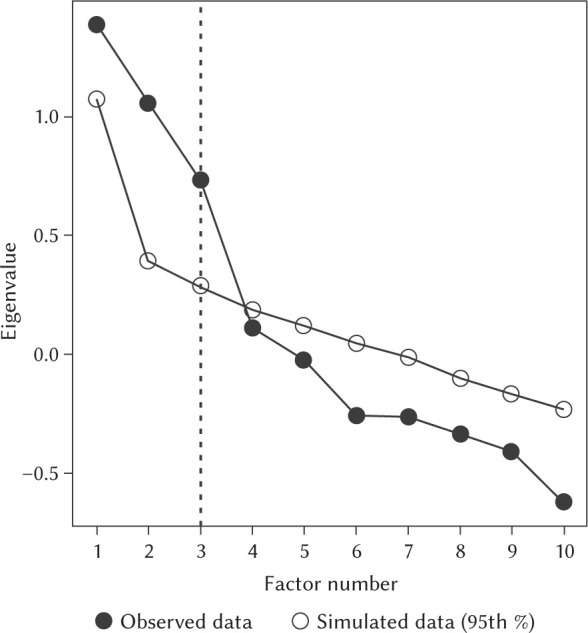
Participants and procedure: This paper examines the structure of temperamental dimensions in children using two different measures - the Children's Behavior Questionnaire (CBQ) and the Temperament in Middle Childhood Questionnaire (TMCQ) - in two studies conducted on children aged 4-7 years (N = 178; CBQ) and aged 7-10 years (N = 189; TMCQ). We verified the structural validity of these measures with a bootstrapped exploratory graph analysis, which represents the network psychometric approach.
Results: Network psychometric analysis supported differentiation of three factors of temperamental traits in both groups of children. In addition, the construct validity of these instruments was supported through correlations of the temperament factors measured by the CBQ and the TMCQ with Emotionality, Activity, Sociability, and Shyness scales measured with the EAS Temperament Survey; and through confirmation of expected gender differences in the CBQ and TMCQ factors.
Conclusions: Our findings support a three-factor solution of temperamental traits in children representing Negative Affectivity, Effortful Control, and Surgency.
期刊介绍:
Physical Review B (PRB) is the world’s largest dedicated physics journal, publishing approximately 100 new, high-quality papers each week. The most highly cited journal in condensed matter physics, PRB provides outstanding depth and breadth of coverage, combined with unrivaled context and background for ongoing research by scientists worldwide.
PRB covers the full range of condensed matter, materials physics, and related subfields, including:
-Structure and phase transitions
-Ferroelectrics and multiferroics
-Disordered systems and alloys
-Magnetism
-Superconductivity
-Electronic structure, photonics, and metamaterials
-Semiconductors and mesoscopic systems
-Surfaces, nanoscience, and two-dimensional materials
-Topological states of matter





 京公网安备 11010802042870号
京ICP备2023020795号-1
京公网安备 11010802042870号
京ICP备2023020795号-1

 分享
分享
 求助内容:
求助内容: 应助结果提醒方式:
 扫码关注我们
