{"title":"How body patterning might have worked in the evolution of arthropods—A case study of the mystacocarid Derocheilocaris remanei (Crustacea, Oligostraca)","authors":"Martin Fritsch, Stefan Richter","doi":"10.1002/jez.b.23140","DOIUrl":null,"url":null,"abstract":"<p>Body organization within arthropods is enormously diverse, but a fusion of segments into “functional groups” (tagmatization) is found in all species. Within Tetraconata/Pancrustacea, an anterior head, a locomotory thorax region, and a posterior, mostly limbless tagma known as the abdomen is present. The posterior-most tagma in crustaceans is frequently confused with the malacostracan, for example, decapod pleon often misleadingly termed abdomen, however, its evolutionary and developmental origin continues to pose a riddle, especially the completely limbless abdomen of the “entomostracan morphotype” (e.g., fairy shrimps). Since the discovery of Hox genes and their involvement in specifying the morphology or identity of segments, tagmata, or regions along the anteroposterior axis of an organism, only a few studies have focused on model organisms representing the “entomostracan morphotype” and used a variety of dedicated Hox genes and their transcription products to shine light on abdomen formation. The homeotic genes or the molecular processes that determine the identity of the entomostracan abdomen remain unknown to date. This study focuses on the “entomostracan morphotype” representative <i>Derocheilocaris remanei</i> (Mystacocarida). We present a complete overview of development throughout larval stages and investigate homeotic gene expression data using the antibody FP6.87 that binds specifically to epitopes of <i>Ultrabithorax</i>/<i>Abdominal-A</i> proteins. Our results suggest that the abdomen in Mystacocarida is bipartite (<i><b>abdomen I</b></i> + <i><b>abdomen II</b></i>). We suggest that the limbless abdomen is an evolutionary novelty that evolved several times independently within crustaceans and which might be the result of a progressive reduction of former thoracic segments into abdominal segments.</p>","PeriodicalId":15682,"journal":{"name":"Journal of experimental zoology. Part B, Molecular and developmental evolution","volume":"338 6","pages":"342-359"},"PeriodicalIF":1.7000,"publicationDate":"2022-04-29","publicationTypes":"Journal Article","fieldsOfStudy":null,"isOpenAccess":false,"openAccessPdf":"https://onlinelibrary.wiley.com/doi/epdf/10.1002/jez.b.23140","citationCount":"1","resultStr":null,"platform":"Semanticscholar","paperid":null,"PeriodicalName":"Journal of experimental zoology. Part B, Molecular and developmental evolution","FirstCategoryId":"99","ListUrlMain":"https://onlinelibrary.wiley.com/doi/10.1002/jez.b.23140","RegionNum":3,"RegionCategory":"生物学","ArticlePicture":[],"TitleCN":null,"AbstractTextCN":null,"PMCID":null,"EPubDate":"","PubModel":"","JCR":"Q3","JCRName":"DEVELOPMENTAL BIOLOGY","Score":null,"Total":0}
引用次数: 1
Abstract
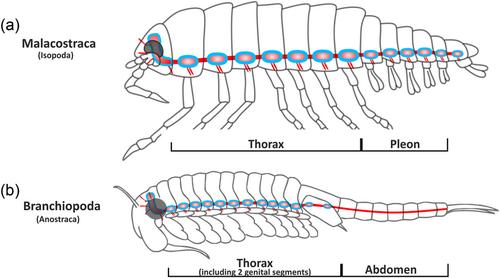
Body organization within arthropods is enormously diverse, but a fusion of segments into “functional groups” (tagmatization) is found in all species. Within Tetraconata/Pancrustacea, an anterior head, a locomotory thorax region, and a posterior, mostly limbless tagma known as the abdomen is present. The posterior-most tagma in crustaceans is frequently confused with the malacostracan, for example, decapod pleon often misleadingly termed abdomen, however, its evolutionary and developmental origin continues to pose a riddle, especially the completely limbless abdomen of the “entomostracan morphotype” (e.g., fairy shrimps). Since the discovery of Hox genes and their involvement in specifying the morphology or identity of segments, tagmata, or regions along the anteroposterior axis of an organism, only a few studies have focused on model organisms representing the “entomostracan morphotype” and used a variety of dedicated Hox genes and their transcription products to shine light on abdomen formation. The homeotic genes or the molecular processes that determine the identity of the entomostracan abdomen remain unknown to date. This study focuses on the “entomostracan morphotype” representative Derocheilocaris remanei (Mystacocarida). We present a complete overview of development throughout larval stages and investigate homeotic gene expression data using the antibody FP6.87 that binds specifically to epitopes of Ultrabithorax/Abdominal-A proteins. Our results suggest that the abdomen in Mystacocarida is bipartite (abdomen I + abdomen II). We suggest that the limbless abdomen is an evolutionary novelty that evolved several times independently within crustaceans and which might be the result of a progressive reduction of former thoracic segments into abdominal segments.
期刊介绍:
Developmental Evolution is a branch of evolutionary biology that integrates evidence and concepts from developmental biology, phylogenetics, comparative morphology, evolutionary genetics and increasingly also genomics, systems biology as well as synthetic biology to gain an understanding of the structure and evolution of organisms.
The Journal of Experimental Zoology -B: Molecular and Developmental Evolution provides a forum where these fields are invited to bring together their insights to further a synthetic understanding of evolution from the molecular through the organismic level. Contributions from all these branches of science are welcome to JEZB.
We particularly encourage submissions that apply the tools of genomics, as well as systems and synthetic biology to developmental evolution. At this time the impact of these emerging fields on developmental evolution has not been explored to its fullest extent and for this reason we are eager to foster the relationship of systems and synthetic biology with devo evo.



 京公网安备 11010802042870号
京ICP备2023020795号-1
京公网安备 11010802042870号
京ICP备2023020795号-1

 分享
分享
 求助内容:
求助内容: 应助结果提醒方式:
 扫码关注我们
