Heng Jiang , Nan Zhang , Minxuan Chen , Xiangkun Meng , Caihong Ji , Huichen Ge , Fan Dong , Lijun Miao , Xuemei Yang , Xin Xu , Kun Qian , Jianjun Wang
{"title":"Transcriptional and post-translational activation of AMPKα by oxidative, heat, and cold stresses in the red flour beetle, Tribolium castaneum","authors":"Heng Jiang , Nan Zhang , Minxuan Chen , Xiangkun Meng , Caihong Ji , Huichen Ge , Fan Dong , Lijun Miao , Xuemei Yang , Xin Xu , Kun Qian , Jianjun Wang","doi":"10.1007/s12192-019-01030-x","DOIUrl":null,"url":null,"abstract":"<div><div>The AMP-activated protein kinase (AMPK) has important roles in the regulation of energy metabolism, and AMPK activity and its regulation have been the focus of relevant investigations. However, functional characterization of AMPK is still limited in insects. In this study, the full-length cDNA coding AMPKα (TcAMPKα) was isolated from the red flour beetle, <em>Tribolium castaneum</em>. The <em>TcAMPKα</em> gene contains an ORF of 1581 bp encoding a protein of 526 amino acid residues, which shared conserved domain structure with <em>Drosophila melanogaster</em> and mammalian orthologs<em>.</em> Exposure of female adults to oxidative, heat, and cold stresses caused an increase in <em>TcAMPKα</em> mRNA expression levels and phosphorylation of Thr-173 in the activation loop. The RNAi-mediated knockdown of <em>TcAMPKα</em> resulted in the increased sensitivity of <em>T. castaneum</em> to oxidative, heat, and cold stresses. These results suggest that stress signals regulate <em>TcAMPKα</em> activity, and <em>TcAMPKα</em> plays an important role in enabling protective mechanisms and processes that confer resistance to environmental stress.</div></div>","PeriodicalId":9684,"journal":{"name":"Cell Stress & Chaperones","volume":"24 6","pages":"Pages 1079-1089"},"PeriodicalIF":3.2000,"publicationDate":"2019-11-01","publicationTypes":"Journal Article","fieldsOfStudy":null,"isOpenAccess":false,"openAccessPdf":"https://www.ncbi.nlm.nih.gov/pmc/articles/PMC6882985/pdf/","citationCount":"0","resultStr":null,"platform":"Semanticscholar","paperid":null,"PeriodicalName":"Cell Stress & Chaperones","FirstCategoryId":"99","ListUrlMain":"https://www.sciencedirect.com/science/article/pii/S1355814523008283","RegionNum":3,"RegionCategory":"生物学","ArticlePicture":[],"TitleCN":null,"AbstractTextCN":null,"PMCID":null,"EPubDate":"2019/8/10 0:00:00","PubModel":"Epub","JCR":"Q3","JCRName":"CELL BIOLOGY","Score":null,"Total":0}
引用次数: 0
Abstract
The AMP-activated protein kinase (AMPK) has important roles in the regulation of energy metabolism, and AMPK activity and its regulation have been the focus of relevant investigations. However, functional characterization of AMPK is still limited in insects. In this study, the full-length cDNA coding AMPKα (TcAMPKα) was isolated from the red flour beetle, Tribolium castaneum. The TcAMPKα gene contains an ORF of 1581 bp encoding a protein of 526 amino acid residues, which shared conserved domain structure with Drosophila melanogaster and mammalian orthologs. Exposure of female adults to oxidative, heat, and cold stresses caused an increase in TcAMPKα mRNA expression levels and phosphorylation of Thr-173 in the activation loop. The RNAi-mediated knockdown of TcAMPKα resulted in the increased sensitivity of T. castaneum to oxidative, heat, and cold stresses. These results suggest that stress signals regulate TcAMPKα activity, and TcAMPKα plays an important role in enabling protective mechanisms and processes that confer resistance to environmental stress.
期刊介绍:
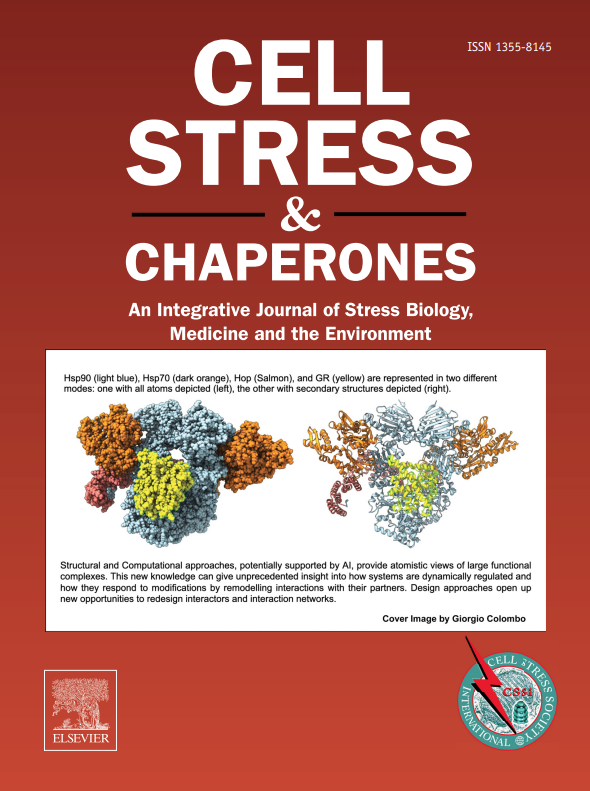
Cell Stress and Chaperones is an integrative journal that bridges the gap between laboratory model systems and natural populations. The journal captures the eclectic spirit of the cellular stress response field in a single, concentrated source of current information. Major emphasis is placed on the effects of climate change on individual species in the natural environment and their capacity to adapt. This emphasis expands our focus on stress biology and medicine by linking climate change effects to research on cellular stress responses of animals, micro-organisms and plants.




 京公网安备 11010802042870号
京ICP备2023020795号-1
京公网安备 11010802042870号
京ICP备2023020795号-1

 分享
分享
 求助内容:
求助内容: 应助结果提醒方式:
 扫码关注我们
