{"title":"Somato-axodendritic release of oxytocin into the brain due to calcium amplification is essential for social memory.","authors":"Haruhiro Higashida","doi":"10.1007/s12576-015-0425-0","DOIUrl":null,"url":null,"abstract":"<p><p>Oxytocin (OT) is released into the brain from the cell soma, axons, and dendrites of neurosecretory cells in the hypothalamus. Locally released OT can activate OT receptors, form inositol-1,4,5-trisphosphate and elevate intracellular free calcium (Ca(2+)) concentrations [(Ca(2+)) i ] in self and neighboring neurons in the hypothalamus, resulting in further OT release: i.e., autocrine or paracrine systems of OT-induced OT release. CD38-dependent cyclic ADP-ribose (cADPR) is also involved in this autoregulation by elevating [Ca(2+)] i via Ca(2+) mobilization through ryanodine receptors on intracellular Ca(2+) pools that are sensitive to both Ca(2+) and cADPR. In addition, it has recently been reported that heat stimulation and hyperthermia enhance [Ca(2+)] i increases by Ca(2+) influx, probably through TRPM2 cation channels, suggesting that cADPR and TRPM2 molecules act as Ca(2+) signal amplifiers. Thus, OT release is not simply due to depolarization-secretion coupling. Both of these molecules play critical roles not only during labor and milk ejection in reproductive females, but also during social behavior in daily life in both genders. This was clearly demonstrated in CD38 knockout mice in that social behavior was impaired by reduction of [Ca(2+)] i elevation and subsequent OT secretion. Evidence for the associations of CD38 with social behavior and psychiatric disorder is discussed, especially in subjects with autism spectrum disorder. </p>","PeriodicalId":22836,"journal":{"name":"The Journal of Physiological Sciences","volume":"1 1","pages":"275-82"},"PeriodicalIF":0.0000,"publicationDate":"2016-07-01","publicationTypes":"Journal Article","fieldsOfStudy":null,"isOpenAccess":false,"openAccessPdf":"https://www.ncbi.nlm.nih.gov/pmc/articles/PMC4893072/pdf/","citationCount":"0","resultStr":null,"platform":"Semanticscholar","paperid":null,"PeriodicalName":"The Journal of Physiological Sciences","FirstCategoryId":"1085","ListUrlMain":"https://doi.org/10.1007/s12576-015-0425-0","RegionNum":0,"RegionCategory":null,"ArticlePicture":[],"TitleCN":null,"AbstractTextCN":null,"PMCID":null,"EPubDate":"2015/11/19 0:00:00","PubModel":"Epub","JCR":"","JCRName":"","Score":null,"Total":0}
引用次数: 0
Abstract
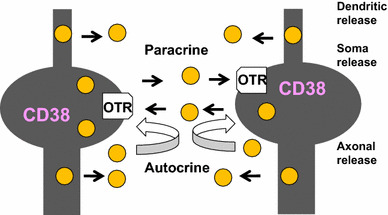
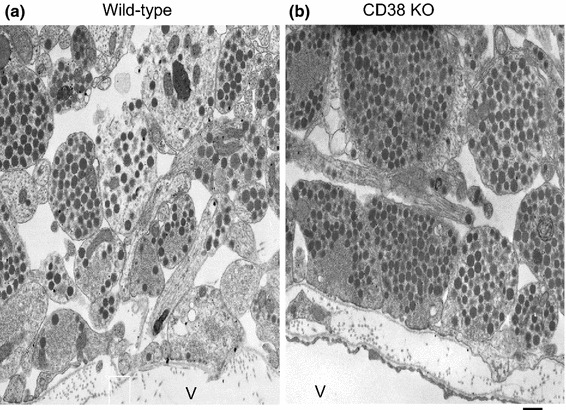
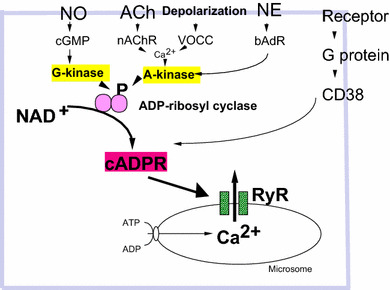
Oxytocin (OT) is released into the brain from the cell soma, axons, and dendrites of neurosecretory cells in the hypothalamus. Locally released OT can activate OT receptors, form inositol-1,4,5-trisphosphate and elevate intracellular free calcium (Ca(2+)) concentrations [(Ca(2+)) i ] in self and neighboring neurons in the hypothalamus, resulting in further OT release: i.e., autocrine or paracrine systems of OT-induced OT release. CD38-dependent cyclic ADP-ribose (cADPR) is also involved in this autoregulation by elevating [Ca(2+)] i via Ca(2+) mobilization through ryanodine receptors on intracellular Ca(2+) pools that are sensitive to both Ca(2+) and cADPR. In addition, it has recently been reported that heat stimulation and hyperthermia enhance [Ca(2+)] i increases by Ca(2+) influx, probably through TRPM2 cation channels, suggesting that cADPR and TRPM2 molecules act as Ca(2+) signal amplifiers. Thus, OT release is not simply due to depolarization-secretion coupling. Both of these molecules play critical roles not only during labor and milk ejection in reproductive females, but also during social behavior in daily life in both genders. This was clearly demonstrated in CD38 knockout mice in that social behavior was impaired by reduction of [Ca(2+)] i elevation and subsequent OT secretion. Evidence for the associations of CD38 with social behavior and psychiatric disorder is discussed, especially in subjects with autism spectrum disorder.



 京公网安备 11010802042870号
京ICP备2023020795号-1
京公网安备 11010802042870号
京ICP备2023020795号-1

 分享
分享

 求助内容:
求助内容: 应助结果提醒方式:
 扫码关注我们
