Matheus Duarte Pimentel, José Glauco Lobo Filho, Heraldo Guedis Lobo Filho, Emílio de Castro Miguel, Sergimar Kennedy Pinheiro Paiva, João Igor Silva Matos, Matheus Augusto Mesquita Fernandes, Francisco Vagnaldo Fechine Jamacaru
{"title":"Effect of preservation solution and distension pressure on saphenous vein's endothelium.","authors":"Matheus Duarte Pimentel, José Glauco Lobo Filho, Heraldo Guedis Lobo Filho, Emílio de Castro Miguel, Sergimar Kennedy Pinheiro Paiva, João Igor Silva Matos, Matheus Augusto Mesquita Fernandes, Francisco Vagnaldo Fechine Jamacaru","doi":"10.1093/icvts/ivac124","DOIUrl":null,"url":null,"abstract":"<p><strong>Objectives: </strong>Approaches to improve saphenous vein (SV) patency in coronary artery bypass graft (CABG) surgery remain relevant. This study aimed to evaluate the effects of different preservation solutions and different pressures of intraluminal distention on the endothelium of SV segments in CABG.</p><p><strong>Methods: </strong>Forty-two SV segments obtained from 12 patients undergoing CABG were divided into 7 groups. Group 1 (control) was prepared without preservation or intraluminal distension, while the other 6 groups were preserved in autologous heparinized autologous arterial blood or normal saline (NS), with distention pressures 30, 100 and 300 mmHg. To assess the effects of using these solutions and pressures on the endothelium, the grafts were analysed by scanning electron microscopy, with the measurement of endothelial damage degree.</p><p><strong>Results: </strong>Segments in group 1 showed minimal endothelial damage. SV grafts preserved with NS had significantly greater endothelial damage both compared to the control group and compared to groups preserved with autologous arterial blood (P < 0.001). Segments distended with pressures up to 100 mmHg showed less damage when compared to those distended at 300 mmHg, with the ones subjected to higher pressures presenting a maximum degree of damage, with considerable loss and separation of endothelial cells, extensive foci of exposure of the basement membrane and numerous fractures of the intimate layer, without differences regarding the solution used.</p><p><strong>Conclusions: </strong>Preparation of SV using NS and with intraluminal distension pressures above 100 mmHg is factors related to increased damage to the venous endothelium.</p>","PeriodicalId":13272,"journal":{"name":"IEEE Transactions on Microwave Theory and Techniques","volume":"43 1","pages":""},"PeriodicalIF":4.5000,"publicationDate":"2022-08-03","publicationTypes":"Journal Article","fieldsOfStudy":null,"isOpenAccess":false,"openAccessPdf":"https://www.ncbi.nlm.nih.gov/pmc/articles/PMC9419693/pdf/","citationCount":"0","resultStr":null,"platform":"Semanticscholar","paperid":null,"PeriodicalName":"IEEE Transactions on Microwave Theory and Techniques","FirstCategoryId":"3","ListUrlMain":"https://doi.org/10.1093/icvts/ivac124","RegionNum":1,"RegionCategory":"工程技术","ArticlePicture":[],"TitleCN":null,"AbstractTextCN":null,"PMCID":null,"EPubDate":"","PubModel":"","JCR":"Q2","JCRName":"ENGINEERING, ELECTRICAL & ELECTRONIC","Score":null,"Total":0}
引用次数: 0
Abstract
Objectives: Approaches to improve saphenous vein (SV) patency in coronary artery bypass graft (CABG) surgery remain relevant. This study aimed to evaluate the effects of different preservation solutions and different pressures of intraluminal distention on the endothelium of SV segments in CABG.
Methods: Forty-two SV segments obtained from 12 patients undergoing CABG were divided into 7 groups. Group 1 (control) was prepared without preservation or intraluminal distension, while the other 6 groups were preserved in autologous heparinized autologous arterial blood or normal saline (NS), with distention pressures 30, 100 and 300 mmHg. To assess the effects of using these solutions and pressures on the endothelium, the grafts were analysed by scanning electron microscopy, with the measurement of endothelial damage degree.
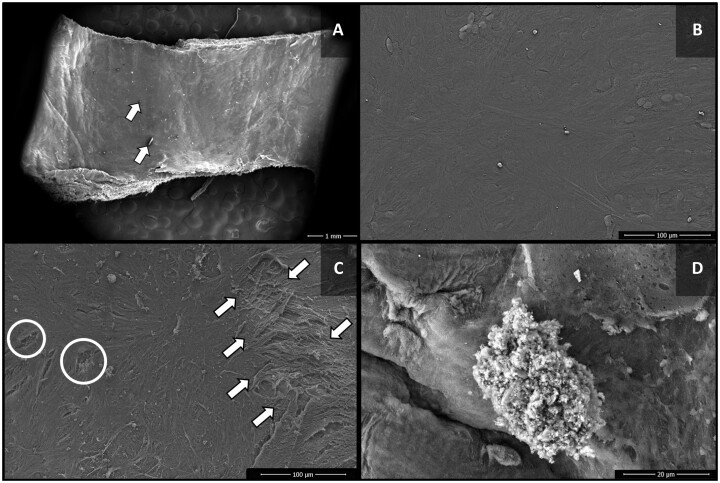
Results: Segments in group 1 showed minimal endothelial damage. SV grafts preserved with NS had significantly greater endothelial damage both compared to the control group and compared to groups preserved with autologous arterial blood (P < 0.001). Segments distended with pressures up to 100 mmHg showed less damage when compared to those distended at 300 mmHg, with the ones subjected to higher pressures presenting a maximum degree of damage, with considerable loss and separation of endothelial cells, extensive foci of exposure of the basement membrane and numerous fractures of the intimate layer, without differences regarding the solution used.
Conclusions: Preparation of SV using NS and with intraluminal distension pressures above 100 mmHg is factors related to increased damage to the venous endothelium.
期刊介绍:
The IEEE Transactions on Microwave Theory and Techniques focuses on that part of engineering and theory associated with microwave/millimeter-wave components, devices, circuits, and systems involving the generation, modulation, demodulation, control, transmission, and detection of microwave signals. This includes scientific, technical, and industrial, activities. Microwave theory and techniques relates to electromagnetic waves usually in the frequency region between a few MHz and a THz; other spectral regions and wave types are included within the scope of the Society whenever basic microwave theory and techniques can yield useful results. Generally, this occurs in the theory of wave propagation in structures with dimensions comparable to a wavelength, and in the related techniques for analysis and design.





 京公网安备 11010802042870号
京ICP备2023020795号-1
京公网安备 11010802042870号
京ICP备2023020795号-1

 分享
分享
 求助内容:
求助内容: 应助结果提醒方式:
 扫码关注我们
