Xue Guo, Mengting Yuan, Jiesi Lei, Zhou Shi, Xishu Zhou, Jiabao Li, Ye Deng, Yunfeng Yang, Liyou Wu, Yiqi Luo, James M Tiedje, Jizhong Zhou
{"title":"Climate warming restructures seasonal dynamics of grassland soil microbial communities.","authors":"Xue Guo, Mengting Yuan, Jiesi Lei, Zhou Shi, Xishu Zhou, Jiabao Li, Ye Deng, Yunfeng Yang, Liyou Wu, Yiqi Luo, James M Tiedje, Jizhong Zhou","doi":"10.1002/mlf2.12035","DOIUrl":null,"url":null,"abstract":"<p><p>Soil microbial community's responses to climate warming alter the global carbon cycle. In temperate ecosystems, soil microbial communities function along seasonal cycles. However, little is known about how the responses of soil microbial communities to warming vary when the season changes. In this study, we investigated the seasonal dynamics of soil bacterial community under experimental warming in a temperate tall-grass prairie ecosystem. Our results showed that warming significantly (<i>p</i> = 0.001) shifted community structure, such that the differences of microbial communities between warming and control plots increased nonlinearly (<i>R</i> <sup>2</sup> = 0.578, <i>p</i> = 0.021) from spring to winter. Also, warming significantly (<i>p</i> < 0.050) increased microbial network complexity and robustness, especially during the colder seasons, despite large variations in network size and complexity in different seasons. In addition, the relative importance of stochastic processes in shaping the microbial community decreased by warming in fall and winter but not in spring and summer. Our study indicates that climate warming restructures the seasonal dynamics of soil microbial community in a temperate ecosystem. Such seasonality of microbial responses to warming may enlarge over time and could have significant impacts on the terrestrial carbon cycle.</p>","PeriodicalId":9760,"journal":{"name":"Cell Proliferation","volume":"15 1","pages":"245-256"},"PeriodicalIF":5.6000,"publicationDate":"2022-09-15","publicationTypes":"Journal Article","fieldsOfStudy":null,"isOpenAccess":false,"openAccessPdf":"https://www.ncbi.nlm.nih.gov/pmc/articles/PMC10989843/pdf/","citationCount":"0","resultStr":null,"platform":"Semanticscholar","paperid":null,"PeriodicalName":"Cell Proliferation","FirstCategoryId":"88","ListUrlMain":"https://doi.org/10.1002/mlf2.12035","RegionNum":1,"RegionCategory":"生物学","ArticlePicture":[],"TitleCN":null,"AbstractTextCN":null,"PMCID":null,"EPubDate":"2022/9/1 0:00:00","PubModel":"eCollection","JCR":"Q2","JCRName":"CELL BIOLOGY","Score":null,"Total":0}
引用次数: 0
Abstract
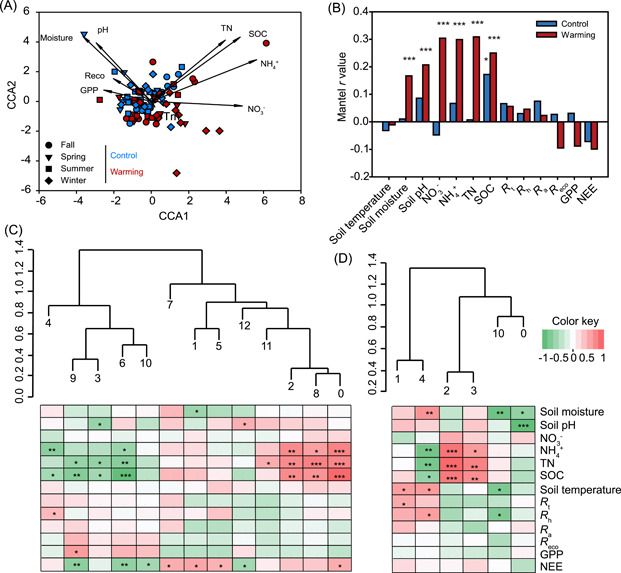
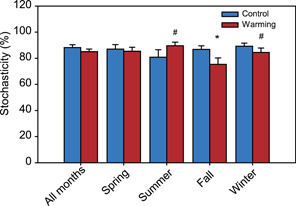
Soil microbial community's responses to climate warming alter the global carbon cycle. In temperate ecosystems, soil microbial communities function along seasonal cycles. However, little is known about how the responses of soil microbial communities to warming vary when the season changes. In this study, we investigated the seasonal dynamics of soil bacterial community under experimental warming in a temperate tall-grass prairie ecosystem. Our results showed that warming significantly (p = 0.001) shifted community structure, such that the differences of microbial communities between warming and control plots increased nonlinearly (R2 = 0.578, p = 0.021) from spring to winter. Also, warming significantly (p < 0.050) increased microbial network complexity and robustness, especially during the colder seasons, despite large variations in network size and complexity in different seasons. In addition, the relative importance of stochastic processes in shaping the microbial community decreased by warming in fall and winter but not in spring and summer. Our study indicates that climate warming restructures the seasonal dynamics of soil microbial community in a temperate ecosystem. Such seasonality of microbial responses to warming may enlarge over time and could have significant impacts on the terrestrial carbon cycle.
期刊介绍:
Cell Proliferation
Focus:
Devoted to studies into all aspects of cell proliferation and differentiation.
Covers normal and abnormal states.
Explores control systems and mechanisms at various levels: inter- and intracellular, molecular, and genetic.
Investigates modification by and interactions with chemical and physical agents.
Includes mathematical modeling and the development of new techniques.
Publication Content:
Original research papers
Invited review articles
Book reviews
Letters commenting on previously published papers and/or topics of general interest
By organizing the information in this manner, readers can quickly grasp the scope, focus, and publication content of Cell Proliferation.



 京公网安备 11010802042870号
京ICP备2023020795号-1
京公网安备 11010802042870号
京ICP备2023020795号-1

 分享
分享
 求助内容:
求助内容: 应助结果提醒方式:
 扫码关注我们
