{"title":"Research on the Effect of MT+FES Training on Sensorimotor Cortex.","authors":"Yuan-Xing Wang, Zhi-Zeng Luo","doi":"10.1155/2022/6385755","DOIUrl":null,"url":null,"abstract":"<p><strong>Purpose: </strong>Aiming at the motor recovery of patients with unilateral upper limb motor dysfunction after stroke, we propose a mirror therapy (MT) training method, which uses surface electromyography (sEMG) to identify movements on one side and control the other side to perform functional electrical stimulation (FES) while mirror therapy is used. And we verify the effect of this training method by analyzing the activity changes of the sensorimotor cortex.</p><p><strong>Method: </strong>Ten subjects (6 men and 4 women) were randomly divided into two groups according to 3 men and 2 women in each group: the experimental group (<i>n</i> = 5) received FES+MT training, and the control group (<i>n</i> = 5) received MT training. Both groups were trained at a fixed time at 9 : 00 am every day, each time lasting 20 minutes, once a day, 5 days a week, continuous training for 4 weeks, and the training action was elbow flexion training. During the training of the elbow flexion exercise, the experimental group applied FES with a frequency of 30 Hz, a pulse width of 100 <i>μs</i>, and a current of 10 mA to the muscles corresponding to the elbow flexion exercise, and rested for 10 s after 10-s stimulation. We collect the EEG of the elbow flexion motor imagery of all subjects before and after training, and calculate the eigenvalue <i>E</i>, and analyze the effect of FES+MT training on the activity of the cerebral sensorimotor cortex.</p><p><strong>Results: </strong>After repeated measure (RM) two-way ANOVA of the two groups, comparing the subjects' <i>μ</i> rhythm elbow flexion motor imagery eigenvalue E, the experimental group (after training) > the control group (after training) > before training.</p><p><strong>Conclusion: </strong>The FES+MT training method has obvious activation effect on the cerebral sensorimotor cortex.</p>","PeriodicalId":50190,"journal":{"name":"Journal of Function Spaces and Applications","volume":"2015 1","pages":"6385755"},"PeriodicalIF":0.0000,"publicationDate":"2022-06-03","publicationTypes":"Journal Article","fieldsOfStudy":null,"isOpenAccess":false,"openAccessPdf":"https://www.ncbi.nlm.nih.gov/pmc/articles/PMC9187490/pdf/","citationCount":"0","resultStr":null,"platform":"Semanticscholar","paperid":null,"PeriodicalName":"Journal of Function Spaces and Applications","FirstCategoryId":"3","ListUrlMain":"https://doi.org/10.1155/2022/6385755","RegionNum":0,"RegionCategory":null,"ArticlePicture":[],"TitleCN":null,"AbstractTextCN":null,"PMCID":null,"EPubDate":"2022/1/1 0:00:00","PubModel":"eCollection","JCR":"","JCRName":"","Score":null,"Total":0}
引用次数: 0
Abstract
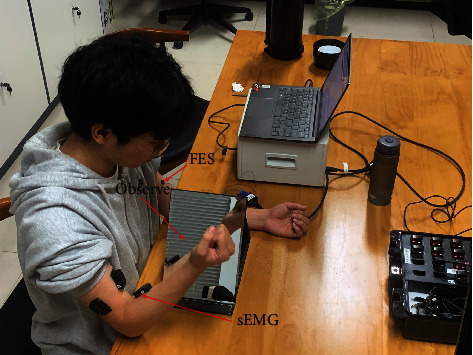
Purpose: Aiming at the motor recovery of patients with unilateral upper limb motor dysfunction after stroke, we propose a mirror therapy (MT) training method, which uses surface electromyography (sEMG) to identify movements on one side and control the other side to perform functional electrical stimulation (FES) while mirror therapy is used. And we verify the effect of this training method by analyzing the activity changes of the sensorimotor cortex.
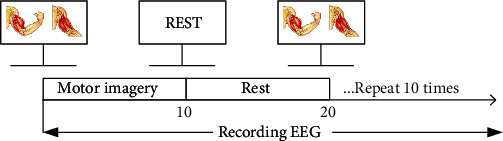
Method: Ten subjects (6 men and 4 women) were randomly divided into two groups according to 3 men and 2 women in each group: the experimental group (n = 5) received FES+MT training, and the control group (n = 5) received MT training. Both groups were trained at a fixed time at 9 : 00 am every day, each time lasting 20 minutes, once a day, 5 days a week, continuous training for 4 weeks, and the training action was elbow flexion training. During the training of the elbow flexion exercise, the experimental group applied FES with a frequency of 30 Hz, a pulse width of 100 μs, and a current of 10 mA to the muscles corresponding to the elbow flexion exercise, and rested for 10 s after 10-s stimulation. We collect the EEG of the elbow flexion motor imagery of all subjects before and after training, and calculate the eigenvalue E, and analyze the effect of FES+MT training on the activity of the cerebral sensorimotor cortex.
Results: After repeated measure (RM) two-way ANOVA of the two groups, comparing the subjects' μ rhythm elbow flexion motor imagery eigenvalue E, the experimental group (after training) > the control group (after training) > before training.
Conclusion: The FES+MT training method has obvious activation effect on the cerebral sensorimotor cortex.



 京公网安备 11010802042870号
京ICP备2023020795号-1
京公网安备 11010802042870号
京ICP备2023020795号-1

 分享
分享
 求助内容:
求助内容: 应助结果提醒方式:
 扫码关注我们
