Diana Palandri, Hanna Raber, Casey Tak, Elizabeth Bald, Katherine Hastings, Karen Gunning
{"title":"Improving Patient Access to Primary Care Providers Using a Pharmacist-Physician Co-Visit Model.","authors":"Diana Palandri, Hanna Raber, Casey Tak, Elizabeth Bald, Katherine Hastings, Karen Gunning","doi":"10.24926/iip.v14i2.5106","DOIUrl":null,"url":null,"abstract":"<p><p><b>Background</b>: Implementation of a clinical pharmacist in the primary care setting can offset provider time spent managing chronic diseases using Collaborative Practice Agreements (CPAs). The pharmacist-physician co-visit model presents an opportunity for pharmacists to increase patient access to their primary care provider (PCP). Studies of the co-visit model show that co-visits increase clinic efficiency by allowing the PCP to see additional patients and achieve more health care goals compared with independent visits<sup>1-4</sup>. <b>Objectives</b>: The aim of this study was to increase patient access to their PCP by utilizing a pharmacist-physician co-visit model at the Madsen Health Center Family Medicine (MHC FM) Clinic. The primary outcome was to identify the number of co-visits completed compared to the number of possible co-visits, and the number of appointment slots made available. The secondary outcomes were to track the time spent with patients and to obtain provider feedback via a survey. <b>Methods</b>: The co-visit model was implemented as a 4-month pilot study at the MHC FM Clinic. Complex care appointments lasting 40 minutes were selected based on inclusion and exclusion criteria. Potential co-visit appointments were identified one week prior then provider consent was obtained to change the appointment into two separate 20-minute visits. Schedules were reviewed to determine if the appointment slot opened by the co-visit was filled by another patient. Upon completion of the study, a survey was distributed to providers to collect feedback. <b>Results</b>: A total of five co-visits were completed out of a possible 19 (26%). All the appointments made available were filled by another patient. On average, the provider and pharmacist spent 15 and 14 minutes with the patient, respectively. <b>Conclusion</b>: Implementation of the physician-pharmacist co-visit model increased the availability of the PCP to see more patients without disrupting clinic workflow and provider schedules.</p>","PeriodicalId":9441,"journal":{"name":"Cancer research","volume":"71 1","pages":""},"PeriodicalIF":16.6000,"publicationDate":"2023-10-10","publicationTypes":"Journal Article","fieldsOfStudy":null,"isOpenAccess":false,"openAccessPdf":"https://www.ncbi.nlm.nih.gov/pmc/articles/PMC10653725/pdf/","citationCount":"0","resultStr":null,"platform":"Semanticscholar","paperid":null,"PeriodicalName":"Cancer research","FirstCategoryId":"1085","ListUrlMain":"https://doi.org/10.24926/iip.v14i2.5106","RegionNum":1,"RegionCategory":"医学","ArticlePicture":[],"TitleCN":null,"AbstractTextCN":null,"PMCID":null,"EPubDate":"2023/1/1 0:00:00","PubModel":"eCollection","JCR":"Q1","JCRName":"ONCOLOGY","Score":null,"Total":0}
引用次数: 0
Abstract
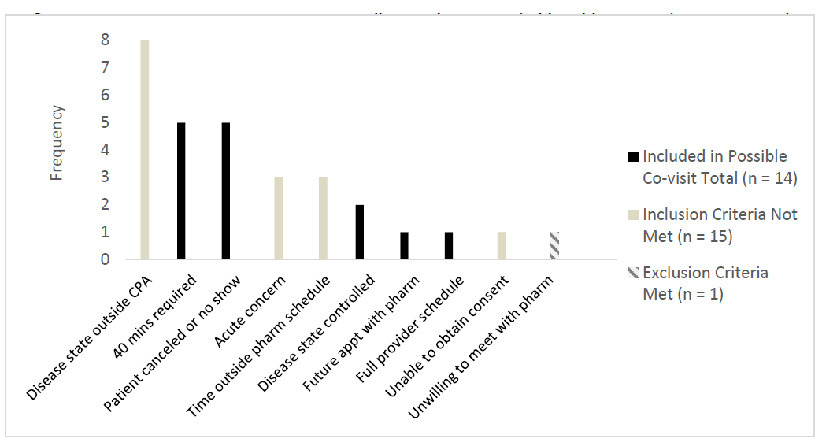
Background: Implementation of a clinical pharmacist in the primary care setting can offset provider time spent managing chronic diseases using Collaborative Practice Agreements (CPAs). The pharmacist-physician co-visit model presents an opportunity for pharmacists to increase patient access to their primary care provider (PCP). Studies of the co-visit model show that co-visits increase clinic efficiency by allowing the PCP to see additional patients and achieve more health care goals compared with independent visits1-4. Objectives: The aim of this study was to increase patient access to their PCP by utilizing a pharmacist-physician co-visit model at the Madsen Health Center Family Medicine (MHC FM) Clinic. The primary outcome was to identify the number of co-visits completed compared to the number of possible co-visits, and the number of appointment slots made available. The secondary outcomes were to track the time spent with patients and to obtain provider feedback via a survey. Methods: The co-visit model was implemented as a 4-month pilot study at the MHC FM Clinic. Complex care appointments lasting 40 minutes were selected based on inclusion and exclusion criteria. Potential co-visit appointments were identified one week prior then provider consent was obtained to change the appointment into two separate 20-minute visits. Schedules were reviewed to determine if the appointment slot opened by the co-visit was filled by another patient. Upon completion of the study, a survey was distributed to providers to collect feedback. Results: A total of five co-visits were completed out of a possible 19 (26%). All the appointments made available were filled by another patient. On average, the provider and pharmacist spent 15 and 14 minutes with the patient, respectively. Conclusion: Implementation of the physician-pharmacist co-visit model increased the availability of the PCP to see more patients without disrupting clinic workflow and provider schedules.
期刊介绍:
Cancer Research, published by the American Association for Cancer Research (AACR), is a journal that focuses on impactful original studies, reviews, and opinion pieces relevant to the broad cancer research community. Manuscripts that present conceptual or technological advances leading to insights into cancer biology are particularly sought after. The journal also places emphasis on convergence science, which involves bridging multiple distinct areas of cancer research.
With primary subsections including Cancer Biology, Cancer Immunology, Cancer Metabolism and Molecular Mechanisms, Translational Cancer Biology, Cancer Landscapes, and Convergence Science, Cancer Research has a comprehensive scope. It is published twice a month and has one volume per year, with a print ISSN of 0008-5472 and an online ISSN of 1538-7445.
Cancer Research is abstracted and/or indexed in various databases and platforms, including BIOSIS Previews (R) Database, MEDLINE, Current Contents/Life Sciences, Current Contents/Clinical Medicine, Science Citation Index, Scopus, and Web of Science.




 京公网安备 11010802042870号
京ICP备2023020795号-1
京公网安备 11010802042870号
京ICP备2023020795号-1

 分享
分享
 求助内容:
求助内容: 应助结果提醒方式:
 扫码关注我们
