A Novel Integrated Optimization-Driven Design Framework for Minimum-Weight Lateral-Load Resisting Systems in Wind-Sensitive Buildings Equipped with Dynamic Vibration Absorbers
{"title":"A Novel Integrated Optimization-Driven Design Framework for Minimum-Weight Lateral-Load Resisting Systems in Wind-Sensitive Buildings Equipped with Dynamic Vibration Absorbers","authors":"Zixiao Wang, Agathoklis Giaralis","doi":"10.1155/2023/3754773","DOIUrl":null,"url":null,"abstract":"<div>\n <p>The increasing rate of urbanization in recent decades has resulted in a global surge in the construction of slender high-rise buildings. These structures are prone to excessive wind-induced lateral vibrations in the crosswind direction owing to vortex shedding effects, causing occupant discomfort and, ultimately, dynamic serviceability failure. To reconcile the worldwide accelerated trend in constructing tall buildings with the sustainable building sector agenda, this paper proposes a novel bi-objective integrated design framework that leverages dynamic vibration absorbers (DVAs) to minimize the required material usage in the wind load-resisting structural systems (WLSSs) of occupant comfort-governed tall buildings. The framework couples structural sizing optimization for minimum-weight WLSS design (objective 1), with optimal DVA tuning for floor acceleration minimization to satisfy codified wind comfort design requirements by using the smallest DVA inertia (objective 2). Furthermore, a versatile numerical strategy is devised for the efficient solution of the proposed bi-objective optimization problem. For illustration, the framework is applied to a 15-storey steel building equipped with one of two different DVAs: a widely considered top-floor tuned mass damper (TMD) and an innovative ground-floor tuned inerter damper (TID). The derived Pareto optimal integrated (WLSS-plus-DVA) designs demonstrate that significant reduction in both structural steel usage and embodied carbon emissions can be achieved using either one of the two DVAs with moderate inertia. It is concluded that the proposed optimization-driven design framework and numerical solution strategy offer an alternative innovative approach to achieve material-efficient high-rise buildings under wind hazards.</p>\n </div>","PeriodicalId":49471,"journal":{"name":"Structural Control & Health Monitoring","volume":"2023 1","pages":""},"PeriodicalIF":5.1000,"publicationDate":"2023-02-24","publicationTypes":"Journal Article","fieldsOfStudy":null,"isOpenAccess":false,"openAccessPdf":"https://onlinelibrary.wiley.com/doi/epdf/10.1155/2023/3754773","citationCount":"0","resultStr":null,"platform":"Semanticscholar","paperid":null,"PeriodicalName":"Structural Control & Health Monitoring","FirstCategoryId":"5","ListUrlMain":"https://onlinelibrary.wiley.com/doi/10.1155/2023/3754773","RegionNum":2,"RegionCategory":"工程技术","ArticlePicture":[],"TitleCN":null,"AbstractTextCN":null,"PMCID":null,"EPubDate":"","PubModel":"","JCR":"Q1","JCRName":"CONSTRUCTION & BUILDING TECHNOLOGY","Score":null,"Total":0}
引用次数: 0
Abstract
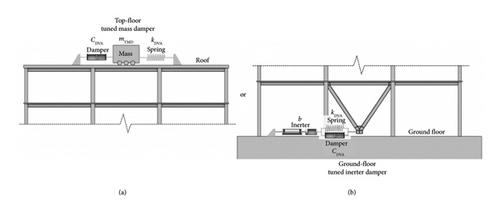
The increasing rate of urbanization in recent decades has resulted in a global surge in the construction of slender high-rise buildings. These structures are prone to excessive wind-induced lateral vibrations in the crosswind direction owing to vortex shedding effects, causing occupant discomfort and, ultimately, dynamic serviceability failure. To reconcile the worldwide accelerated trend in constructing tall buildings with the sustainable building sector agenda, this paper proposes a novel bi-objective integrated design framework that leverages dynamic vibration absorbers (DVAs) to minimize the required material usage in the wind load-resisting structural systems (WLSSs) of occupant comfort-governed tall buildings. The framework couples structural sizing optimization for minimum-weight WLSS design (objective 1), with optimal DVA tuning for floor acceleration minimization to satisfy codified wind comfort design requirements by using the smallest DVA inertia (objective 2). Furthermore, a versatile numerical strategy is devised for the efficient solution of the proposed bi-objective optimization problem. For illustration, the framework is applied to a 15-storey steel building equipped with one of two different DVAs: a widely considered top-floor tuned mass damper (TMD) and an innovative ground-floor tuned inerter damper (TID). The derived Pareto optimal integrated (WLSS-plus-DVA) designs demonstrate that significant reduction in both structural steel usage and embodied carbon emissions can be achieved using either one of the two DVAs with moderate inertia. It is concluded that the proposed optimization-driven design framework and numerical solution strategy offer an alternative innovative approach to achieve material-efficient high-rise buildings under wind hazards.
期刊介绍:
The Journal Structural Control and Health Monitoring encompasses all theoretical and technological aspects of structural control, structural health monitoring theory and smart materials and structures. The journal focuses on aerospace, civil, infrastructure and mechanical engineering applications.
Original contributions based on analytical, computational and experimental methods are solicited in three main areas: monitoring, control, and smart materials and structures, covering subjects such as system identification, health monitoring, health diagnostics, multi-functional materials, signal processing, sensor technology, passive, active and semi active control schemes and implementations, shape memory alloys, piezoelectrics and mechatronics.
Also of interest are actuator design, dynamic systems, dynamic stability, artificial intelligence tools, data acquisition, wireless communications, measurements, MEMS/NEMS sensors for local damage detection, optical fibre sensors for health monitoring, remote control of monitoring systems, sensor-logger combinations for mobile applications, corrosion sensors, scour indicators and experimental techniques.



 京公网安备 11010802042870号
京ICP备2023020795号-1
京公网安备 11010802042870号
京ICP备2023020795号-1

 分享
分享
 求助内容:
求助内容: 应助结果提醒方式:
 扫码关注我们
