Can early weight loss, eating behaviors and socioeconomic factors predict successful weight loss at 12- and 24-months in adolescents with obesity and insulin resistance participating in a randomised controlled trial?
Megan L Gow, Louise A Baur, Mandy Ho, Kerryn Chisholm, Manny Noakes, Chris T Cowell, Sarah P Garnett
{"title":"Can early weight loss, eating behaviors and socioeconomic factors predict successful weight loss at 12- and 24-months in adolescents with obesity and insulin resistance participating in a randomised controlled trial?","authors":"Megan L Gow, Louise A Baur, Mandy Ho, Kerryn Chisholm, Manny Noakes, Chris T Cowell, Sarah P Garnett","doi":"10.1186/s12966-016-0367-9","DOIUrl":null,"url":null,"abstract":"<p><strong>Background: </strong>Lifestyle interventions in adolescents with obesity can result in weight loss following active intervention but individual responses vary widely. This study aimed to identify predictors of weight loss at 12- and 24-months in adolescents with obesity and clinical features of insulin resistance.</p><p><strong>Methods: </strong>Adolescents (n = 111, 66 girls, aged 10-17 years) were participants in a randomised controlled trial, the RESIST study, examining the effects of two diets differing in macronutrient content on insulin sensitivity. Eighty-five completed the 12-month program and 24-month follow-up data were available for 42 adolescents. Change in weight was determined by BMI expressed as a percentage of the 95th percentile (BMI95). The study physician collected socioeconomic data at baseline. Physical activity and screen time, and psychological dimensions of eating behavior were self-reported using the validated CLASS and EPI-C questionnaires, respectively. Stepwise multiple regressions were conducted to identify models that best predicted change in BMI95 at 12- and 24-months.</p><p><strong>Results: </strong>Mean BMI95 was reduced at 12-months compared with baseline (mean difference [MD] ± SE: -6.9 ± 1.0, P < 0.001) but adolescents had significant re-gain from 12- to 24-months (MD ± SE: 3.7 ± 1.5, P = 0.017). Participants who achieved greater 12-month weight loss had: greater 3-month weight loss, a father with a higher education, lower baseline external eating and parental pressure to eat scores and two parents living at home. Participants who achieved greater 24-month weight loss had: greater 12-month weight loss and a lower baseline emotional eating score.</p><p><strong>Conclusions: </strong>Early weight loss is consistently identified as a strong predictor of long-term weight loss. This could be because early weight loss identifies those more motivated and engaged individuals. Patients who have baseline factors predictive of long-term weight loss failure may benefit from additional support during the intervention. Additionally, if a patient does not achieve early weight loss, further support or transition to an alternate intervention where they may have increased success may be considered.</p><p><strong>Trial registration: </strong>Australian New Zealand Clinical Trial Registration Number (ACTRN) 12608000416392 https://www.anzctr.org.au/Trial/Registration/TrialReview.aspx?id=83071.</p>","PeriodicalId":49658,"journal":{"name":"Progress of Theoretical Physics","volume":"98 1","pages":"43"},"PeriodicalIF":0.0000,"publicationDate":"2016-04-01","publicationTypes":"Journal Article","fieldsOfStudy":null,"isOpenAccess":false,"openAccessPdf":"https://www.ncbi.nlm.nih.gov/pmc/articles/PMC4818484/pdf/","citationCount":"0","resultStr":null,"platform":"Semanticscholar","paperid":null,"PeriodicalName":"Progress of Theoretical Physics","FirstCategoryId":"3","ListUrlMain":"https://doi.org/10.1186/s12966-016-0367-9","RegionNum":0,"RegionCategory":null,"ArticlePicture":[],"TitleCN":null,"AbstractTextCN":null,"PMCID":null,"EPubDate":"","PubModel":"","JCR":"","JCRName":"","Score":null,"Total":0}
引用次数: 0
Abstract
Background: Lifestyle interventions in adolescents with obesity can result in weight loss following active intervention but individual responses vary widely. This study aimed to identify predictors of weight loss at 12- and 24-months in adolescents with obesity and clinical features of insulin resistance.
Methods: Adolescents (n = 111, 66 girls, aged 10-17 years) were participants in a randomised controlled trial, the RESIST study, examining the effects of two diets differing in macronutrient content on insulin sensitivity. Eighty-five completed the 12-month program and 24-month follow-up data were available for 42 adolescents. Change in weight was determined by BMI expressed as a percentage of the 95th percentile (BMI95). The study physician collected socioeconomic data at baseline. Physical activity and screen time, and psychological dimensions of eating behavior were self-reported using the validated CLASS and EPI-C questionnaires, respectively. Stepwise multiple regressions were conducted to identify models that best predicted change in BMI95 at 12- and 24-months.
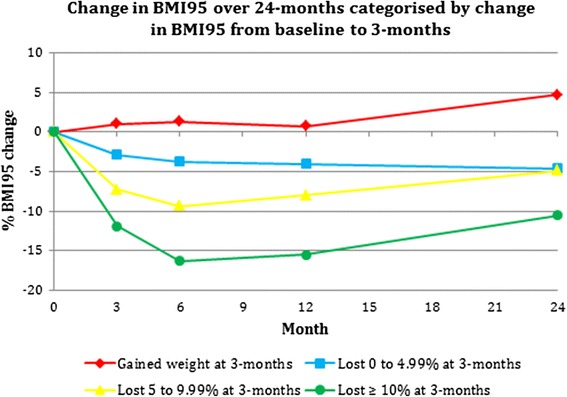
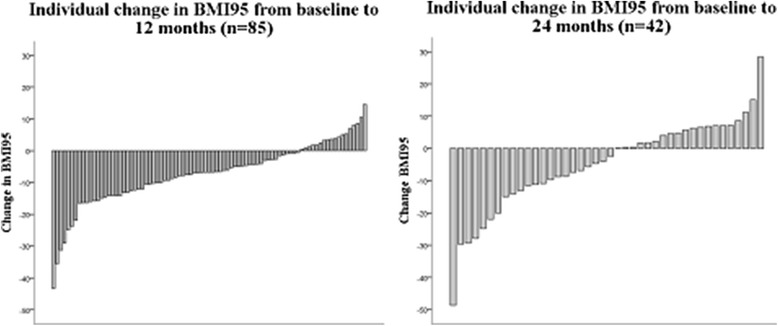
Results: Mean BMI95 was reduced at 12-months compared with baseline (mean difference [MD] ± SE: -6.9 ± 1.0, P < 0.001) but adolescents had significant re-gain from 12- to 24-months (MD ± SE: 3.7 ± 1.5, P = 0.017). Participants who achieved greater 12-month weight loss had: greater 3-month weight loss, a father with a higher education, lower baseline external eating and parental pressure to eat scores and two parents living at home. Participants who achieved greater 24-month weight loss had: greater 12-month weight loss and a lower baseline emotional eating score.
Conclusions: Early weight loss is consistently identified as a strong predictor of long-term weight loss. This could be because early weight loss identifies those more motivated and engaged individuals. Patients who have baseline factors predictive of long-term weight loss failure may benefit from additional support during the intervention. Additionally, if a patient does not achieve early weight loss, further support or transition to an alternate intervention where they may have increased success may be considered.
Trial registration: Australian New Zealand Clinical Trial Registration Number (ACTRN) 12608000416392 https://www.anzctr.org.au/Trial/Registration/TrialReview.aspx?id=83071.



 京公网安备 11010802042870号
京ICP备2023020795号-1
京公网安备 11010802042870号
京ICP备2023020795号-1

 分享
分享
 求助内容:
求助内容: 应助结果提醒方式:
 扫码关注我们
