{"title":"Interfacial Characterization of a Conventional Glass-Ionomer Cement after Functioning for 1-year In Vivo.","authors":"Shuhei Hoshika, Kenichi Koshiro, Satoshi Inoue, Toru Tanaka, Hidehiko Sano, Sharanbir K Sidhu","doi":"10.3290/j.jad.b2916453","DOIUrl":null,"url":null,"abstract":"<p><strong>Purpose: </strong>To morphologically evaluate the interface between a conventional glass-ionomer cement (GIC) and dentin one day after placement, as well as the changes at the interface after one year of aging/functioning in monkey teeth.</p><p><strong>Materials and methods: </strong>On the buccal surfaces of seven intact teeth in each of two monkeys, shallow class V cavities were prepared, which were then filled with Fuji IX GP (GC) to provide 1-year in vivo data. A year later, two more teeth in each monkey were similarly prepared and restored for the 1-day in vivo group. The following day, the restored teeth were extracted and the restoration interfaces observed using transmission electron microscopy (TEM). In addition, restorations were similarly placed in two extracted human teeth (control, 1-day in vitro group) and observed a day after placement using TEM.</p><p><strong>Results: </strong>The 1-day in vivo and in vitro results showed that the GIC appeared to bond to dentin through a demineralized zone similar to the hybrid layer produced by resinous adhesives. However, the interface between GIC and dentin after 1 year in vivo appeared to change over time: many needle-like crystals were detected within the remineralized layer and along the collagen fibrils. Slow diffusion of ions resulted in pores, which filled with mineral crystals and made the pores smaller.</p><p><strong>Conclusion: </strong>The interface between GIC and dentin morphologically changes over time, and recrystallization or remineralization at the interface may occur (1 year in vivo).</p>","PeriodicalId":362,"journal":{"name":"Journal of Hydrology","volume":"552 1","pages":"203-208"},"PeriodicalIF":6.3000,"publicationDate":"2022-04-13","publicationTypes":"Journal Article","fieldsOfStudy":null,"isOpenAccess":false,"openAccessPdf":"https://www.ncbi.nlm.nih.gov/pmc/articles/PMC11734312/pdf/","citationCount":"0","resultStr":null,"platform":"Semanticscholar","paperid":null,"PeriodicalName":"Journal of Hydrology","FirstCategoryId":"89","ListUrlMain":"https://doi.org/10.3290/j.jad.b2916453","RegionNum":1,"RegionCategory":"地球科学","ArticlePicture":[],"TitleCN":null,"AbstractTextCN":null,"PMCID":null,"EPubDate":"","PubModel":"","JCR":"Q1","JCRName":"ENGINEERING, CIVIL","Score":null,"Total":0}
引用次数: 0
Abstract
Purpose: To morphologically evaluate the interface between a conventional glass-ionomer cement (GIC) and dentin one day after placement, as well as the changes at the interface after one year of aging/functioning in monkey teeth.
Materials and methods: On the buccal surfaces of seven intact teeth in each of two monkeys, shallow class V cavities were prepared, which were then filled with Fuji IX GP (GC) to provide 1-year in vivo data. A year later, two more teeth in each monkey were similarly prepared and restored for the 1-day in vivo group. The following day, the restored teeth were extracted and the restoration interfaces observed using transmission electron microscopy (TEM). In addition, restorations were similarly placed in two extracted human teeth (control, 1-day in vitro group) and observed a day after placement using TEM.
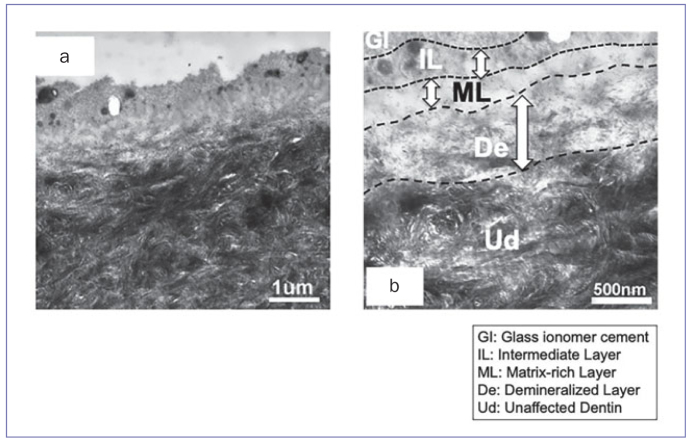
Results: The 1-day in vivo and in vitro results showed that the GIC appeared to bond to dentin through a demineralized zone similar to the hybrid layer produced by resinous adhesives. However, the interface between GIC and dentin after 1 year in vivo appeared to change over time: many needle-like crystals were detected within the remineralized layer and along the collagen fibrils. Slow diffusion of ions resulted in pores, which filled with mineral crystals and made the pores smaller.
Conclusion: The interface between GIC and dentin morphologically changes over time, and recrystallization or remineralization at the interface may occur (1 year in vivo).
期刊介绍:
The Journal of Hydrology publishes original research papers and comprehensive reviews in all the subfields of the hydrological sciences including water based management and policy issues that impact on economics and society. These comprise, but are not limited to the physical, chemical, biogeochemical, stochastic and systems aspects of surface and groundwater hydrology, hydrometeorology and hydrogeology. Relevant topics incorporating the insights and methodologies of disciplines such as climatology, water resource systems, hydraulics, agrohydrology, geomorphology, soil science, instrumentation and remote sensing, civil and environmental engineering are included. Social science perspectives on hydrological problems such as resource and ecological economics, environmental sociology, psychology and behavioural science, management and policy analysis are also invited. Multi-and interdisciplinary analyses of hydrological problems are within scope. The science published in the Journal of Hydrology is relevant to catchment scales rather than exclusively to a local scale or site.





 京公网安备 11010802042870号
京ICP备2023020795号-1
京公网安备 11010802042870号
京ICP备2023020795号-1

 分享
分享
 求助内容:
求助内容: 应助结果提醒方式:
 扫码关注我们
