{"title":"State participation in the development of high-tech industries as the basis for ensuring the technological sovereignty of the country","authors":"A. Polosin, D. Baydarov, D. Faikov","doi":"10.12737/2587-6295-2023-7-2-3-16","DOIUrl":null,"url":null,"abstract":"The purpose of this work is the author's assessment of the measures taken by the authorities aimed at the formation of technological sovereignty as part of a new economic and political model of society. The article is based on the principles of system analysis, the methods of factor analysis and logical modeling are also used. Based on the theoretical and empirical studies conducted, it is shown that technological sovereignty is a relatively new category, the study of which should be carried out at the intersection of political and economic sciences. In economic terms, technological sovereignty is based on the ability of the state to create critical, promising technologies and organize production based on them. It is revealed that the formation of technological sovereignty requires state participation in the economy. In particular, in such areas as planning technological and industrial development, identifying priority areas of research and production and forming a list of critical technologies, financing priority areas and projects, creating institutional conditions for technological development, protecting national researchers and manufacturers, developing science and education, etc. The analysis showed that currently work has begun in the country in almost all these areas, but most often not actively enough. It is concluded that these aspects of state participation can be represented as elements of an emerging new economic model that strengthens the regulatory role of the state in the economy, while preserving the basic principles and niches for market relations.","PeriodicalId":48273,"journal":{"name":"European Journal of Political Research","volume":"68 1","pages":""},"PeriodicalIF":4.2000,"publicationDate":"2023-07-31","publicationTypes":"Journal Article","fieldsOfStudy":null,"isOpenAccess":false,"openAccessPdf":"","citationCount":"0","resultStr":null,"platform":"Semanticscholar","paperid":null,"PeriodicalName":"European Journal of Political Research","FirstCategoryId":"90","ListUrlMain":"https://doi.org/10.12737/2587-6295-2023-7-2-3-16","RegionNum":1,"RegionCategory":"社会学","ArticlePicture":[],"TitleCN":null,"AbstractTextCN":null,"PMCID":null,"EPubDate":"","PubModel":"","JCR":"Q1","JCRName":"POLITICAL SCIENCE","Score":null,"Total":0}
引用次数: 0
Abstract
The purpose of this work is the author's assessment of the measures taken by the authorities aimed at the formation of technological sovereignty as part of a new economic and political model of society. The article is based on the principles of system analysis, the methods of factor analysis and logical modeling are also used. Based on the theoretical and empirical studies conducted, it is shown that technological sovereignty is a relatively new category, the study of which should be carried out at the intersection of political and economic sciences. In economic terms, technological sovereignty is based on the ability of the state to create critical, promising technologies and organize production based on them. It is revealed that the formation of technological sovereignty requires state participation in the economy. In particular, in such areas as planning technological and industrial development, identifying priority areas of research and production and forming a list of critical technologies, financing priority areas and projects, creating institutional conditions for technological development, protecting national researchers and manufacturers, developing science and education, etc. The analysis showed that currently work has begun in the country in almost all these areas, but most often not actively enough. It is concluded that these aspects of state participation can be represented as elements of an emerging new economic model that strengthens the regulatory role of the state in the economy, while preserving the basic principles and niches for market relations.
期刊介绍:
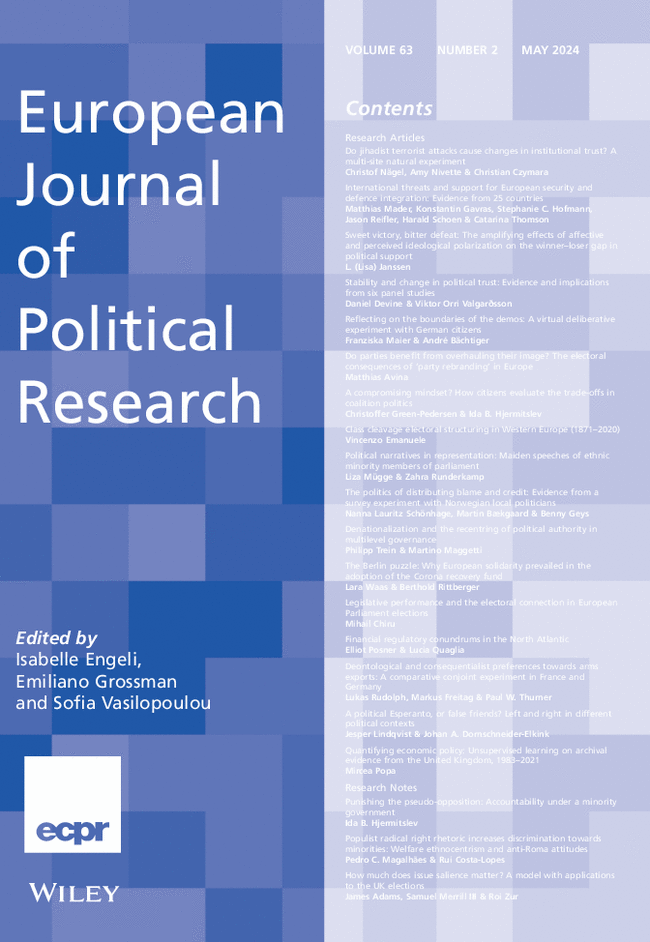
European Journal of Political Research specialises in articles articulating theoretical and comparative perspectives in political science, and welcomes both quantitative and qualitative approaches. EJPR also publishes short research notes outlining ongoing research in more specific areas of research. The Journal includes the Political Data Yearbook, published as a double issue at the end of each volume.



 京公网安备 11010802042870号
京ICP备2023020795号-1
京公网安备 11010802042870号
京ICP备2023020795号-1

 分享
分享
 求助内容:
求助内容: 应助结果提醒方式:
 扫码关注我们
