{"title":"Differences in Severity and Outcomes Between Hypertriglyceridemia and Alcohol-Induced Pancreatitis.","authors":"Hemant Goyal, Betsy Smith, Chelsey Bayer, Carla Rutherford, Danielle Shelnut","doi":"10.4103/1947-2714.177307","DOIUrl":null,"url":null,"abstract":"<p><strong>Background: </strong>Alcohol and hypertriglyceridemia (HTG) are among the most common causes of acute pancreatitis (AP) after gallstones. However, differences in severity at the time of presentation and outcomes have not been well-studied.</p><p><strong>Objective: </strong>The aim of this study is to assess the differences between severity at presentation and outcomes of AP of hypertriglyceridemic and alcoholic origins.</p><p><strong>Materials and methods: </strong>A retrospective review of 177 patients who were discharged with diagnosis of AP was performed. Severity at presentation was identified by the presence of systemic inflammatory response syndrome, bedside index for severity in AP (BISAP) score, and Balthazar index. Outcomes were measured by the length of stay, intensive care unit care, surgical intervention, and mortality.</p><p><strong>Results: </strong>We found 147 patients with alcoholic pancreatitis and 30 patients with hypertriglyceridemic pancreatitis. A larger percentage of hypertriglyceridemic pancreatitis patients (23.33%) had a BISAP score of ≥2 compared to the alcoholic group (12.24%). Only 32.65% of the patients with alcoholic pancreatitis but 60% of the patients with hypertriglyceridemic pancreatitis had the presence of systemic inflammatory response syndrome (SIRS) at admission (P = 0.0067). There were 73.34% hypertriglyceridemic pancreatits patients and only 40.28% alcoholic pancreatitis patients with Balthazar index C or greater, suggesting a higher disease burden at admission for hypertriglyceridemic pancreatitis patients (P = 0.0047). There was a statistically significant difference in the relative number of hypertriglyceridemic and alcoholic pancreatitis patients receiving intensive care (P = 0.00030) and in receiving surgical interventions related to pancreatitis (P = 0.016).</p><p><strong>Conclusion: </strong>Our study found that patients with hypertriglyceridemic pancreatitis have a greater severity of disease and they experience less favorable outcomes than patients with alcoholic pancreatitis.</p>","PeriodicalId":19276,"journal":{"name":"Neurosurgery","volume":"28 6 1","pages":"82-7"},"PeriodicalIF":3.9000,"publicationDate":"2016-02-01","publicationTypes":"Journal Article","fieldsOfStudy":null,"isOpenAccess":false,"openAccessPdf":"https://www.ncbi.nlm.nih.gov/pmc/articles/PMC4791903/pdf/","citationCount":"0","resultStr":null,"platform":"Semanticscholar","paperid":null,"PeriodicalName":"Neurosurgery","FirstCategoryId":"1085","ListUrlMain":"https://doi.org/10.4103/1947-2714.177307","RegionNum":2,"RegionCategory":"医学","ArticlePicture":[],"TitleCN":null,"AbstractTextCN":null,"PMCID":null,"EPubDate":"","PubModel":"","JCR":"Q1","JCRName":"CLINICAL NEUROLOGY","Score":null,"Total":0}
引用次数: 0
Abstract
Background: Alcohol and hypertriglyceridemia (HTG) are among the most common causes of acute pancreatitis (AP) after gallstones. However, differences in severity at the time of presentation and outcomes have not been well-studied.
Objective: The aim of this study is to assess the differences between severity at presentation and outcomes of AP of hypertriglyceridemic and alcoholic origins.
Materials and methods: A retrospective review of 177 patients who were discharged with diagnosis of AP was performed. Severity at presentation was identified by the presence of systemic inflammatory response syndrome, bedside index for severity in AP (BISAP) score, and Balthazar index. Outcomes were measured by the length of stay, intensive care unit care, surgical intervention, and mortality.
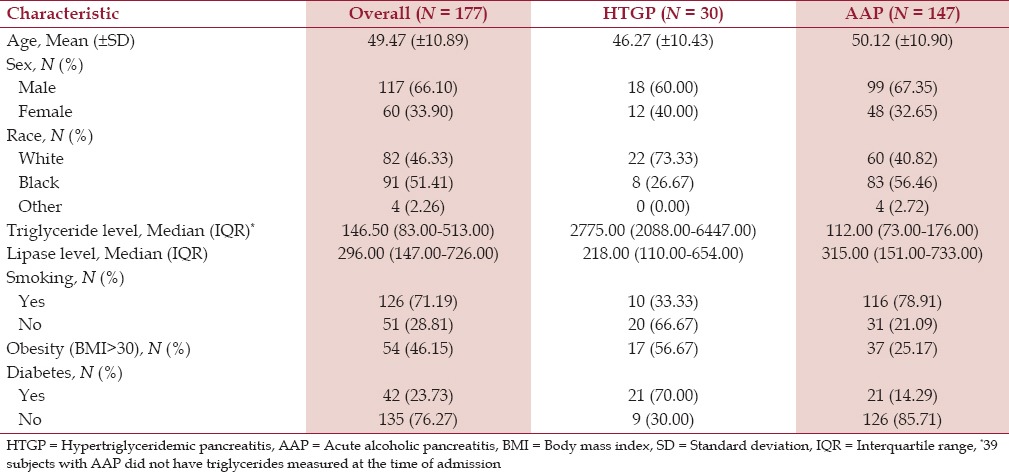
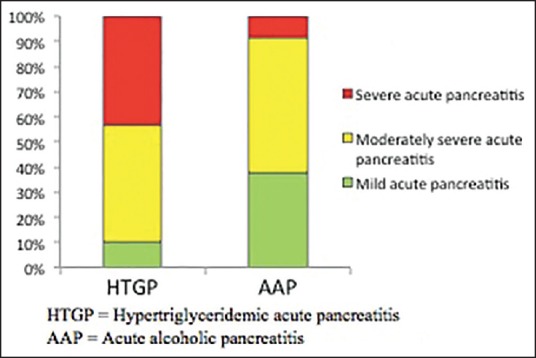
Results: We found 147 patients with alcoholic pancreatitis and 30 patients with hypertriglyceridemic pancreatitis. A larger percentage of hypertriglyceridemic pancreatitis patients (23.33%) had a BISAP score of ≥2 compared to the alcoholic group (12.24%). Only 32.65% of the patients with alcoholic pancreatitis but 60% of the patients with hypertriglyceridemic pancreatitis had the presence of systemic inflammatory response syndrome (SIRS) at admission (P = 0.0067). There were 73.34% hypertriglyceridemic pancreatits patients and only 40.28% alcoholic pancreatitis patients with Balthazar index C or greater, suggesting a higher disease burden at admission for hypertriglyceridemic pancreatitis patients (P = 0.0047). There was a statistically significant difference in the relative number of hypertriglyceridemic and alcoholic pancreatitis patients receiving intensive care (P = 0.00030) and in receiving surgical interventions related to pancreatitis (P = 0.016).
Conclusion: Our study found that patients with hypertriglyceridemic pancreatitis have a greater severity of disease and they experience less favorable outcomes than patients with alcoholic pancreatitis.
期刊介绍:
Neurosurgery, the official journal of the Congress of Neurological Surgeons, publishes research on clinical and experimental neurosurgery covering the very latest developments in science, technology, and medicine. For professionals aware of the rapid pace of developments in the field, this journal is nothing short of indispensable as the most complete window on the contemporary field of neurosurgery.
Neurosurgery is the fastest-growing journal in the field, with a worldwide reputation for reliable coverage delivered with a fresh and dynamic outlook.




 京公网安备 11010802042870号
京ICP备2023020795号-1
京公网安备 11010802042870号
京ICP备2023020795号-1

 分享
分享
 求助内容:
求助内容: 应助结果提醒方式:
 扫码关注我们
