Alana Campbell, Louise Gustafsson, Rohan Grimley, Hannah Gullo, Ingrid Rosbergen, Mathew Summers
{"title":"Mapping the trajectory of acute mild-stroke cognitive recovery using serial computerised cognitive assessment.","authors":"Alana Campbell, Louise Gustafsson, Rohan Grimley, Hannah Gullo, Ingrid Rosbergen, Mathew Summers","doi":"10.1017/BrImp.2022.24","DOIUrl":null,"url":null,"abstract":"<p><strong>Introduction: </strong>Cognitive impairment is common post-stroke. There is a need to understand patterns of early cognitive recovery post-stroke to guide both clinical and research practice. The aim of the study was to map the trajectory of cognitive recovery during the first week to 90-days post-stroke using serial computerised assessment.</p><p><strong>Method: </strong>An observational cohort study recruited consecutive stroke patients admitted to a stroke unit within 48 hours of onset. Cognitive function was assessed using the computerised Cambridge Neuropsychological Test Automated Battery (CANTAB) daily for seven days, then 14, 30 and 90 days post-stroke. The CANTAB measured visual episodic memory and learning, information processing speed, visuo-spatial working memory, complex sustained attention and mental flexibility. Repeated measures MANOVA/ANOVA with Least Squares Difference post-hoc analyses were performed to ascertain significant change over time.</p><p><strong>Result: </strong>Forty-eight participants, mean age 73, primarily mild, ischaemic stroke, completed all assessment timepoints. There was a trajectory of early, global cognitive improvement, indicative of a post-stroke delirium, that largely stabilised between 6 and 14-days post-stroke. Change over time was examined within each cognitive test, with one measure stabilising by day 6 (Reaction Time) and others detecting improving performances up to 14 days post-stroke.</p><p><strong>Conclusions: </strong>Serial, computerised cognitive assessment can effectively map post-stroke cognitive recovery and revealed an early phase of global improvement over 14 days that is evidence for an acute post-stroke delirium. Resolution of post-stroke delirium in the second week following mild stroke indicates more extensive neuropsychological testing may be undertaken earlier than previously thought.</p>","PeriodicalId":353,"journal":{"name":"Journal of Crystal Growth","volume":"486 1","pages":"629-648"},"PeriodicalIF":2.0000,"publicationDate":"2023-12-01","publicationTypes":"Journal Article","fieldsOfStudy":null,"isOpenAccess":false,"openAccessPdf":"","citationCount":"0","resultStr":null,"platform":"Semanticscholar","paperid":null,"PeriodicalName":"Journal of Crystal Growth","FirstCategoryId":"3","ListUrlMain":"https://doi.org/10.1017/BrImp.2022.24","RegionNum":4,"RegionCategory":"材料科学","ArticlePicture":[],"TitleCN":null,"AbstractTextCN":null,"PMCID":null,"EPubDate":"2022/10/12 0:00:00","PubModel":"Epub","JCR":"Q3","JCRName":"CRYSTALLOGRAPHY","Score":null,"Total":0}
引用次数: 0
Abstract
Introduction: Cognitive impairment is common post-stroke. There is a need to understand patterns of early cognitive recovery post-stroke to guide both clinical and research practice. The aim of the study was to map the trajectory of cognitive recovery during the first week to 90-days post-stroke using serial computerised assessment.
Method: An observational cohort study recruited consecutive stroke patients admitted to a stroke unit within 48 hours of onset. Cognitive function was assessed using the computerised Cambridge Neuropsychological Test Automated Battery (CANTAB) daily for seven days, then 14, 30 and 90 days post-stroke. The CANTAB measured visual episodic memory and learning, information processing speed, visuo-spatial working memory, complex sustained attention and mental flexibility. Repeated measures MANOVA/ANOVA with Least Squares Difference post-hoc analyses were performed to ascertain significant change over time.
Result: Forty-eight participants, mean age 73, primarily mild, ischaemic stroke, completed all assessment timepoints. There was a trajectory of early, global cognitive improvement, indicative of a post-stroke delirium, that largely stabilised between 6 and 14-days post-stroke. Change over time was examined within each cognitive test, with one measure stabilising by day 6 (Reaction Time) and others detecting improving performances up to 14 days post-stroke.
Conclusions: Serial, computerised cognitive assessment can effectively map post-stroke cognitive recovery and revealed an early phase of global improvement over 14 days that is evidence for an acute post-stroke delirium. Resolution of post-stroke delirium in the second week following mild stroke indicates more extensive neuropsychological testing may be undertaken earlier than previously thought.
期刊介绍:
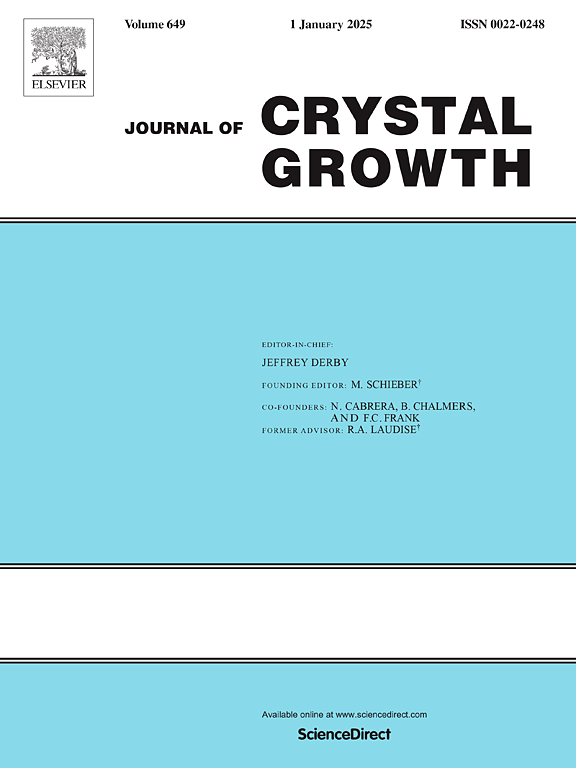
The journal offers a common reference and publication source for workers engaged in research on the experimental and theoretical aspects of crystal growth and its applications, e.g. in devices. Experimental and theoretical contributions are published in the following fields: theory of nucleation and growth, molecular kinetics and transport phenomena, crystallization in viscous media such as polymers and glasses; crystal growth of metals, minerals, semiconductors, superconductors, magnetics, inorganic, organic and biological substances in bulk or as thin films; molecular beam epitaxy, chemical vapor deposition, growth of III-V and II-VI and other semiconductors; characterization of single crystals by physical and chemical methods; apparatus, instrumentation and techniques for crystal growth, and purification methods; multilayer heterostructures and their characterisation with an emphasis on crystal growth and epitaxial aspects of electronic materials. A special feature of the journal is the periodic inclusion of proceedings of symposia and conferences on relevant aspects of crystal growth.



 京公网安备 11010802042870号
京ICP备2023020795号-1
京公网安备 11010802042870号
京ICP备2023020795号-1

 分享
分享
 求助内容:
求助内容: 应助结果提醒方式:
 扫码关注我们
