Shin-Ichiro Fujii, Toyotaka Kawamata, Kanako Shimizu, Jun Nakabayashi, Satoru Yamasaki, Tomonori Iyoda, Jun Shinga, Hiroshi Nakazato, An Sanpei, Masami Kawamura, Shogo Ueda, Jan Dörrie, Svetlana Mojsov, Madhav V Dhodapkar, Michihiro Hidaka, Masanori Nojima, Fumitaka Nagamura, Shigemi Yoshida, Toshio Goto, Arinobu Tojo
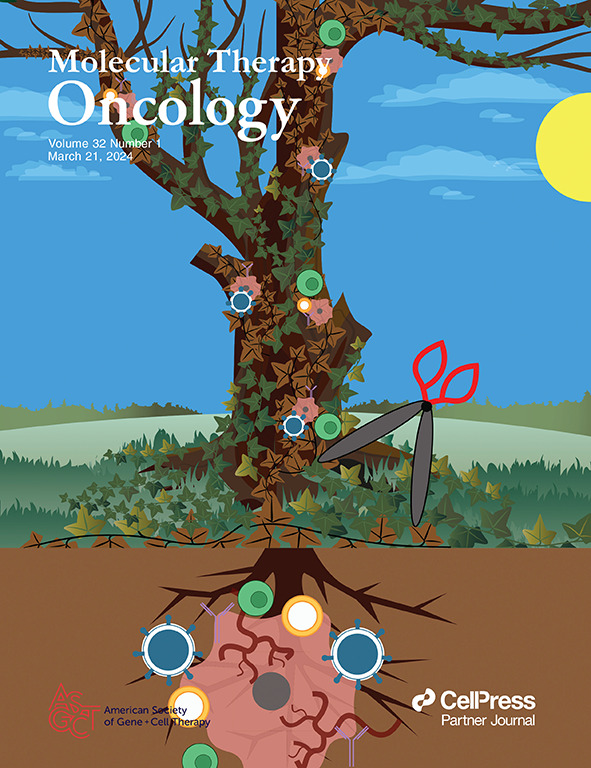
{"title":"Reinvigoration of innate and adaptive immunity via therapeutic cellular vaccine for patients with AML.","authors":"Shin-Ichiro Fujii, Toyotaka Kawamata, Kanako Shimizu, Jun Nakabayashi, Satoru Yamasaki, Tomonori Iyoda, Jun Shinga, Hiroshi Nakazato, An Sanpei, Masami Kawamura, Shogo Ueda, Jan Dörrie, Svetlana Mojsov, Madhav V Dhodapkar, Michihiro Hidaka, Masanori Nojima, Fumitaka Nagamura, Shigemi Yoshida, Toshio Goto, Arinobu Tojo","doi":"10.1016/j.omto.2022.09.001","DOIUrl":null,"url":null,"abstract":"<p><p>Strategies integrating activation of innate and adaptive immunity against cancer are desired. We established a novel platform, Wilms' tumor antigen 1 (WT1)-expressing artificial adjuvant vector cells (aAVC-WT1), linking invariant natural killer T (iNKT)-mediated dendritic cell activation to T cell immunity. Here, we report the first-in-human application of aAVC-WT1 in nine patients with relapsed and refractory acute myelogenous leukemia. No dose-limiting toxicities were observed, whereas activation of iNKT and/or NK cells was observed in all patients. Five patients experienced objective leukemic regression, which correlated with WT1-specific T cell responses. Paired single-cell RNA and T cell receptor (TCR) sequencing demonstrated effector CD8<sup>+</sup> T cell clones in the bone marrow. Some bone marrow CD8<sup>+</sup> T cells underwent transition from pre-existing precursor exhausted T cells to functional T cells or emerged as newly activated T cells, some of which were maintained long term. These demonstrate the feasibility and safety of aAVC-WT1 therapy and the capacity of this platform to activate both innate and adaptive immunity in humans.</p>","PeriodicalId":18869,"journal":{"name":"Molecular Therapy Oncolytics","volume":"23 1","pages":"315-332"},"PeriodicalIF":5.3000,"publicationDate":"2022-09-23","publicationTypes":"Journal Article","fieldsOfStudy":null,"isOpenAccess":false,"openAccessPdf":"https://www.ncbi.nlm.nih.gov/pmc/articles/PMC12447268/pdf/","citationCount":"0","resultStr":null,"platform":"Semanticscholar","paperid":null,"PeriodicalName":"Molecular Therapy Oncolytics","FirstCategoryId":"3","ListUrlMain":"https://doi.org/10.1016/j.omto.2022.09.001","RegionNum":2,"RegionCategory":"医学","ArticlePicture":[],"TitleCN":null,"AbstractTextCN":null,"PMCID":null,"EPubDate":"2022/12/15 0:00:00","PubModel":"eCollection","JCR":"Q1","JCRName":"MEDICINE, RESEARCH & EXPERIMENTAL","Score":null,"Total":0}
引用次数: 0
Abstract
Strategies integrating activation of innate and adaptive immunity against cancer are desired. We established a novel platform, Wilms' tumor antigen 1 (WT1)-expressing artificial adjuvant vector cells (aAVC-WT1), linking invariant natural killer T (iNKT)-mediated dendritic cell activation to T cell immunity. Here, we report the first-in-human application of aAVC-WT1 in nine patients with relapsed and refractory acute myelogenous leukemia. No dose-limiting toxicities were observed, whereas activation of iNKT and/or NK cells was observed in all patients. Five patients experienced objective leukemic regression, which correlated with WT1-specific T cell responses. Paired single-cell RNA and T cell receptor (TCR) sequencing demonstrated effector CD8+ T cell clones in the bone marrow. Some bone marrow CD8+ T cells underwent transition from pre-existing precursor exhausted T cells to functional T cells or emerged as newly activated T cells, some of which were maintained long term. These demonstrate the feasibility and safety of aAVC-WT1 therapy and the capacity of this platform to activate both innate and adaptive immunity in humans.
期刊介绍:
Molecular Therapy — Oncolytics is an international, online-only, open access journal focusing on the development and clinical testing of viral, cellular, and other biological therapies targeting cancer.



 京公网安备 11010802042870号
京ICP备2023020795号-1
京公网安备 11010802042870号
京ICP备2023020795号-1

 分享
分享
 求助内容:
求助内容: 应助结果提醒方式:
 扫码关注我们
