{"title":"Touch and look: The role of visual-haptic cues for categorical learning in primary school children","authors":"Hannah Broadbent, Tamsin Osborne, Natasha Kirkham, Denis Mareschal","doi":"10.1002/icd.2168","DOIUrl":null,"url":null,"abstract":"<div>\n \n \n <section>\n \n <p>Benefits of synchronous presentation of multisensory compared to unisensory cues are well established. However, the generality of such findings to children's learning with visual and haptic sensory cue pairings is unclear. Children aged 6 to 10 years (<i>N</i> = 180) participated in a novel tabletop category-learning paradigm with visual, haptic, or visuohaptic informative cues. The results indicated that combinations of complimentary visual and haptic cues facilitated learning above unisensory visual cues only in 8-year-old children. Primarily, however, haptic information was found to dominate children's category learning across ages, particularly in the youngest children (6-year-olds), even with equal discriminability of haptic and visual exemplars. These findings suggest developmental changes in the ability to effectively combine unrelated visual and haptic information for categorical learning. Implications for the use of nonpertinent visuohaptic cues in learning tasks within educational settings at different ages, and in particular the dominance of haptic stimuli for children's learning, are discussed.</p>\n </section>\n \n <section>\n \n <h3> Highlights</h3>\n \n <div>\n \n <ul>\n \n <li>A novel category learning task examined the role of unisensory and multisensory visual and haptic information in children's learning.</li>\n \n <li>Haptic cues dominated learning from 6 to 10 years of age, particularly when combined with visual information in older children.</li>\n \n <li>Findings infer protracted development of benefits in combining visuohaptic cues, and dominance of haptic over visual information for category learning.</li>\n </ul>\n </div>\n </section>\n </div>","PeriodicalId":47820,"journal":{"name":"Infant and Child Development","volume":"29 2","pages":""},"PeriodicalIF":2.9000,"publicationDate":"2019-12-11","publicationTypes":"Journal Article","fieldsOfStudy":null,"isOpenAccess":false,"openAccessPdf":"https://sci-hub-pdf.com/10.1002/icd.2168","citationCount":"4","resultStr":null,"platform":"Semanticscholar","paperid":null,"PeriodicalName":"Infant and Child Development","FirstCategoryId":"102","ListUrlMain":"https://onlinelibrary.wiley.com/doi/10.1002/icd.2168","RegionNum":4,"RegionCategory":"心理学","ArticlePicture":[],"TitleCN":null,"AbstractTextCN":null,"PMCID":null,"EPubDate":"","PubModel":"","JCR":"Q2","JCRName":"PSYCHOLOGY, DEVELOPMENTAL","Score":null,"Total":0}
引用次数: 4
Abstract
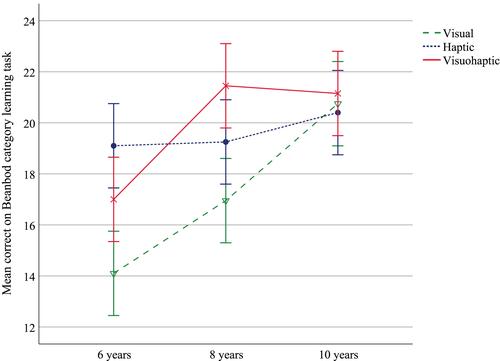
Benefits of synchronous presentation of multisensory compared to unisensory cues are well established. However, the generality of such findings to children's learning with visual and haptic sensory cue pairings is unclear. Children aged 6 to 10 years (N = 180) participated in a novel tabletop category-learning paradigm with visual, haptic, or visuohaptic informative cues. The results indicated that combinations of complimentary visual and haptic cues facilitated learning above unisensory visual cues only in 8-year-old children. Primarily, however, haptic information was found to dominate children's category learning across ages, particularly in the youngest children (6-year-olds), even with equal discriminability of haptic and visual exemplars. These findings suggest developmental changes in the ability to effectively combine unrelated visual and haptic information for categorical learning. Implications for the use of nonpertinent visuohaptic cues in learning tasks within educational settings at different ages, and in particular the dominance of haptic stimuli for children's learning, are discussed.
Highlights
A novel category learning task examined the role of unisensory and multisensory visual and haptic information in children's learning.
Haptic cues dominated learning from 6 to 10 years of age, particularly when combined with visual information in older children.
Findings infer protracted development of benefits in combining visuohaptic cues, and dominance of haptic over visual information for category learning.
期刊介绍:
Infant and Child Development publishes high quality empirical, theoretical and methodological papers addressing psychological development from the antenatal period through to adolescence. The journal brings together research on: - social and emotional development - perceptual and motor development - cognitive development - language development atypical development (including conduct problems, anxiety and depressive conditions, language impairments, autistic spectrum disorders, and attention-deficit/hyperactivity disorders)




 京公网安备 11010802042870号
京ICP备2023020795号-1
京公网安备 11010802042870号
京ICP备2023020795号-1

 分享
分享
 求助内容:
求助内容: 应助结果提醒方式:
 扫码关注我们
